

Mahmoud AlKafarna
Mahmoud Basem AlKafarna is a 21-year-old writer living in the Gaza Strip, currently displaced in Deir al-Balah. Before his life changed in the past years after October 2023, he had been pursuing Multimedia studies and wished to pursue this as a career path.
Now, after being forced to stop his education, Mahmoud has been writing to document life under genocide and occupation, fighting to preserve the living memory of his people.
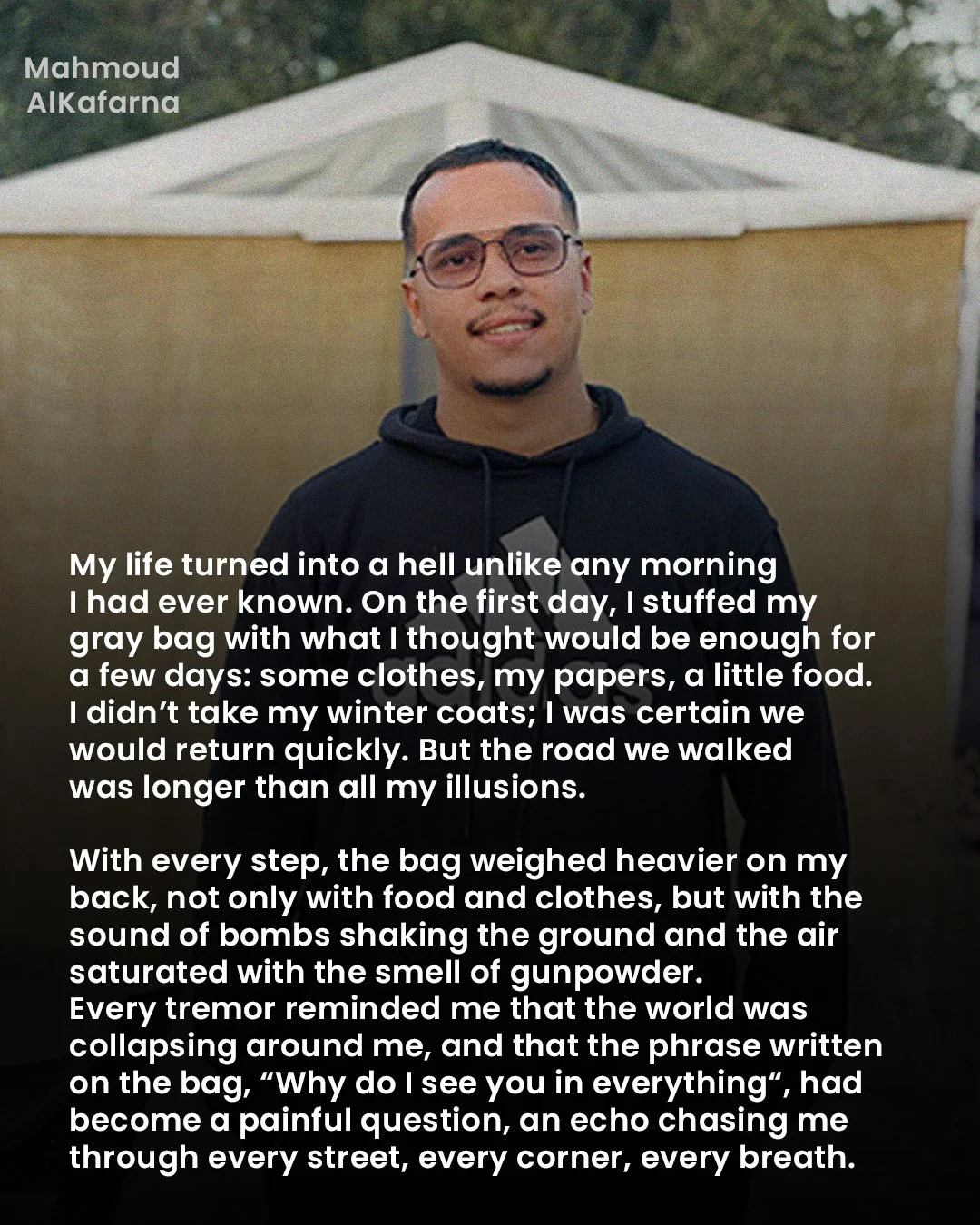
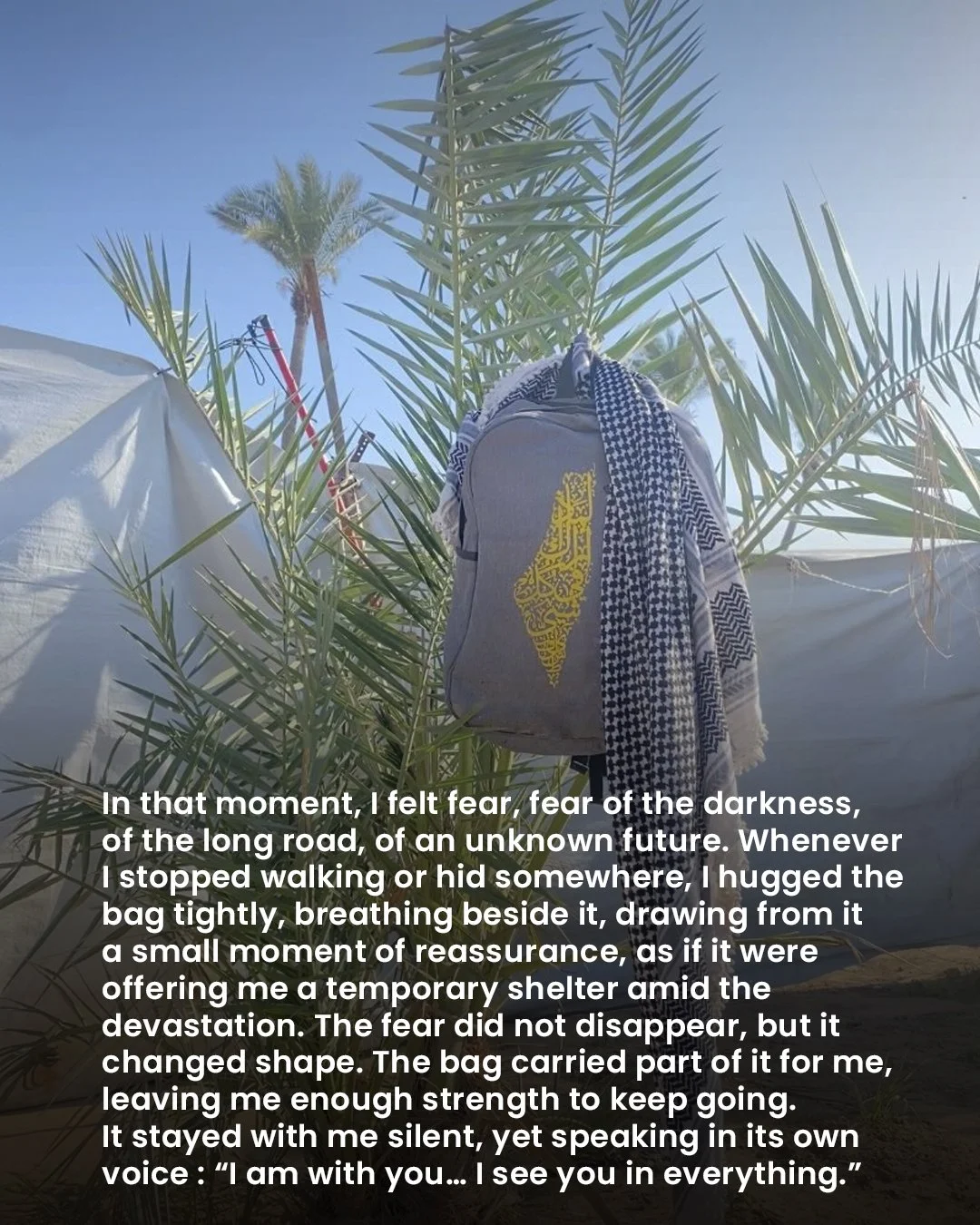
Mahmoud recently finished his independent book – Why Do I See You in Everything? – which he wrote over the genocide.
“This book is based on real lived experiences of war, displacement, loss, and survival in Gaza. Writing has become my only way to continue, to document what is happening, and to support my family under these extremely difficult conditions.”
He is currently working to try to get the book published.
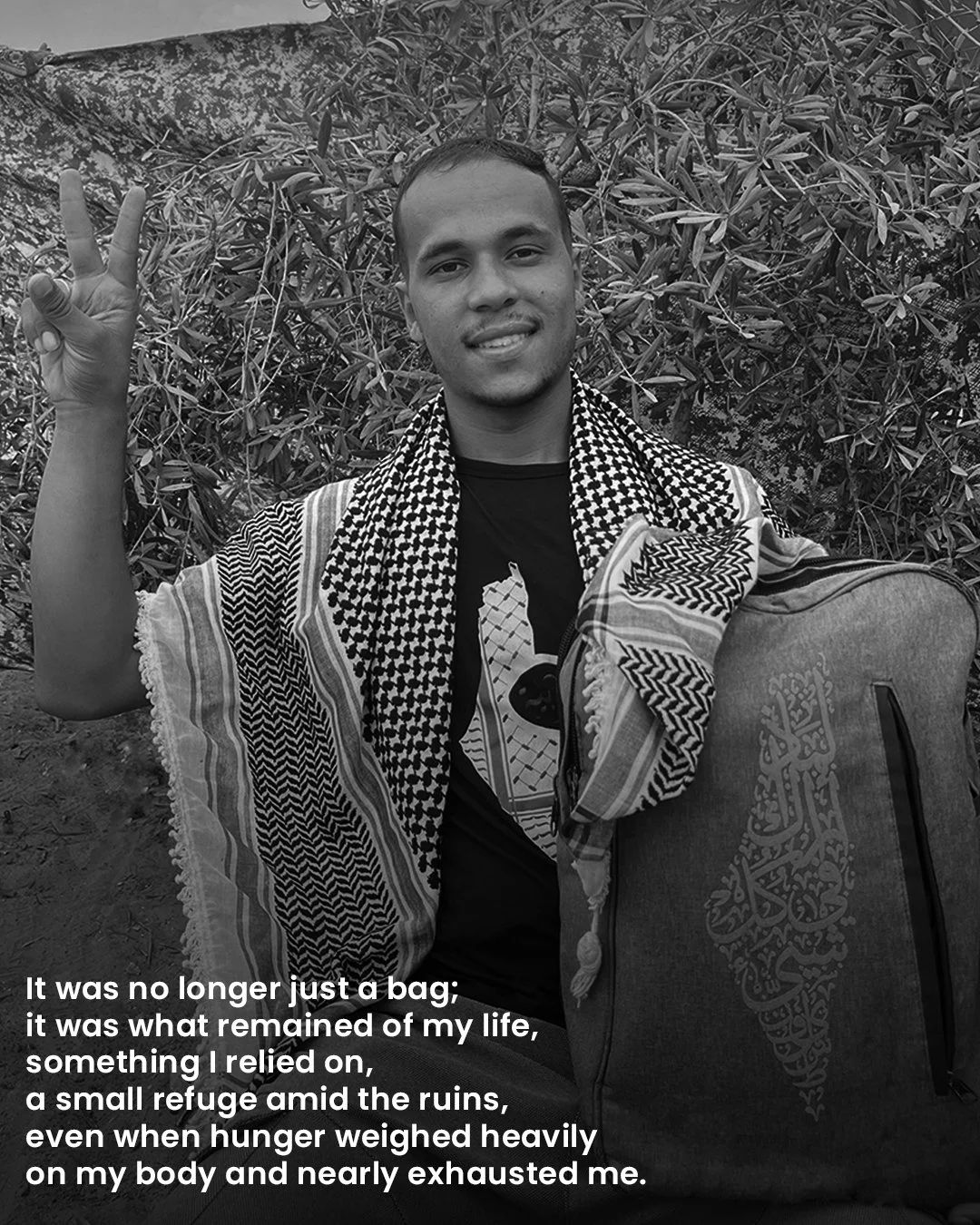
Read writing from Mahmoud
Excerpt from the chapter: ‘Starting a New Life’
When hunger became stronger than fear, there was nothing left for us but to run after any flicker of hope that might keep us alive. The land we once lived on had turned into an open grave: no homes, no safety, only torn tents beneath a sky heavy with smoke, and children crying because hunger bit their stomachs harder than the cold.
We heard about a place they called American aid, a distribution point described as “humanitarian, ” yet it carried nothing of humanity. It was an aid of death; it lured people to gather, then left them suspended between bullets and hunger, as if life were a sack of flour granted only to those who survived.
When everything that could be called food disappeared, I was forced to go, like everyone else.
I was no better than anyone; I was just as hungry as the others. I carried my bag and walked ten endless kilometers. Everytime I asked someone, “Where is the aid point?” they pointed farther away, as if the road itself were fleeing from us. It was evening when I arrived. The place was near an abandoned landfill, the sea behind us and rubble in front of us; a place that resembled nothing of life, crowded with hundreds of thousands of people.
I sat on the hard sand, watching exhausted faces, eyes reddened by hunger and fatigue, trembling hands stretching without hope, bodies on the verge of collapse under the weight of waiting. The sky above us was choked with smoke, the air thick with dust and death. The moon hovered faintly, and every passing moment pressed heavier on our hearts than the mud clinging to our feet. Despite all this pain, I felt something strange. In the silence of the crowd, in fearful glances, in the fragile hope that had not yet died, there was resilience screaming without sound, resilience reminding us that life, even when it seems impossible, still clings to us.
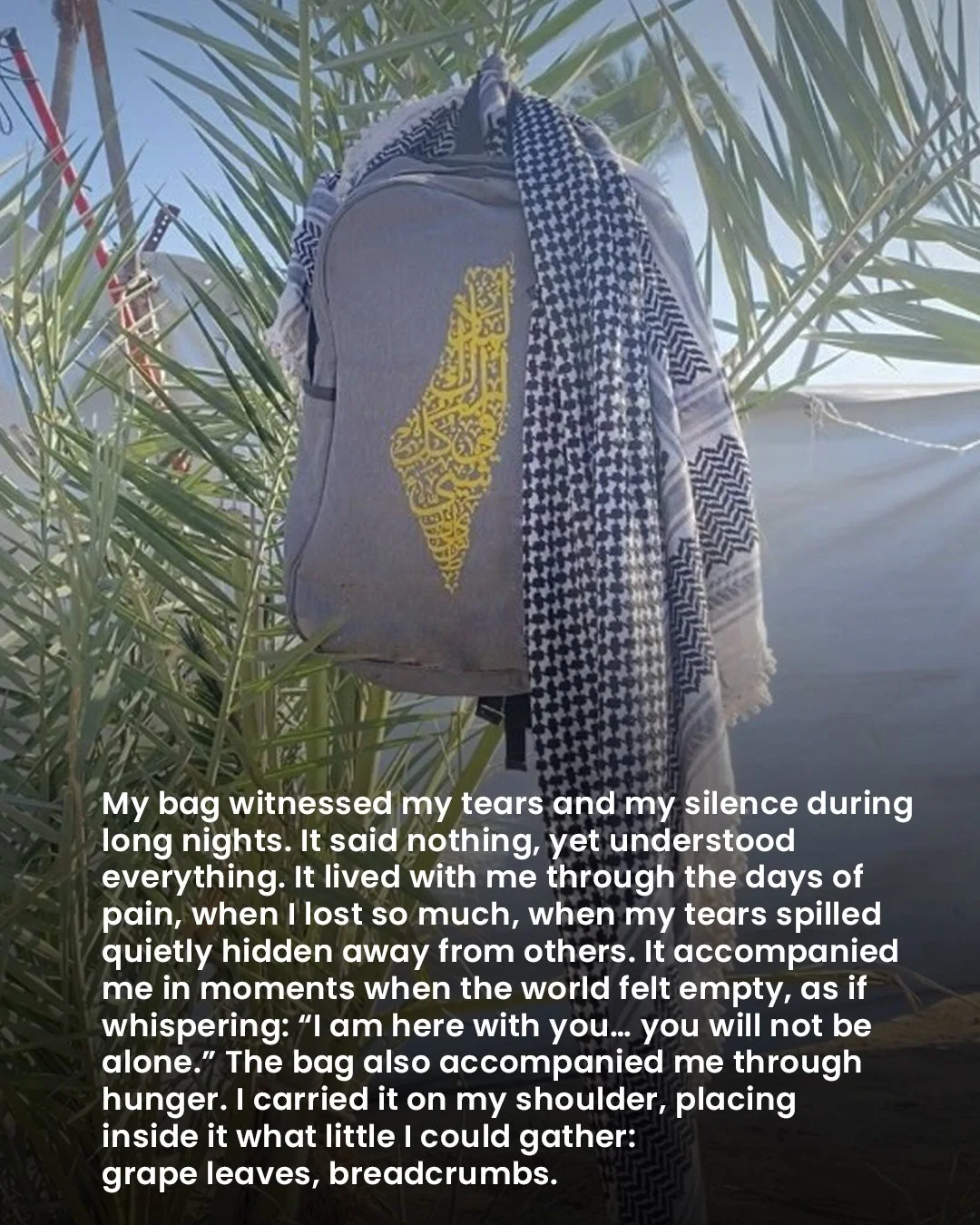
I asked myself: Will anyone get a sack of flour? Will I return with anything for my family? Or will I become just another number on a piece of paper? Hours passed heavily - one, two, then three. Night fell, and the cold gnawed at my bones. I lay on sand and stones, placing my bag, the one bearing the words “Why do I see you in everything?” , beneath my head like a pillow. The ground was cruel, as cruel as those who run this so-called “aid” . With every shiver in my body, I felt that the bag, in its silence, carried something greater than food or temporary safety; it carried my memory, my pain, and my small dreams.
There was no light, only the darkness of night and the sound of fear. I was so hungry that food no longer felt like salvation but like a final test of the body. I kept thinking: even if I get the flour, will I be able to carry it? Hunger tore at my muscles, weighed down my legs, turned every step into a battle. My body was exhausted, my head spinning, my hands trembling, as if hunger were no longer an emptiness in the stomach but a force pulling me toward the ground. Suddenly, an explosion tore through the air. Bombs split the sky like fire escaping from hell. The ground shook beneath my feet, my heart leaped before my body did. I clutched my bag with whatever strength remained and ran in search of a shadow of safety, but in that place, safety had no name and no shape. I asked myself, gasping among rubble and garbage: Do I die for a sack of flour? Do I become a martyr of hunger? I found no answer. The question lingered heavily in my chest, and with it fell a single tear, a tear not of fear alone, but of betrayal by a world that forced us to choose between dying of hunger or dying under bombardment. Some said, “Whoever risks their life gets the food. ” Others said, “Whoever hesitates belongs to the bullets.”
At that moment, I understood the bitter truth: this was not aid; it was a sniper’s field where survival was tested with brutal cruelty. Gunfire erupted above our heads. People dropped to the ground, shouting, “Keep your head down! Hide!” We stood like statues among dirt and dust until eight in the morning, the entire night devouring us with its silence and screams. When light finally crept in, people withdrew one by one, their voices low and broken: “There’s no aid today. ”
I returned to my tent defeated, hungry, with something shattered inside me. This experience taught me that hunger kills the body but humiliation kills the soul, and that when we stretched our hands toward trucks we did not know carried life or death, we were not asking only for food but for dignity, survival, and a small chance to remain alive. A human being can endure hunger for days, but not a single moment of feeling worthless, unprotected, stripped of rights. Yet we did not break. Despite bullets passing above our heads, bombs tearing the earth beneath our feet, false promises, and endless disappointments, we remained standing. I learned that no matter how long the night lasts, its darkness must eventually crack, and that history, no matter how much some try to distort it, will one day write the truth: we did not starve because we were weak, and we were not killed because we were guilty, but because the world stayed silent and cruel hearts saw our hunger as an opportunity for death.
Our children will grow up and carry this story after us. They will know that we did not run after flour, but after life. They will know that hunger did not break us, that death did not steal our humanity, and that light, no matter how dangerous, could not extinguish what lived in our hearts.
Excerpt from the chapter: ‘An Unforgettable Meal’
We were trapped in Jabalia, living under fire belts that never slept. Children cried, and hunger cried louder. There was no room for logic, no place for dignity, only the desperate attempt to stay alive in any way possible. And in those moments when the world narrowed, a new kind of food entered our lives. A food I never imagined I would put in my mouth: water and salt.
An unforgettable meal… yes… water and salt. This was our first “meal” under siege. We mixed a little salt with water and drank it in fear - it burned the throat as if the sea itself had taken shelter within us. But it tricked the stomach a little, masked the ache of hunger for a few minutes, and left in the mouth a taste impossible to forget: The taste of poverty… The taste of survival… The taste of Gaza trying to stay alive. It wasn’t a bad taste, nor a good one, just a taste unlike anything else. A taste reminding you that you’re still breathing, and that you eat not because you’re hungry… but because life needs to continue .We looked at water and salt as a medicine, a cure for weakness, dizziness, and the emptiness drilling into our stomachs. We sometimes laughed, despite the pain, and told the crying child: “Drink… it will fill your stomach a little. ” But the truth was… we were trying to fill our souls with patience, not our bodies with food.
After another day of hunger, we managed to go out and search for food. I carried my bag - the bag that has a question written on its leather, a question that follows me everywhere: “Why do I see you in everything?” As if it were questioning me, and questioning hunger, and questioning the life that had almost faded away. I searched long… and all I found was a little bit of lentils.
Lentils were no longer “food, ” but the last remains of memory, the last thing war hadn’t stolen yet. I began thinking… How could we eat it? We had no bread, no oil, no salt, no spices, nothing at all. I put the lentils in a small pot over low heat, no seasoning and I sipped it like water: a taste without taste, a color without color, a life without life. I drank it to stay alive, but hunger in Gaza wasn’t a feeling… it was a beast crouching in the stomach, devouring us from within. Still… we didn’t feel full. Every sip passed as if it reached nowhere in my body, a faint warmth deceiving the soul, and then the truth returned: We were still hungry. Then I heard an idea whispered by people around me: “Grind the lentils… bake them. Make lentil bread.”
I froze, my mind froze, my spirit froze. I asked myself: Can lentils become bread? Can we live on something God didn’t create to be a loaf? I thought about it long. My mind refused the idea. I couldn’t imagine its taste, nor imagine myself swallowing something like that. But hunger… hunger makes the impossible possible. It makes what cannot be eaten edible. It makes what is unbearable essential for survival.
We began grinding the lentils. Tiny grains crushed beneath the stone, turning into coarse powder - dark like Gaza’s night. We mixed it with water, kneaded it slowly. Everything about it was strange: the smell, the texture, the sound, even the name: lentil bread. When we put it on fire, it made no sound of bread, released no aroma of home, of ovens, of safety - only a faint sound, like the moan of fear. I took the first bite. It was bitter, bitter like hunger, bitter like fear, bitter like the war chewing our souls every day. I couldn’t swallow it easily. My throat tightened, my mind refused (it), my heart shattered inside me. How does a human eat bread that isn’t bread? How did we reach this point?
But I swallowed it because death was no longer far, and because life, no matter how bitter it is, is still better than nothingness.
I ate lentil bread.. not because I wanted it, nor because I could tolerate its taste, but because I had no other choice. I ate it so I wouldn’t die, so I could write, so I could remain a witness, so I could remain a son of Gaza… not another number.
We lived on lentil bread for days.
Discover more Gaza writers & artists
Follow the links below to see a list of other creative individuals in the Strip to support and amplify.