
Artist Martyred
in the Gaza Genocide
(2023-ongoing)
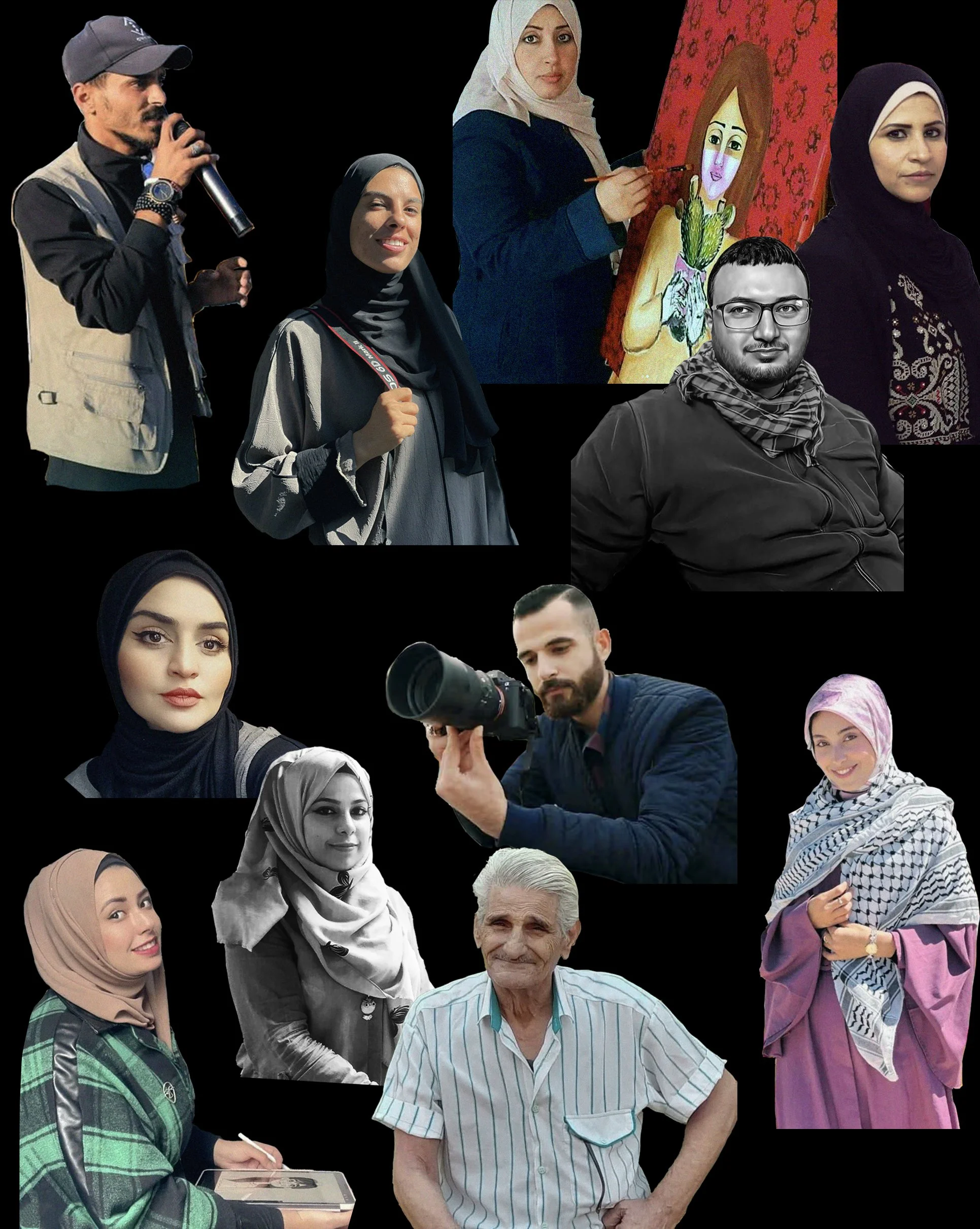
No one was safe from the bombs dropped by “israel” in the years after Al Aqsa Flood, and that includes visual artists.
The Zionist state murdered them by airstrikes on their homes, or the tents they were displaced to. They murdered them through the blockade of medical supplies or inability to leave for treatment. They targeted them for their voice, for their community work, for their mere existence.
2023
October 13 - Heba Zagout
October 29 - Halima Al-Kahlout
2024
February 25 - Fathi Ghaben
October 18 - Mahasen Al-Khatib
2025
March 18 - Dorgham Qreaiqea
April 12 - Dina Zaurab
April 15 - Fatma Hassouna
May 15 - Elham Al-Badi
June 30 - Frans Al-Salmi & Ismail Abu Hatab
September 17 - Mohammed Abu Layeh
2026
May 26 - Fadi Almeghari
Below are some tributes to these artists who should not be forgotten. Keep their memories alive.
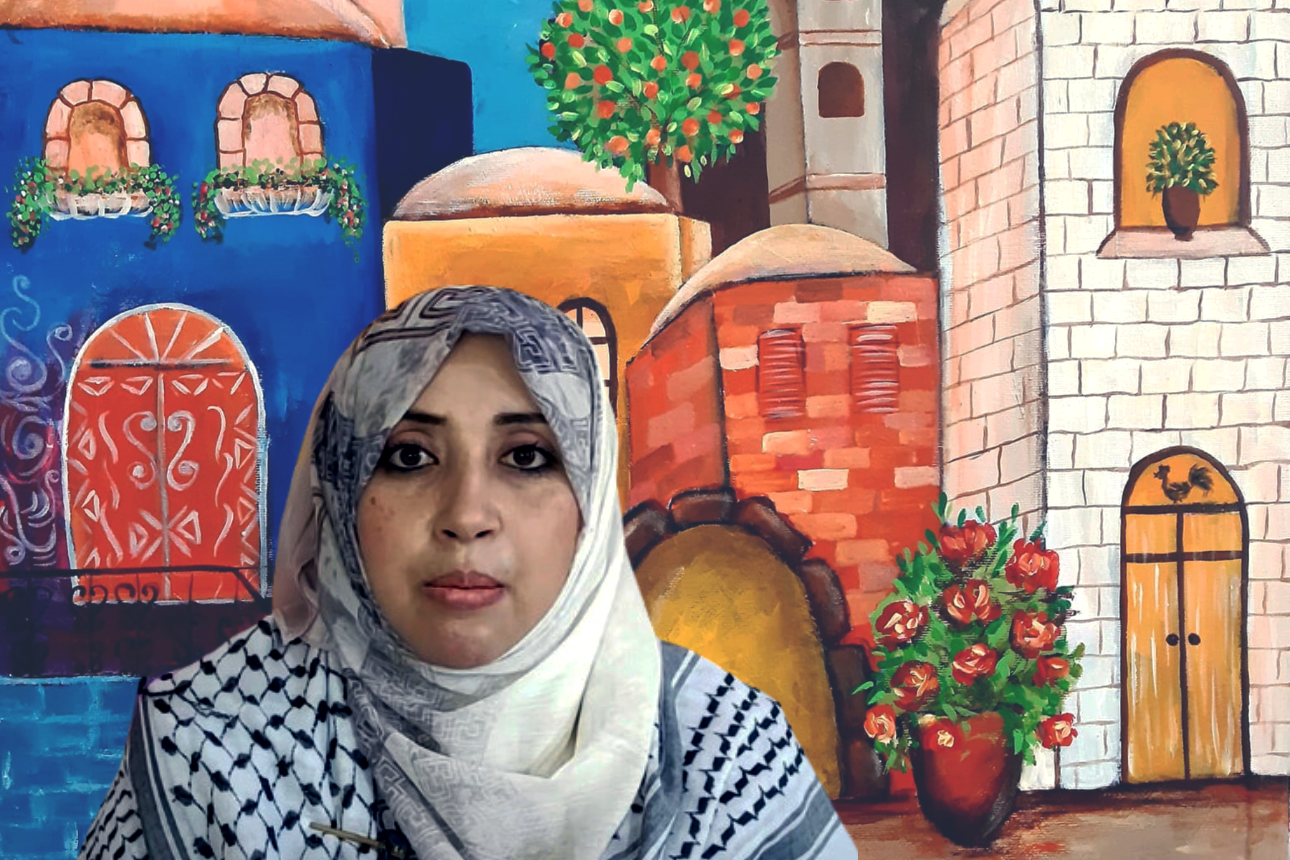
Heba Zagout
October 2023
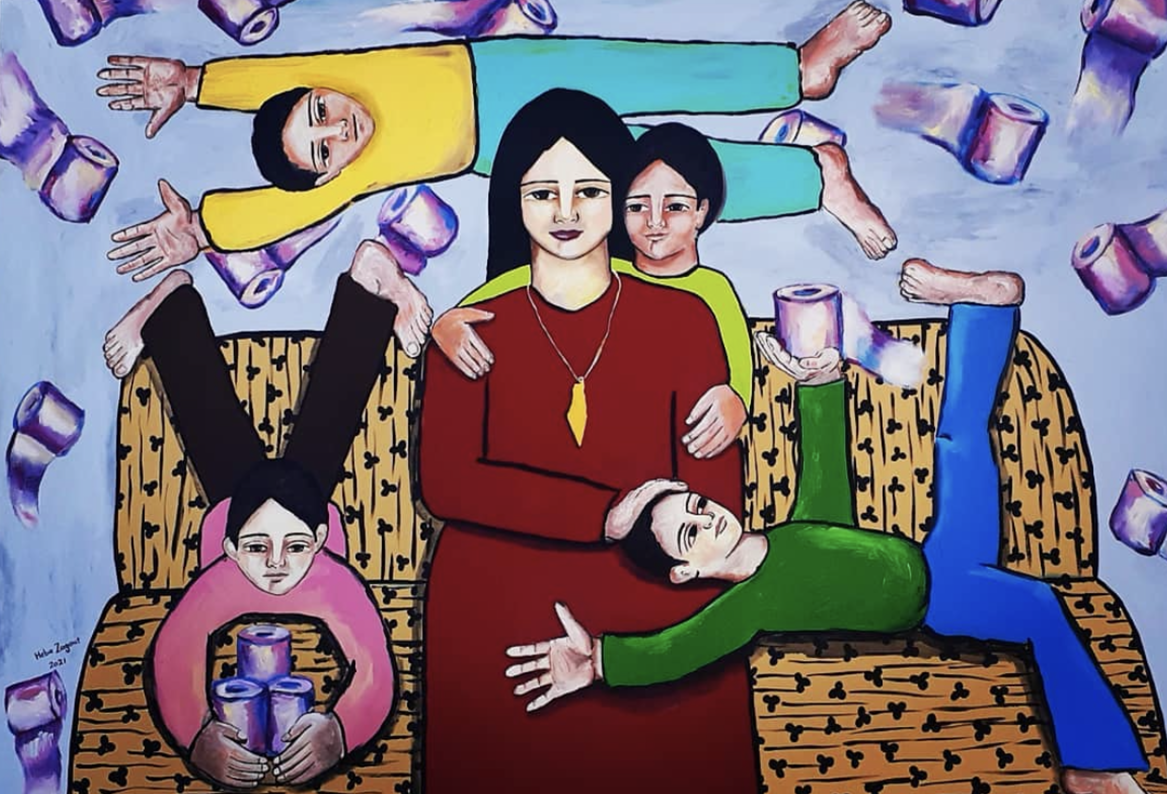
The first artist martyr of the genocide came less than a week into the genocide. Heba Zagout was martyred by an IOF airstrike on her home – alongside two of her children, Adam and Mahmoud – on October 13, 2023. Her husband and two other children survived. She is also survived by her sister, Maysaa.
Her family had initially been from the village of Isdud, forcibly expelled during the 1948 Nakba, and Heba was born in Al-Bureij refugee camp. From a young age, she had a love for painting.
Zagout was born in 1984 in Bureij refugee camp, in the middle of the Gaza Strip near Maghazi and Nuseirat refugee camps. She grew up listening to her family and other elders tell stories about Palestine before the Nakba. According to her sister, Heba developed a love of painting from a young age.
She graduated from Gaza Training College in 2003 with a degree in Graphic Design and from Al-Aqsa University with a Bachelor’s degree of Fine Arts. After finishing school, Heba went on to be an art teacher and work with UNRWA. Selling her artwork provided for her family of six.
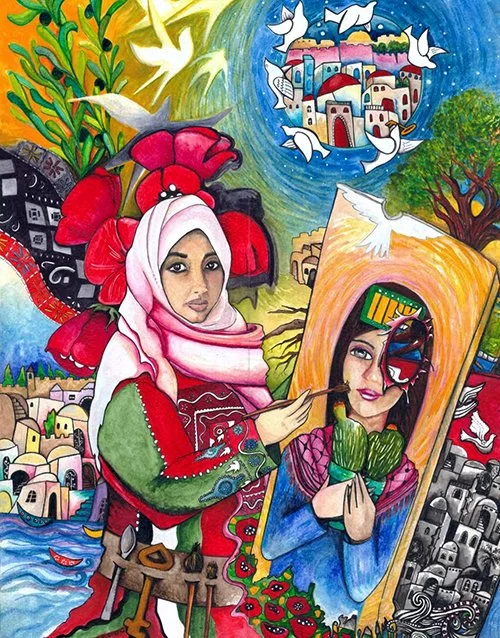
A tribute to Heba Zagout by @ladyalinden
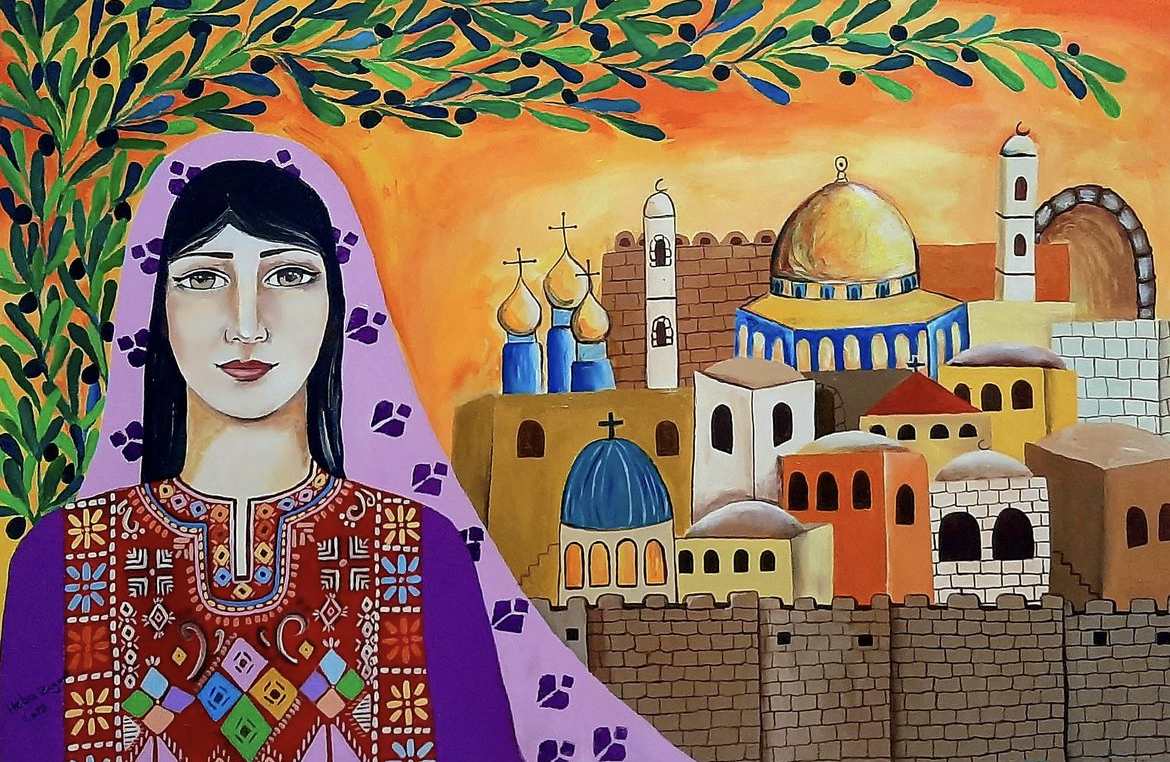
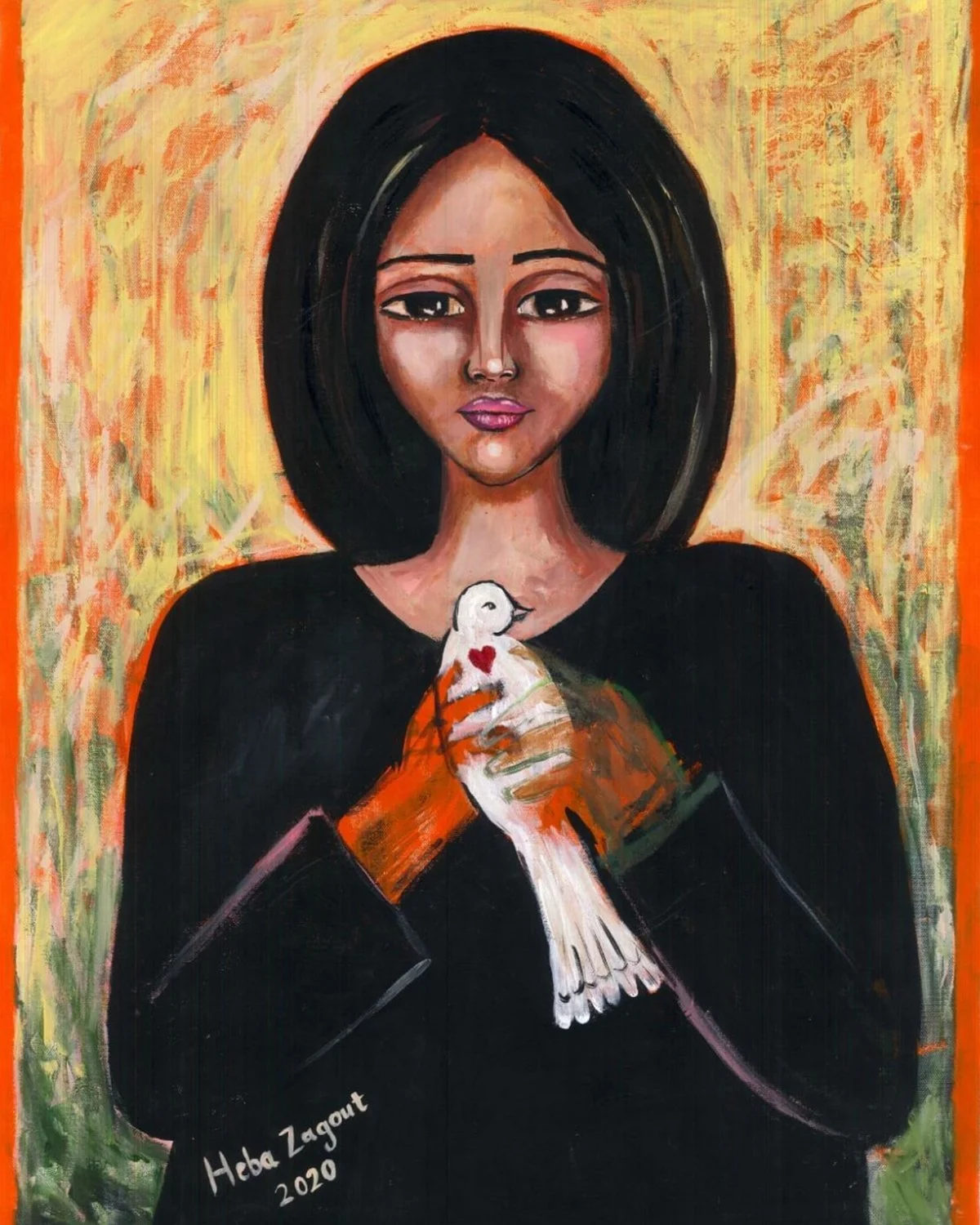
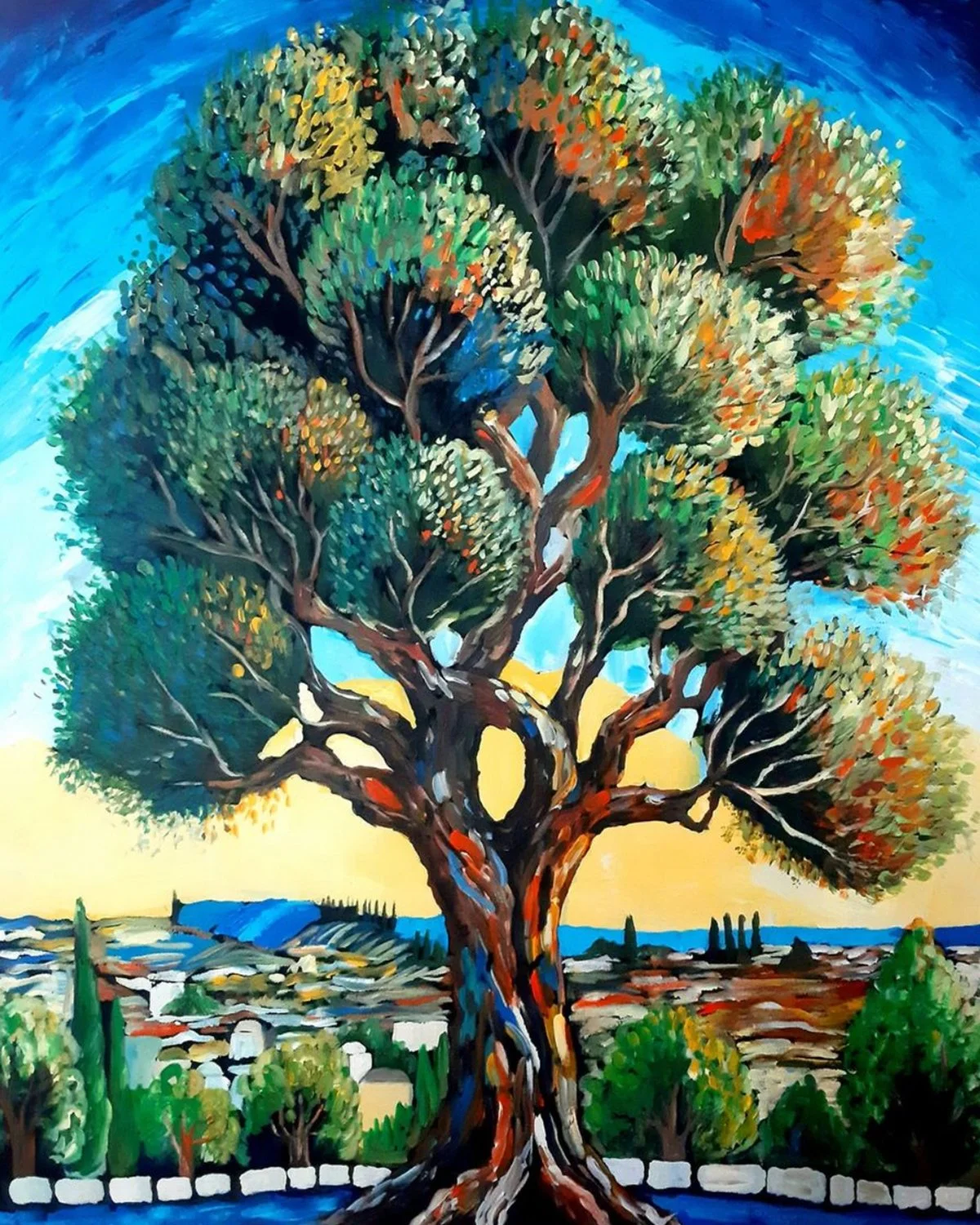
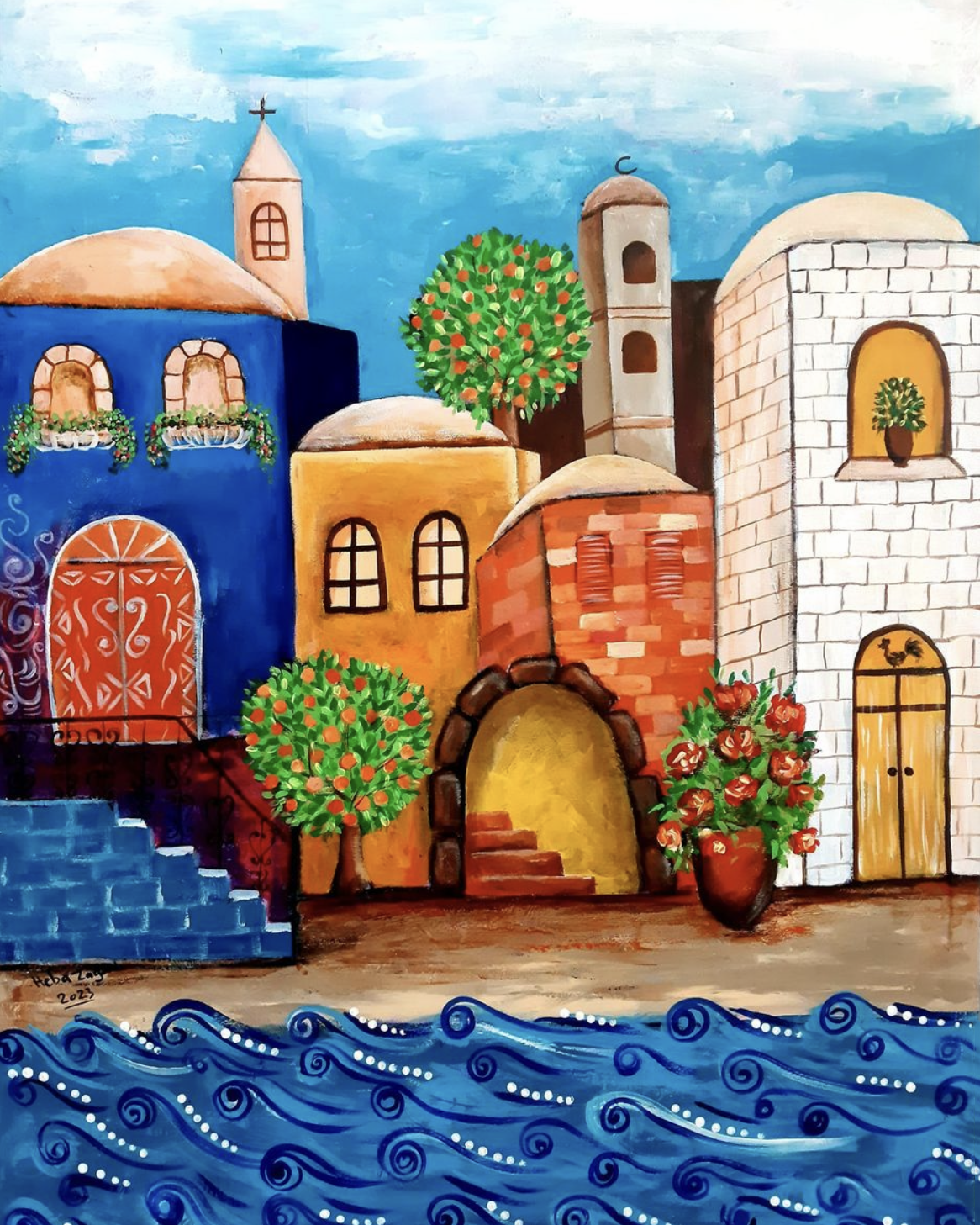
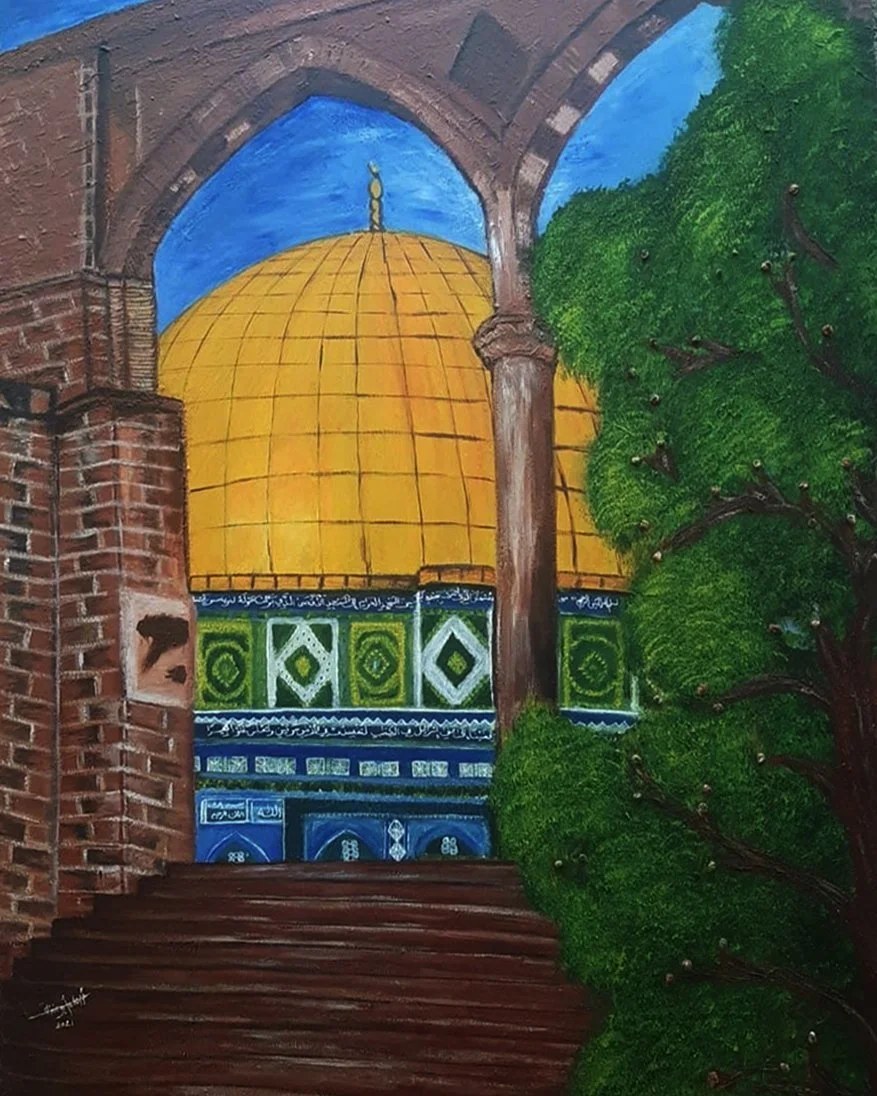
Heba made many paintings, often capturing Palestinian women and villages – as well as one of her favorites, the Dome of the Rock at Al Aqsa Mosque. Her work was featured in many exhibitions, including a 2021 solo show My Children in Quarantine looking at life during the Covid-19 pandemic. In the exhibition, she showed images of Palestinians in masks, including herself, in their homes and in Al Quds / Jerusalem.
Zagout was also a frequent visitor at art openings and more for the Dar Kalima Art Centre in Gaza. The founder, a Bethlehem-based Palestinian Lutheran priest named Mitri Raheb, said “that beyond helping expose young Gazan artists to the outside world and assisting them in earning their livelihoods by selling their work abroad, the college’s goal is to provide a venue for ‘art as therapy’ and as a way to express a dynamic Gazan identity that transcends politics. Making art is a way for Gazans to represent their own reality and tell their own stories.”
As an educator and artist, Zagout dedicated her life to documenting Palestinian heritage and history as it faced endless erasure and threat under Israeli occupation. She stayed committed to art until her last moments, both for her and her students.
Laura Albast, a Palestinian-American journalist, spoke to Zagout just two days before she was martyred. She described Zagout’s art as very connected to her experience as Palestinian woman living in Gaza and a great loss. "They didn't just bomb her home, her children, but they erased the traces of her creativity,” said Albast. "This is a woman who has brought so much joy to the homes of so many people who have bought her art, who have displayed her art.”
Two weeks before the "isareli" airstrike, Zagout posted a video on YouTube about her work at the end of September 2023. In it, Heba said: “I consider art a message that I deliver to the outside world through my expression of the Palestinian cause and Palestinian identity.”
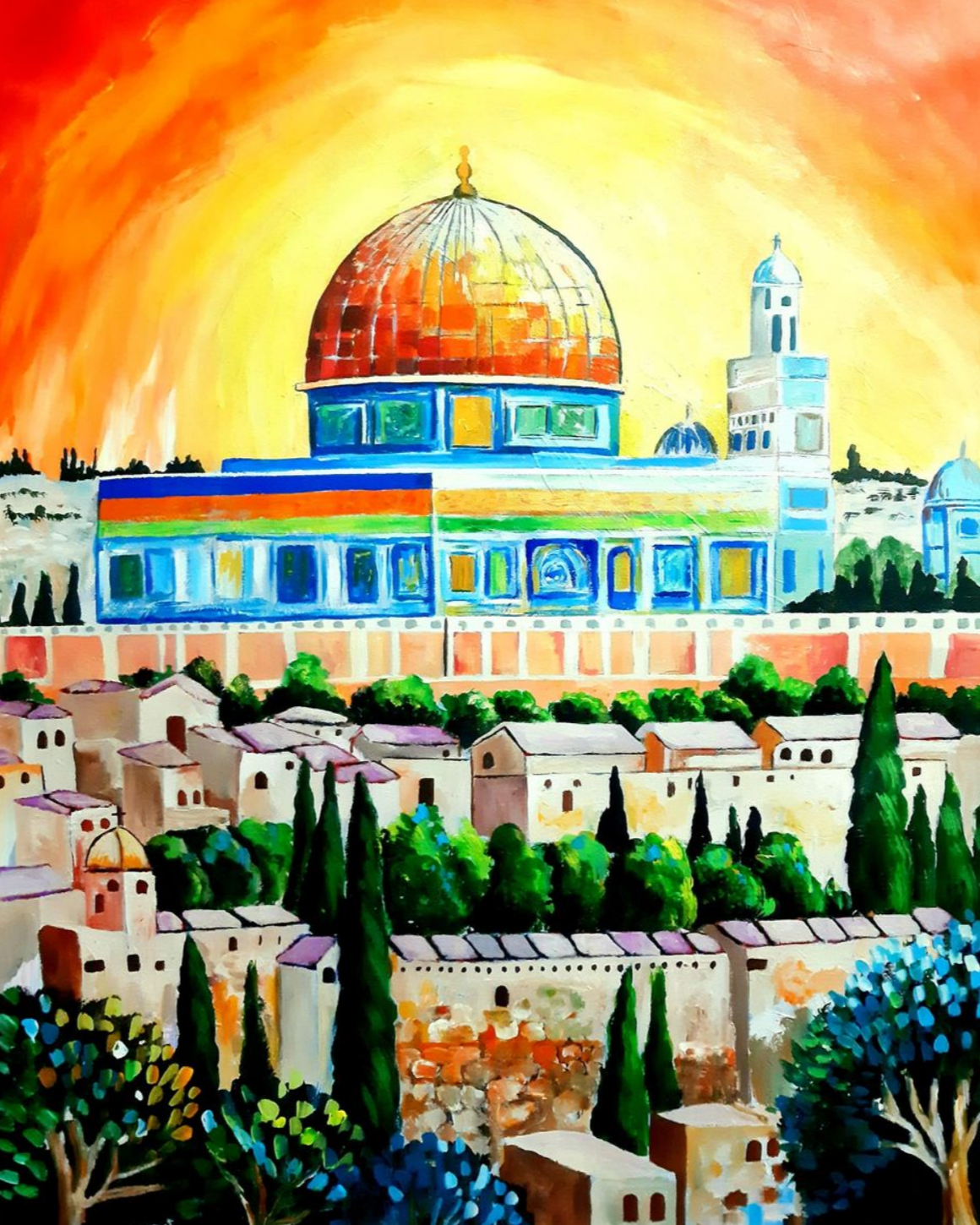
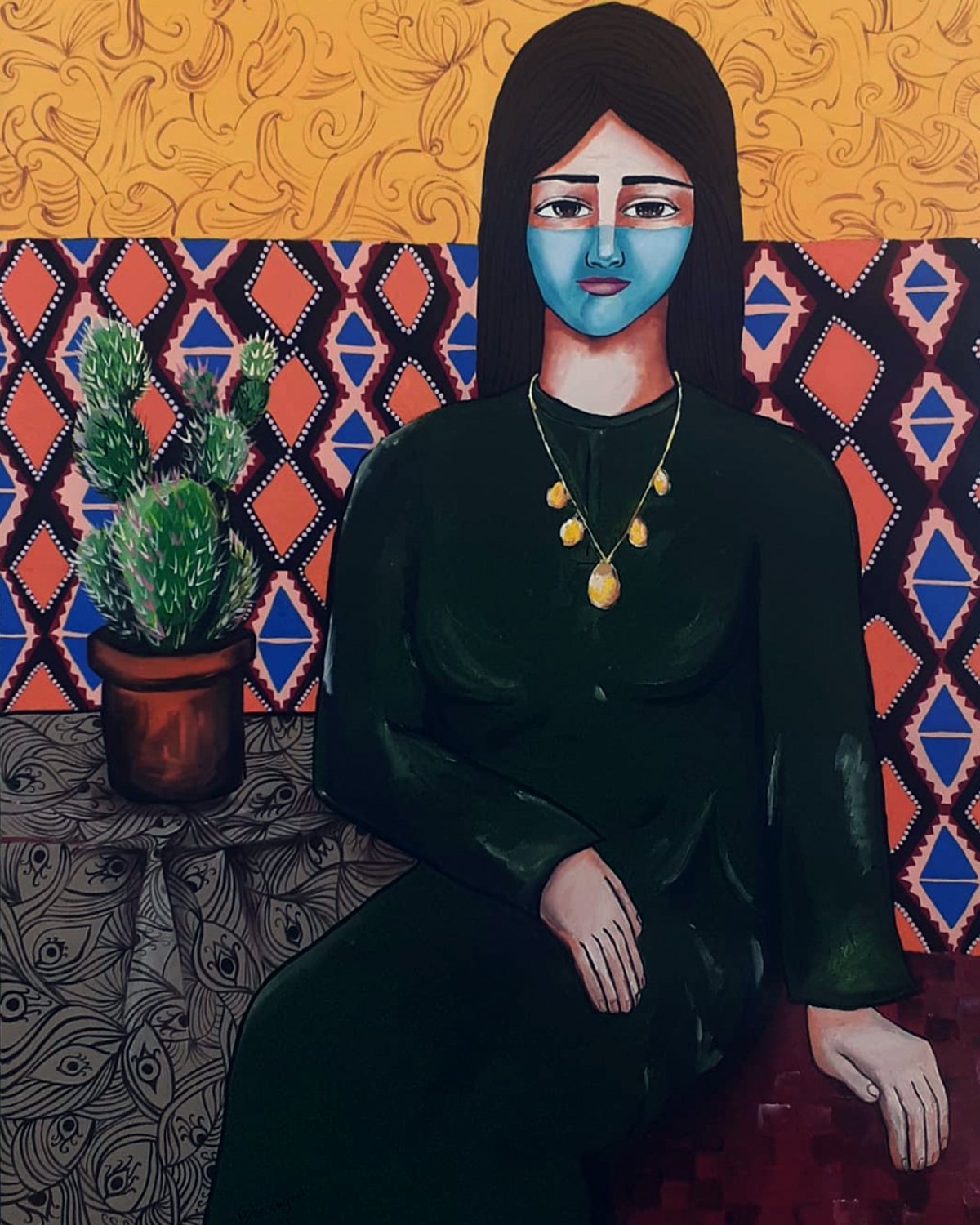
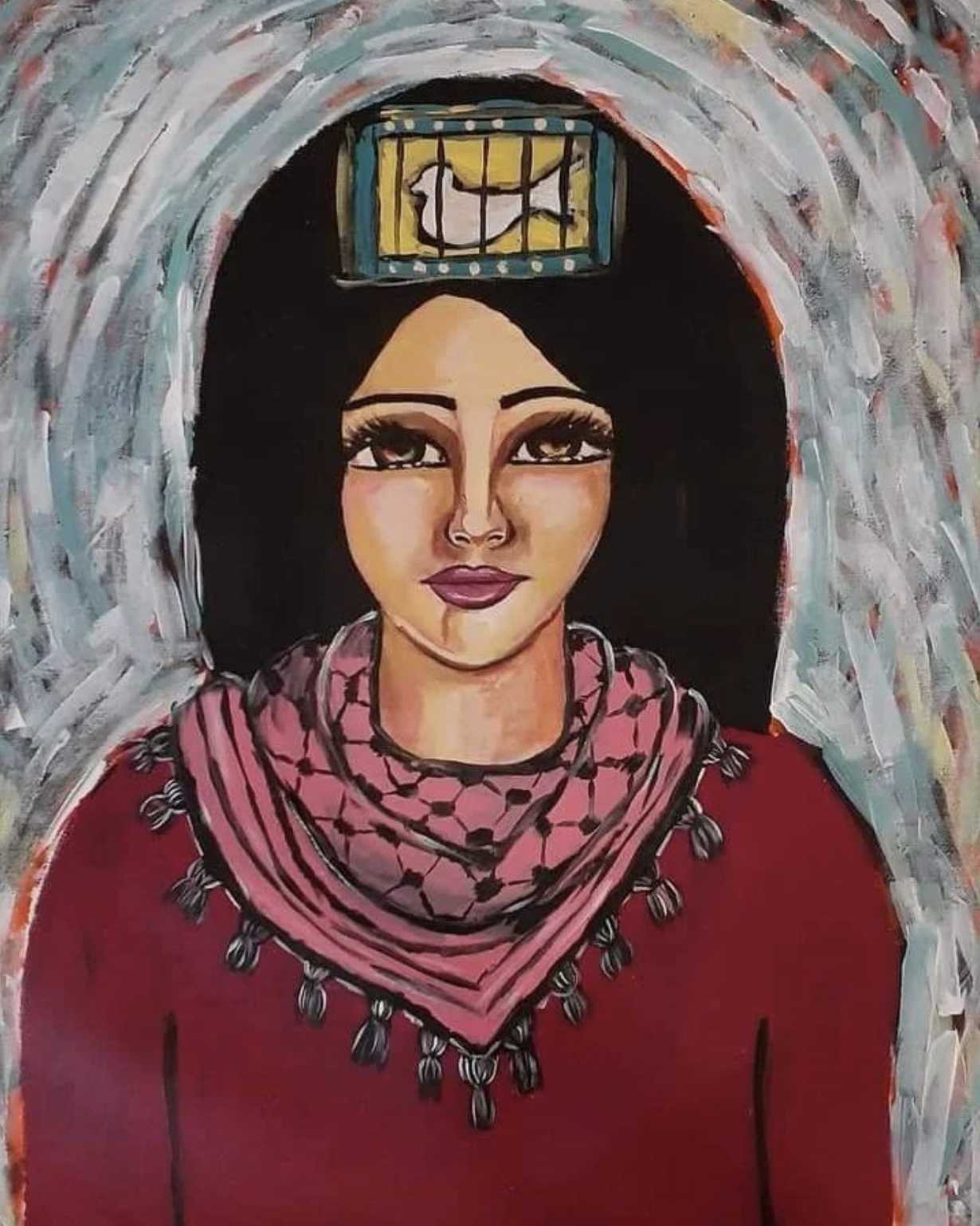
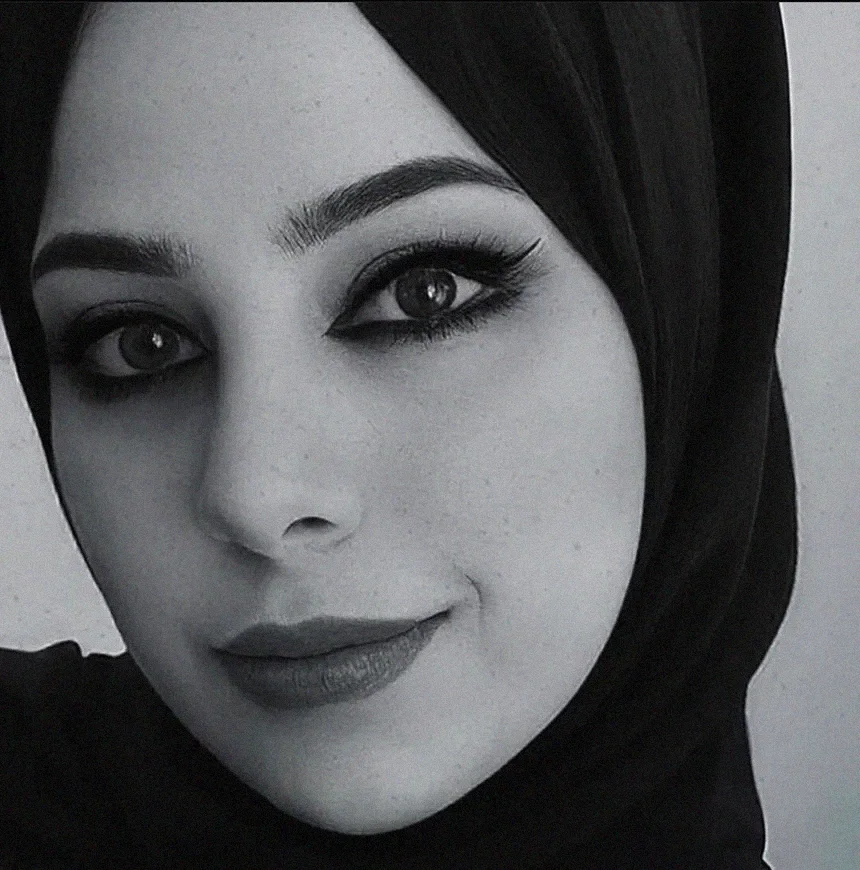
Halima Al-Kahlout
October 2023
Halima Al-Kahlout was initially born in Gaza City. She later earned her Bachelor’s degree in Fine Arts from Al-Aqsa University and was finding success as an artist, including being awarded an artistic residency grant at Shababeek for Contemporary Art, through the Art for Gaza campaign.
She worked across a variety of mediums, including painting murals and making work with cardboard. The Institute for Palestine Studies notes:
“(Halima) participated in the 2019 exhibition In the Void, which included sculptural and installation works using non-traditional tools and media available in the local environment, since materials such as bronze, copper, or aluminum were not available, due to the ongoing siege on Gaza. In the 2022 exhibition Fragments of the City, produced through an engraving and printmaking workshop with the participation of 28 artists (with several showings in Gaza City, Deir al-Balah, Rafah, and Jabalia Refugee Camp), the works revolved around Gaza's historical landmarks, historical Palestinian postage stamps, and aspects of public life in the past.”
In addition to making her own work, Halima also worked as an art facilitator with the Palestinian Ministry of Culture and collaborated with various art centers, including at Dar al-Kalima University’s Gaza location.
When the genocide broke out, she was 28 years old. Halima was initially at her family’s home in the Sheikh Radwan area of Gaza City, but then was displaced with her family later in October.
They went to the Yarmouk area, where an IOF airstrike hit and the schrapnel martyred Halima along with the rest of her family on October 29, 2023.
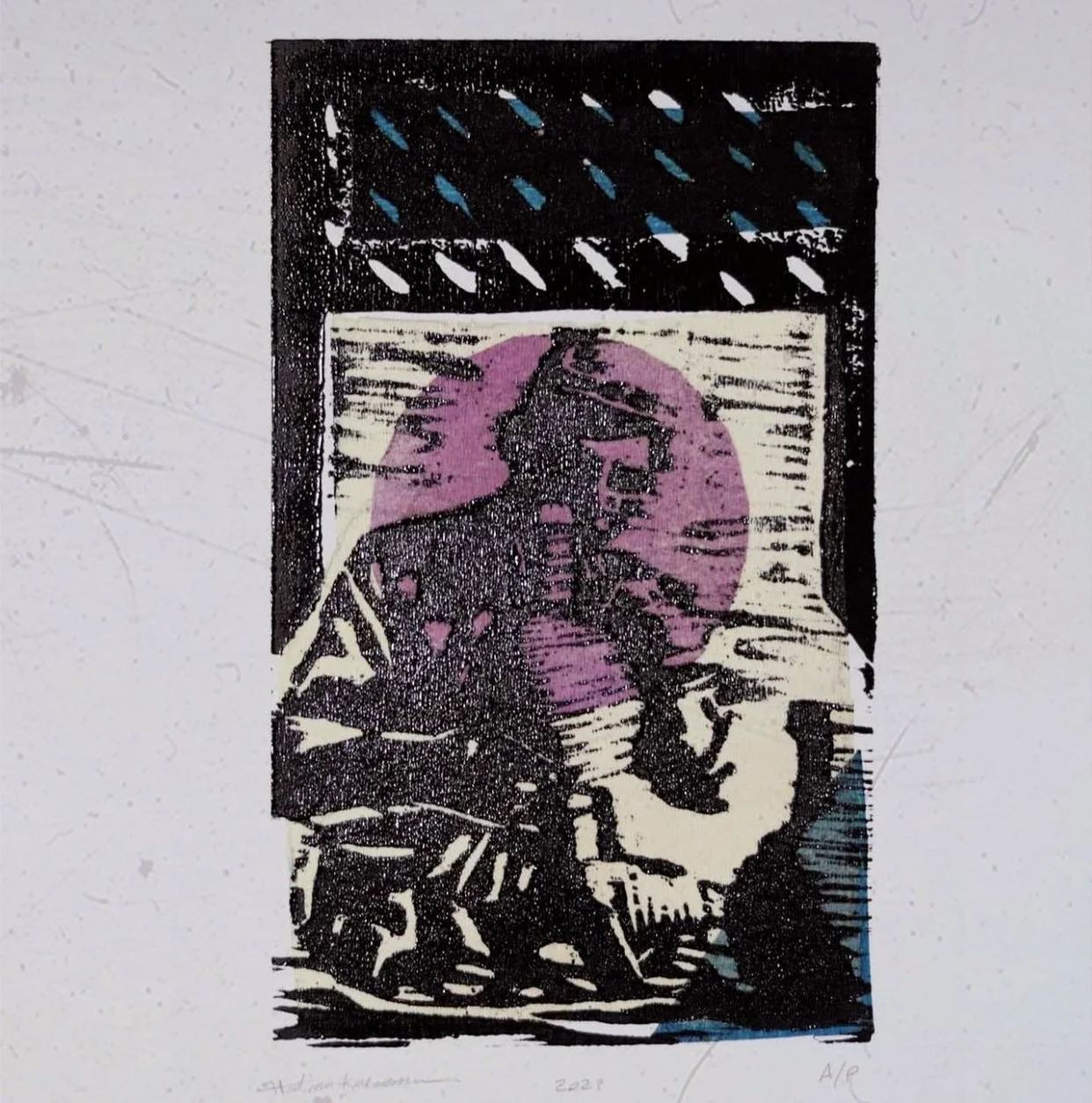
She had previously told Turkish feminist news agency NuJINHA that she wanted her artwork to spread internationally.
“The breadwinners of half of Palestinian families are women and girls. They are the most marginalized groups in the labor force. I want to participate in international exhibitions and competitions to show my artworks to the whole world.”
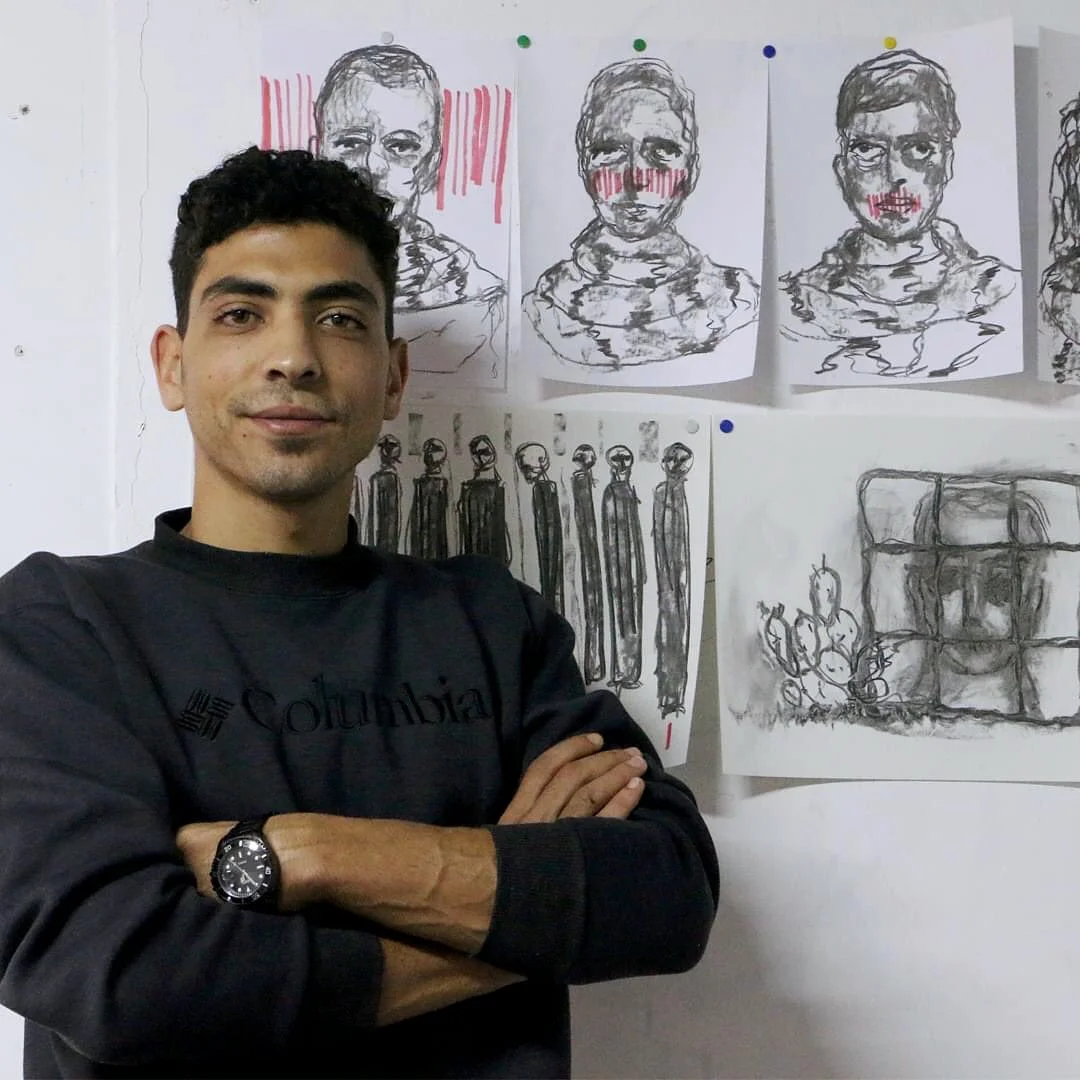
Mural below painted by Halima at Dar al-Kalima University in Gaza

Mohammed Sami Qariqa
October 2023
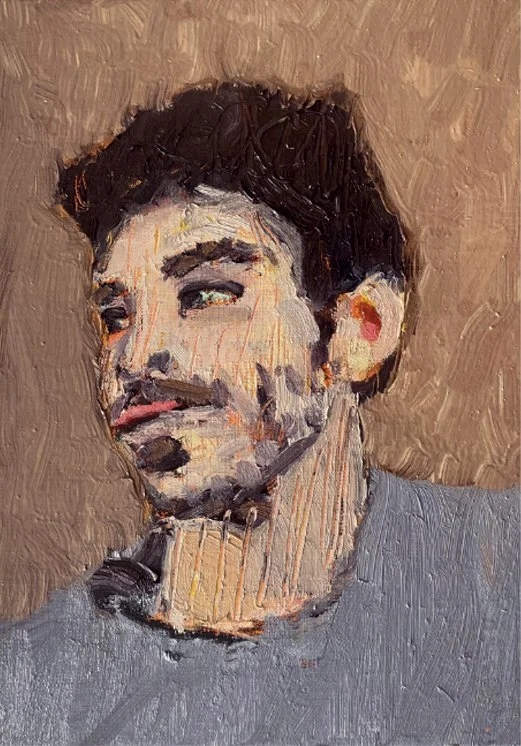
A tribute to Qariqa by Matthew Collings
As a 23-year-old artist and journalist, Mohammed Sami Qariqa was one of the martyrs in the first hospital attack of the genocide – when an IOF airstrike hit Al-Ahil Baptist Hospital, where hundreds of Palestinians had taken shelter under displacement. He had been there helping kids to reieve stress by drawing and signing under bombardment.
Mohammed worked as part of the art studio for Tamer Institute for Community Education, described as the soul of the effort as the one who came to open it every day, put paintings up, prepare materials, and get everything ready before younger participants arrived.
One day, he had hoped, the plan was to open his own art gallery in Gaza.
As far as his own work, his work blended painting, animation, and technology.
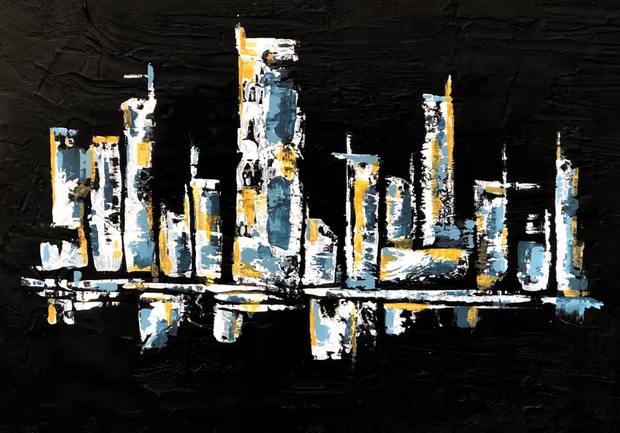
The Institute for Palestine Studies writes:
“Qariqa graduated from Al-Azhar University in Gaza and focused on integrating technology with the arts. He launched the ‘Rubik Code’ project, which presents aspects of the Palestinian cause, such as Judaization, the killing of unarmed civilians, arrests, and the siege, through scannable barcodes. The project relies on different techniques, with its core idea being linking the barcode to a Rubik's Cube, alongside sketches and paintings that convey real scenes from Palestinian reality that the occupation seeks to erase and falsify.
The late artist participated in a short documentary film titled The Airport, which captures an unfulfilled dream: the return of Gaza's international airport, which the Occupation forces destroyed in 2001 (only three years after its opening). ‘Here is Gaza Airport,’ the Palestinian artist writes with his brush on one of the ruined walls, as he speaks about his collogues whom the place inspired with different visions of a stolen homeland, and what the airport means to each of them.
He focused much of his artistic attention on comics and sought to establish a Palestinian comics collective that would shed light on scenes from everyday life. From this came the idea of Transit magazine, which he helped found in 2022 with a group of artists and enthusiasts in this field, including: Khaled Jarada, Hala Al-‘Absi, Hiba Shahtout, Alaa Al-Ja‘bari, Jihad Jarbo‘, Tamer Kaheel, Fatima Al-Houbi, Bayan Abu Nahla, and others.
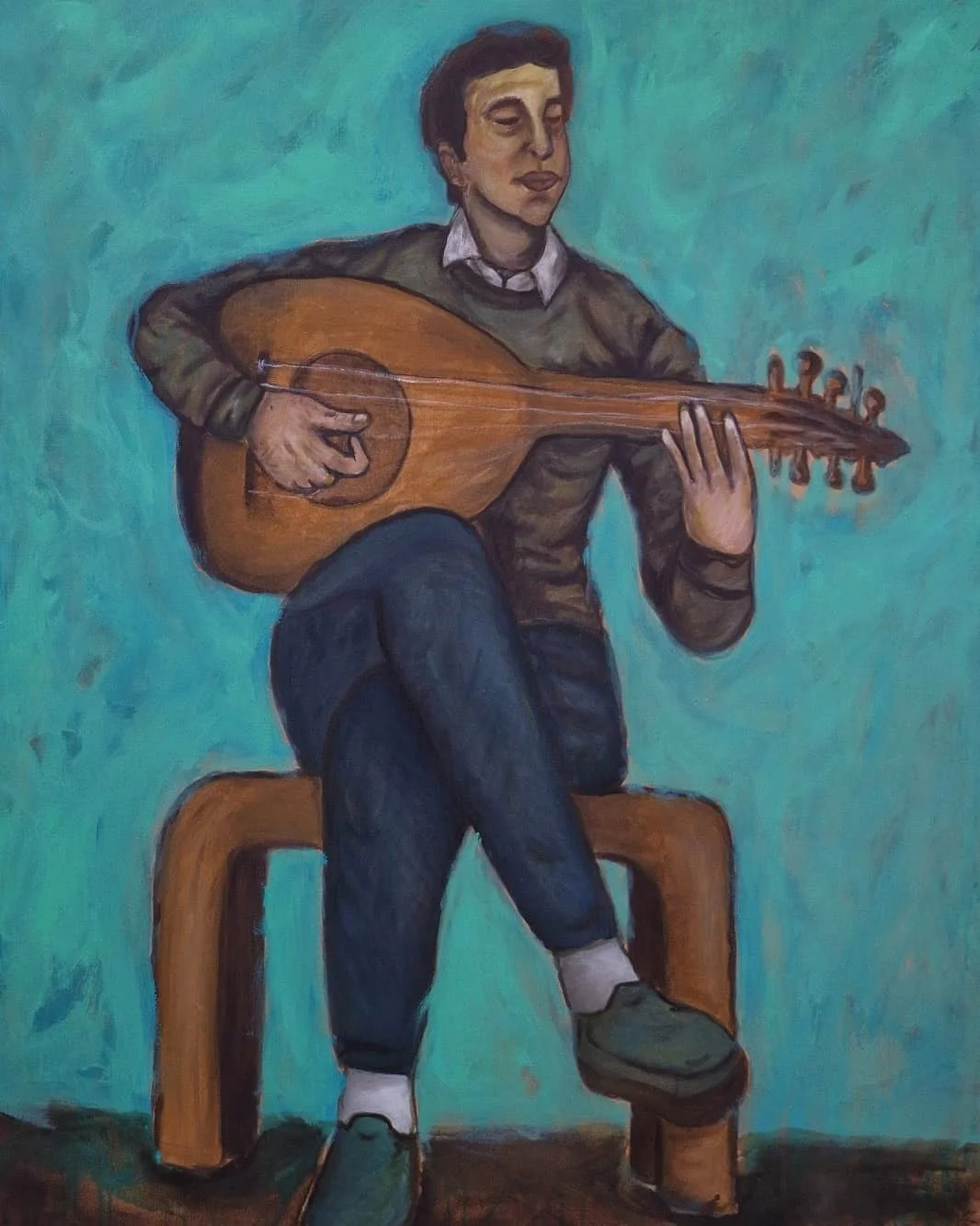
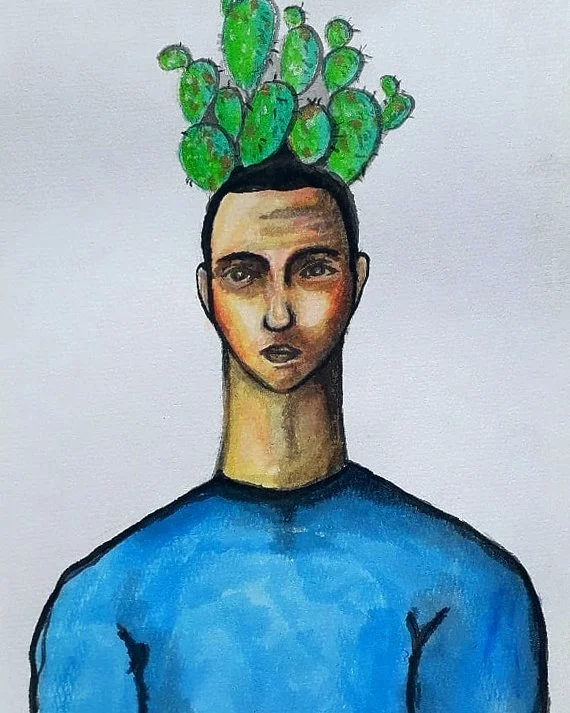
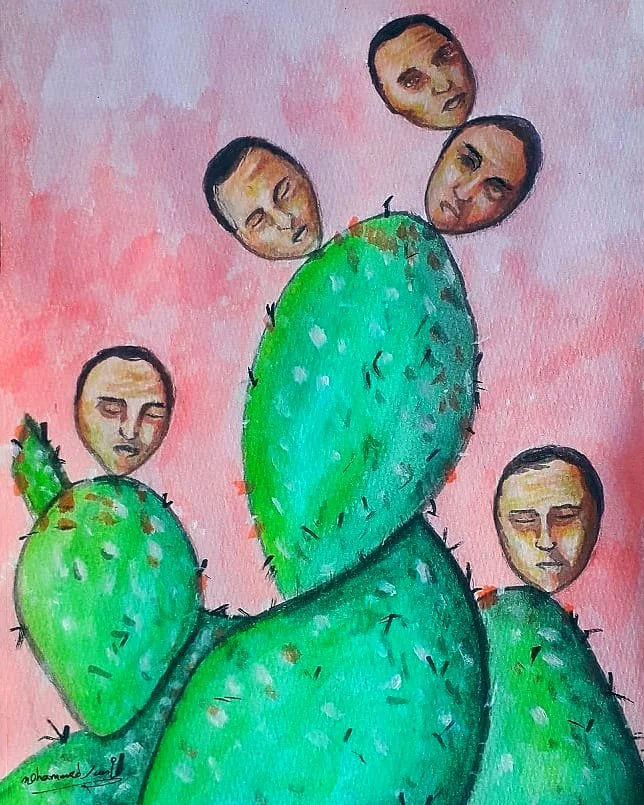
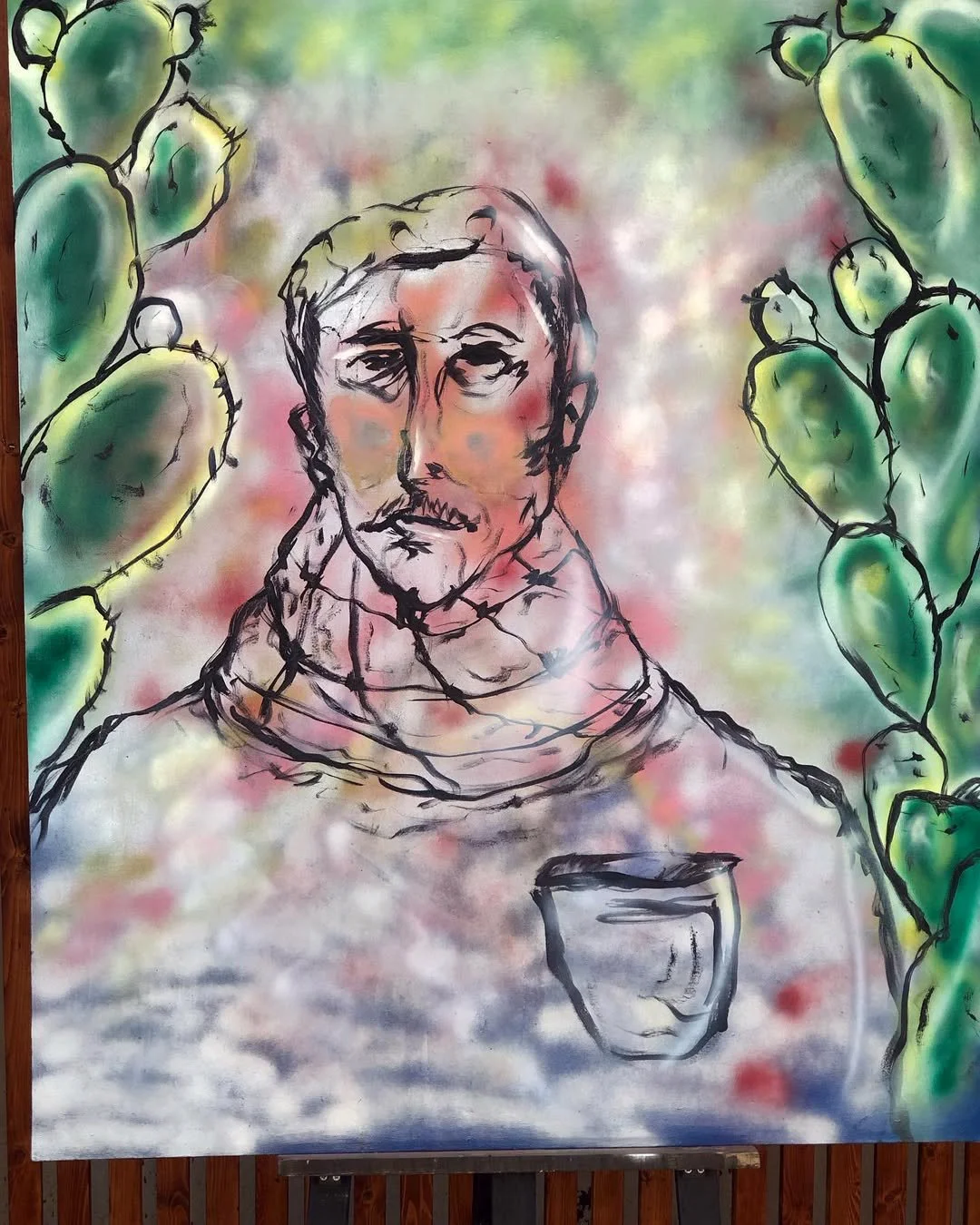
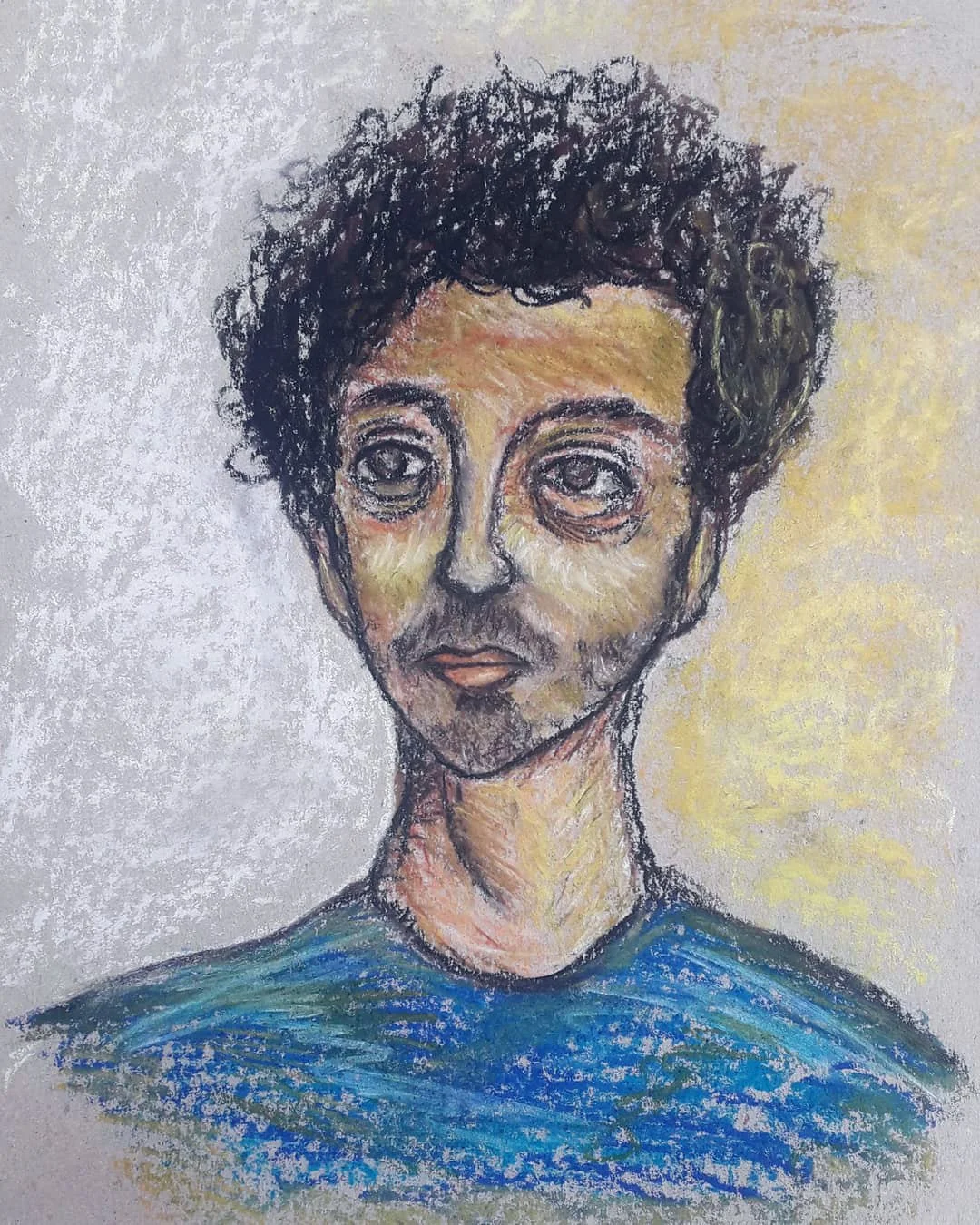
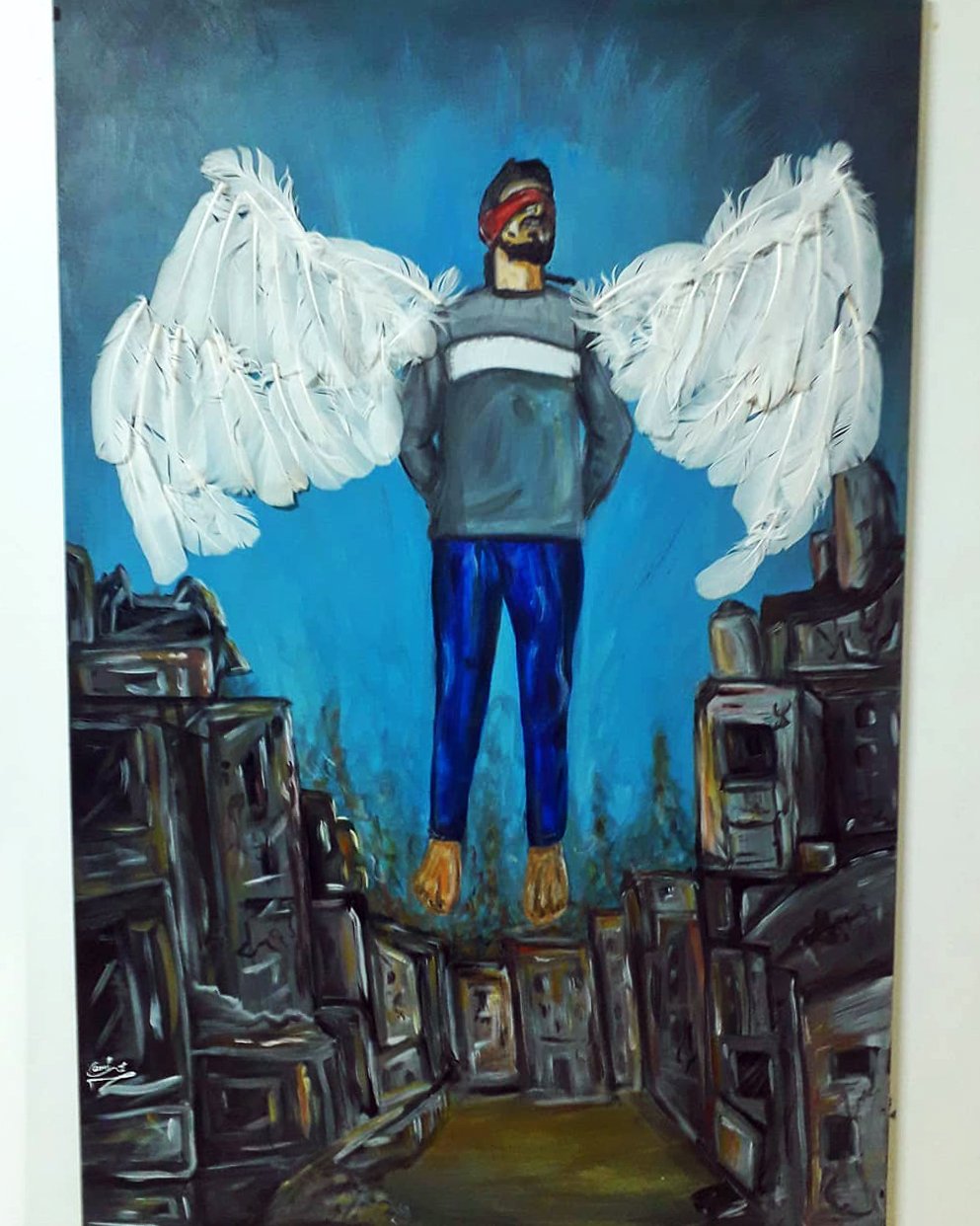
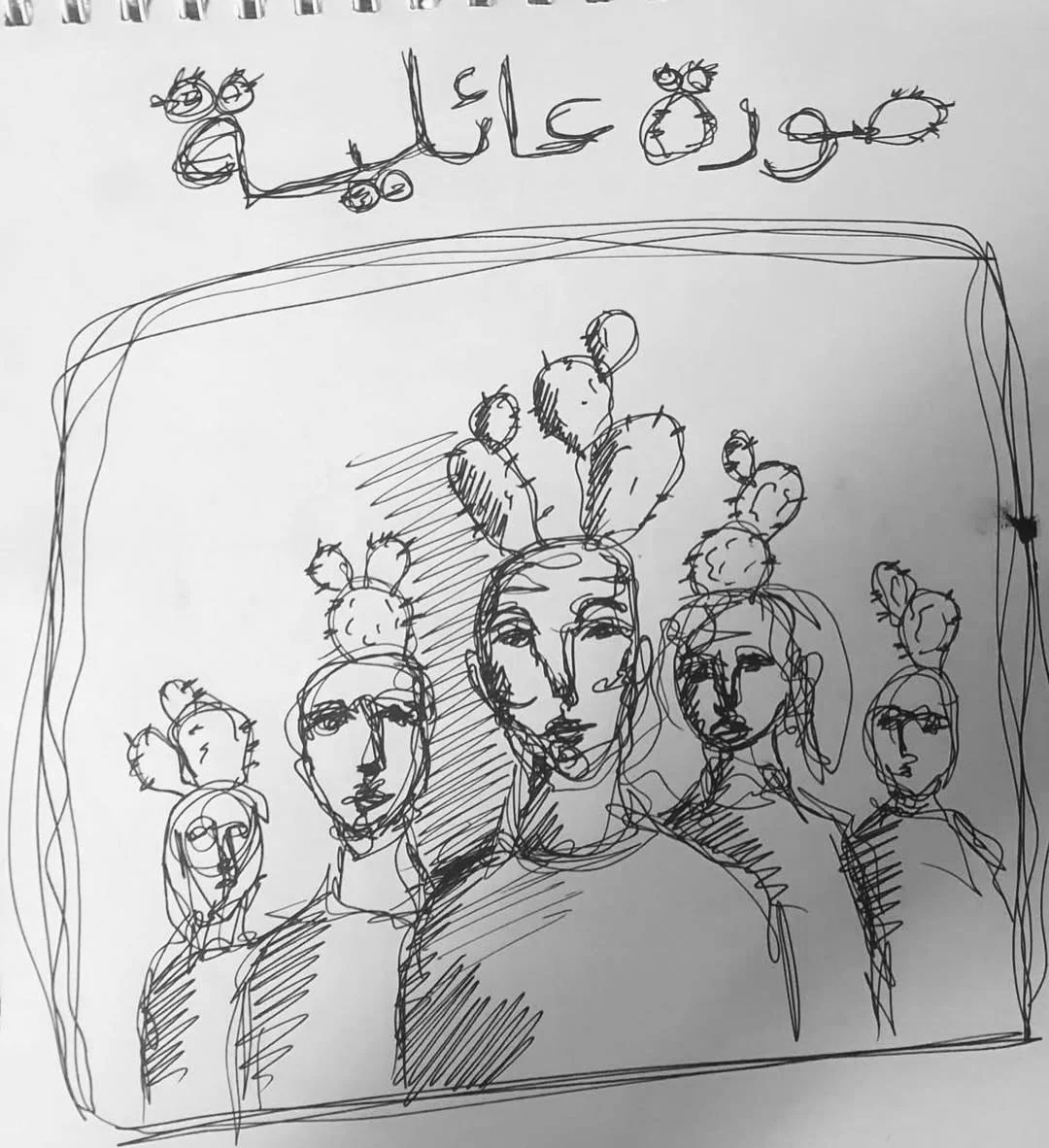
"Family Portrait"
This phrase was the title of my brother Mohammed's last artwork. He drew it on his personal notebook within the walls of the hospital before his life was taken and robbed by the ruthless Israeli occupation, shattering the family's hope of being reunited with him again.
🕊️May his soul rest in peace
" صورة عائلية "
كانت هذه العبارة عنوان اللوحة الأخيرة لأخي محمد ،
حيث قام برسمها على دفتره الخاص داخل اسوار المستشفى قبل قتله وسلب حياته على يد الاحتلال الإسرائيلي الغاشم محطما بذلك أمل العائلة في ان تجتمع به مرة اخرى .
لروحه السلام 🕊️🕊️
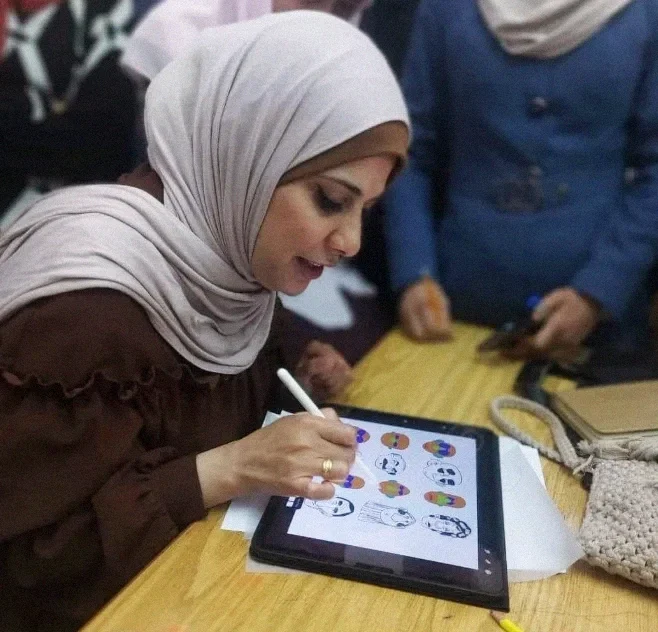
Nesma Abu Sha’ira
October 2023
At the age of 36-years-old, Nesma Abu Shaira was an artist, lecturer, and educator.
She attended Al-Aqsa University for undergrad and grad school. While she was at university, she worked with fellow students to create a satirical magazine titled “Barm” (chatter), which they published to highlight everyday life in Gaza.
After graduating, Nesma soon became a teacher of fine arts and graphic design at the school. In particular, one area she wanted to introduce was illustration, which wasn’t common in Gaza schools, to the art curriculum. Eventually, she became the Head of the Visual Arts Department
Nesma was also a mother. After getting married to the artist Mohammad Sha‘ban, they had two daughters.
However, she was martyred on October 28, 2023, as a result of an IOF strike on her family home in Gaza City.
Before this tragic attack, she was reportedly in the middle of creating illustrations for a children’s book and working on a series of artworks around her perspective on documenting Palestine.
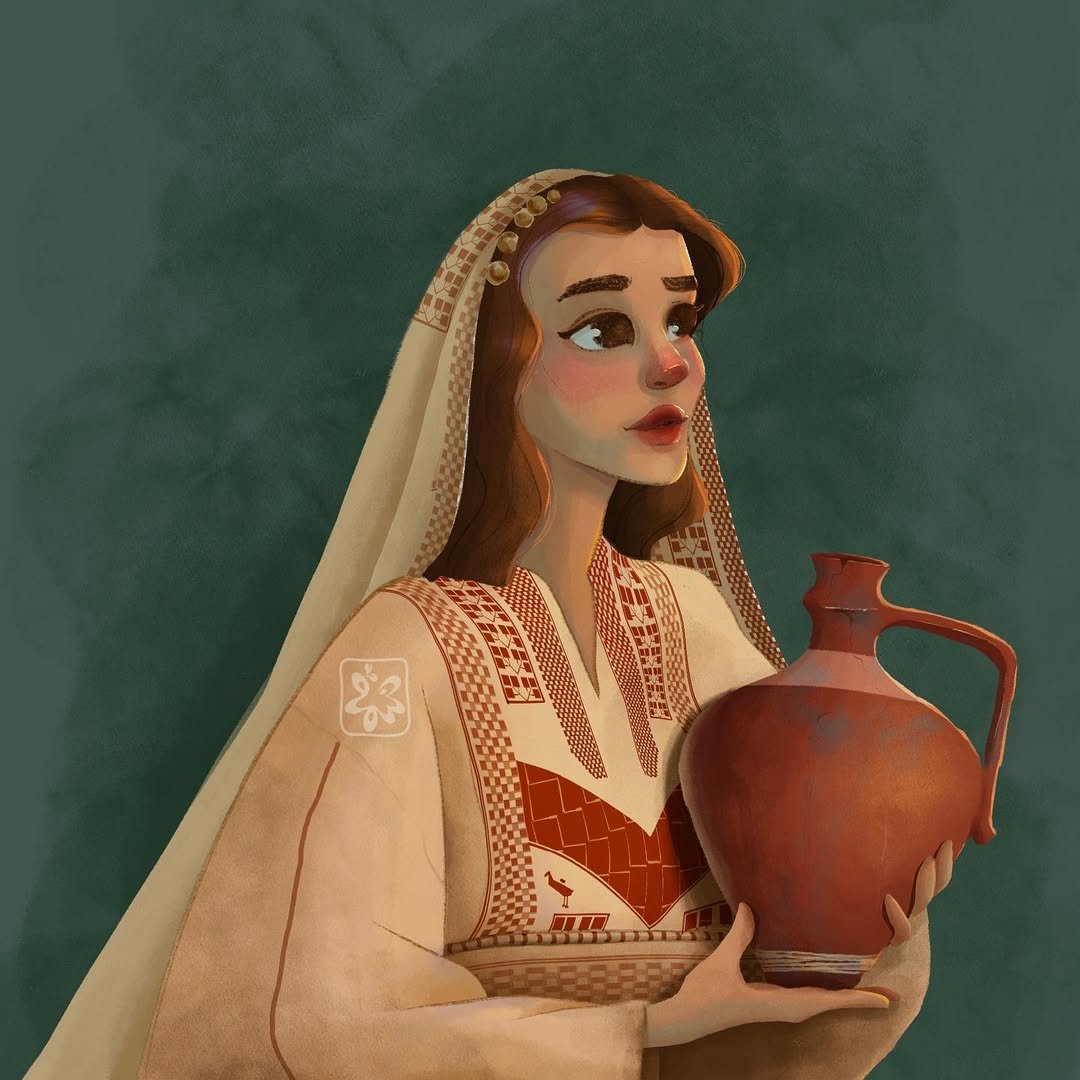
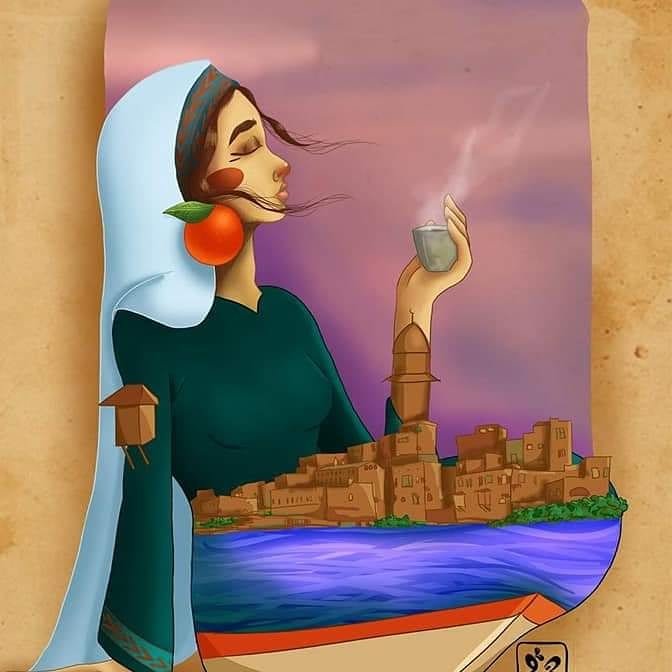
After her martyrdom, one of her students wrote:
"My beloved teacher, Nesma Abu Sha'ira, or as we always called her, 'Miss Nesma.' She had a tender heart and a beautiful gentle influence. She used to be my lecturer in the College of Fine Arts, excelling in her field. I considered her my role model and regarded her as my favorite artist.
I always used to share art, love, and warm, gentle words, never imagining that one day I would share my sorrow and exhausted emotions, and moments that I will never forget, like the departure of my teacher.
Our last encounter was during the discussion of my graduation project. The last thing she said to me then was, 'You, Zeinab, are like the moon. You disappear and then return, dazzling everyone with your magnificent presence, talent, and beauty.' I will never forget the sparkle in her eyes and her pride at that moment.
It breaks my heart, truly, to lose you. We will never have another teacher like you!”
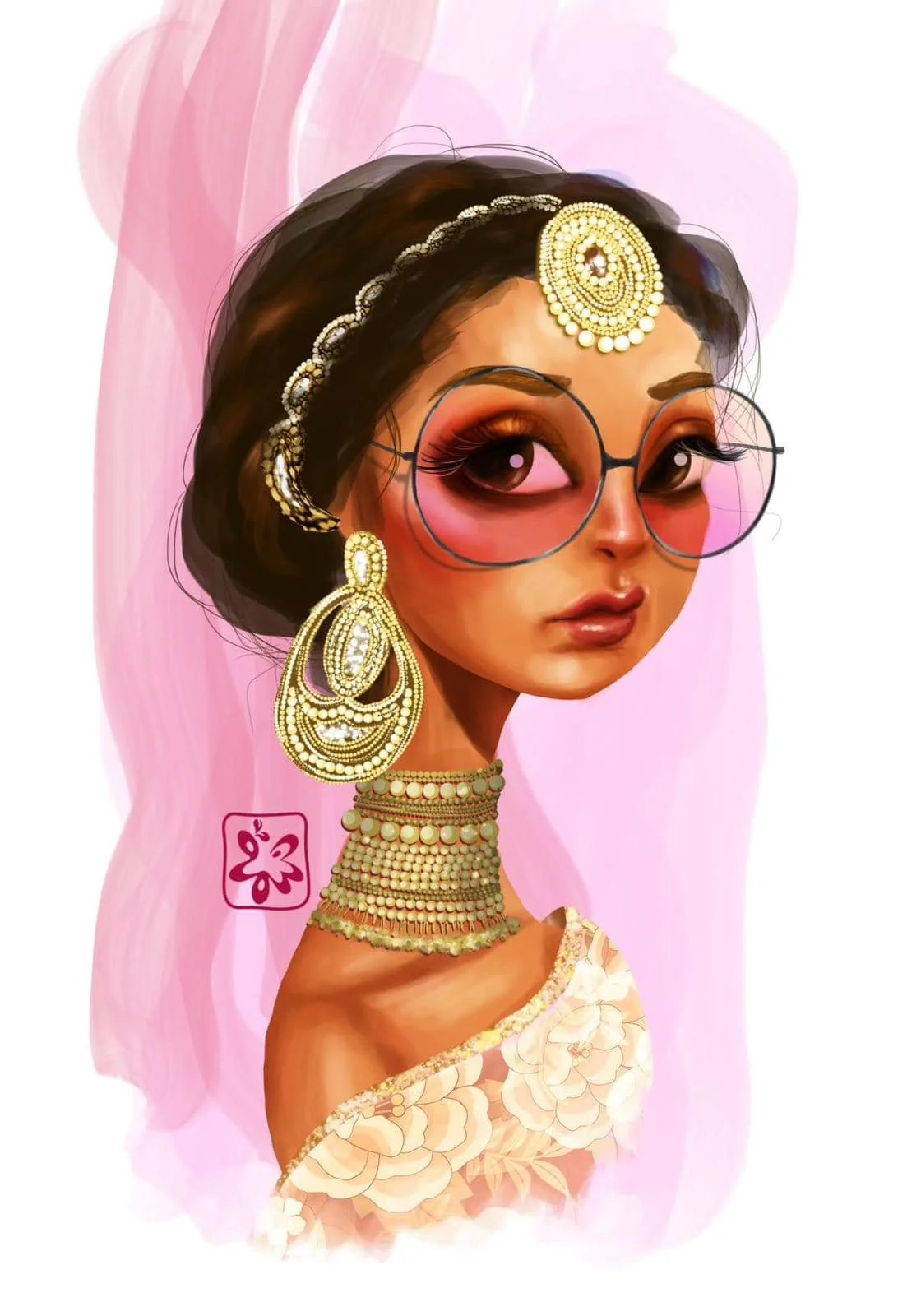
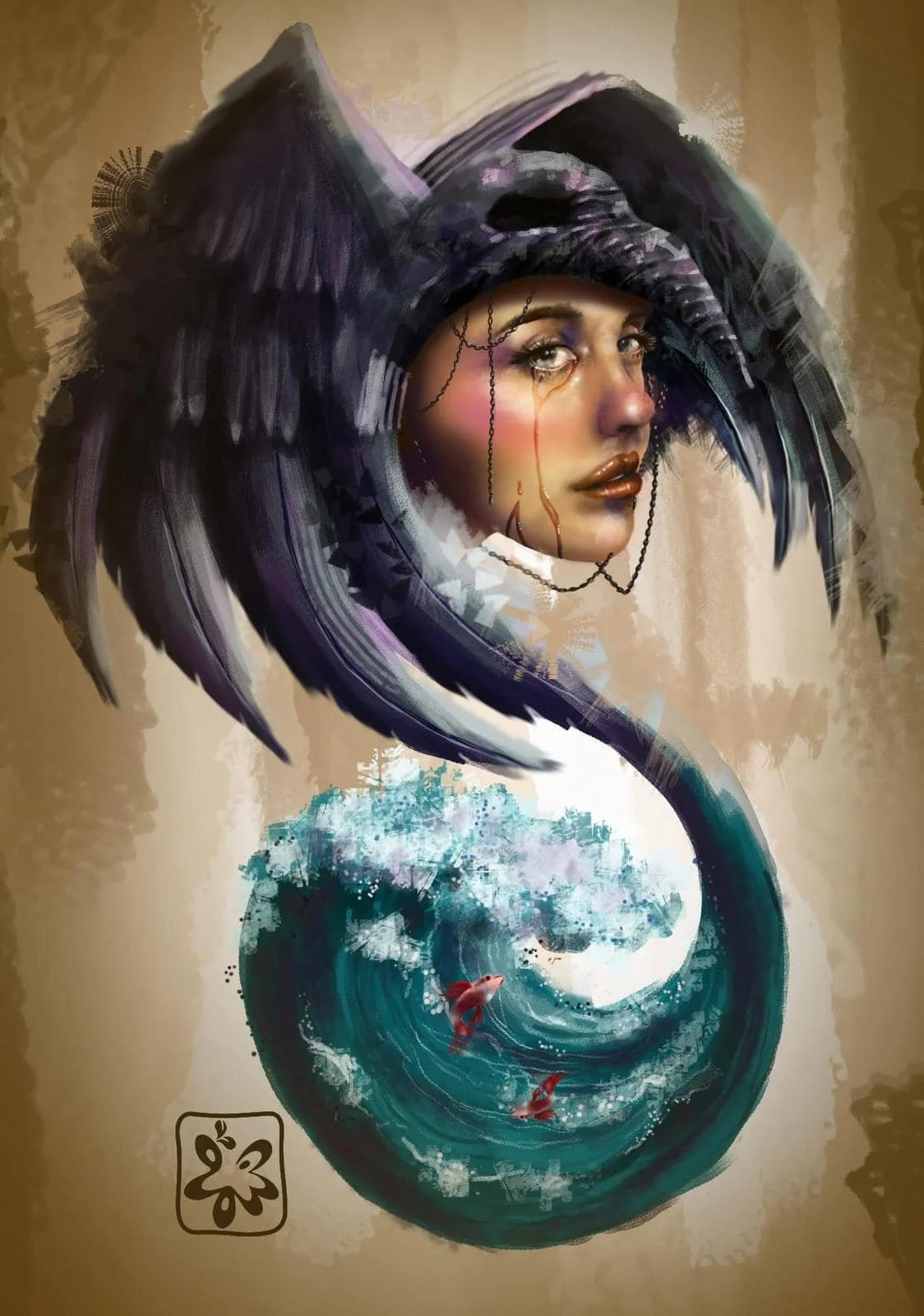

Photo Fathi Ghaben by Mike Abrahams
Fathi Ghaben
February 2024
There are many ways that the IOF imposed a genocide on the Palestinian people. Airstrikes and starvation may be two of the most used techniques, but another big one was the lack of medical supplies. The hospital infrastructure in Gaza, which was limited to begin with, got completely decimated since some of the initial attacks on Al Alhi Baptist Hospital and Al Shifa Hospital. Not only that, many people who have tried to evacuate for medical treatment were not able to do so.
This was the case with Fathi Ghaben, one of the most important artists in Palestinian history. He was having difficulties with his chest and lungs, making it difficult to breathe. His family had been displaced, with their home and his studio destroyed by airstrikes during the genocide.
Due to the shortage of medicines and oxygen, Fathi sought treatment in Egypt but needed permission from his "israeli" oppressors. He was getting some treatment at Al-Aqsa Martyrs Hospital in Deir Al-Balah, waiting to be able to leave, but the IOF never let him travel. As a result, he succumbed to his health difficulties on February 25, 2024.
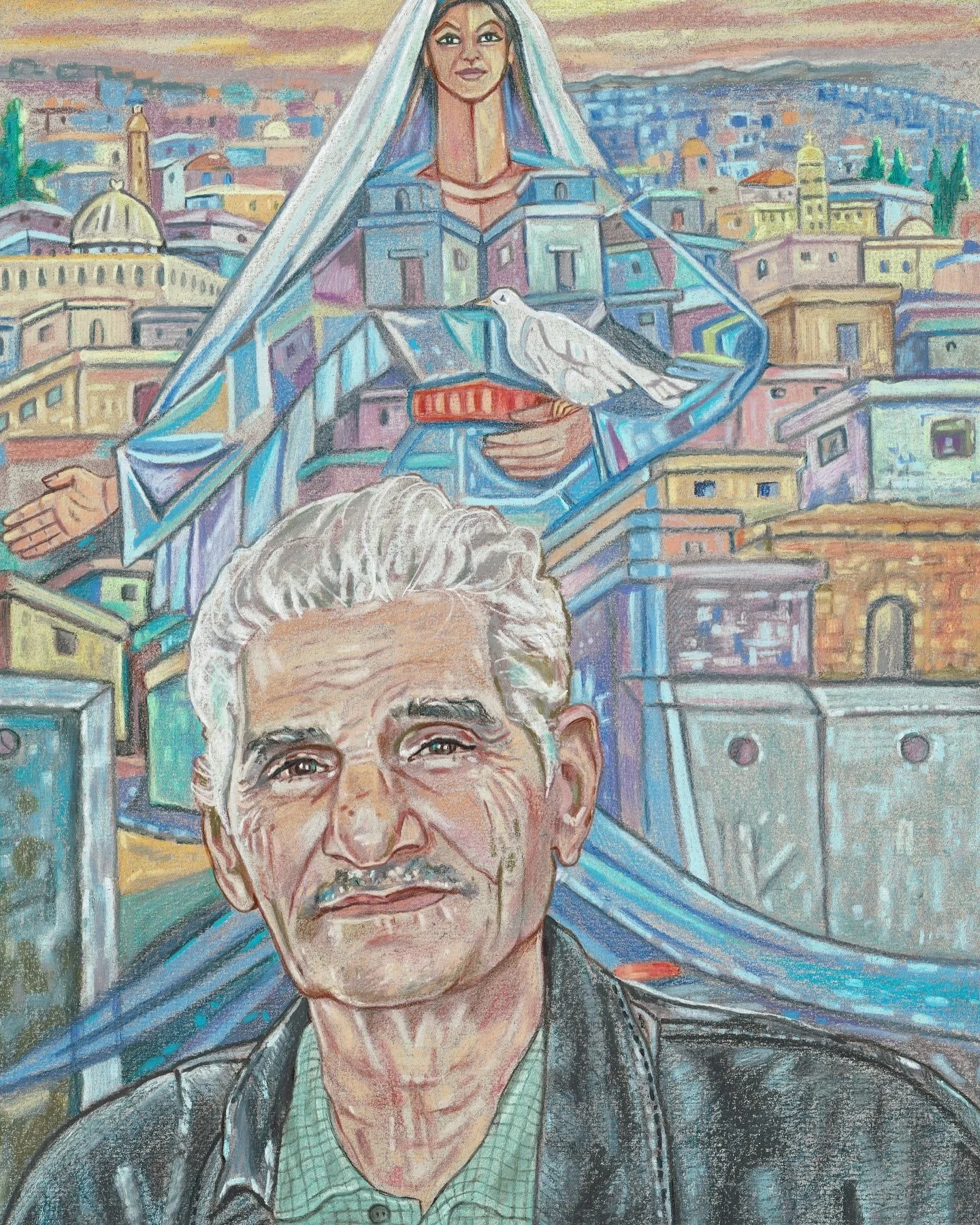
A tribute to Fathi Ghaben by Anne-Marie Farrell
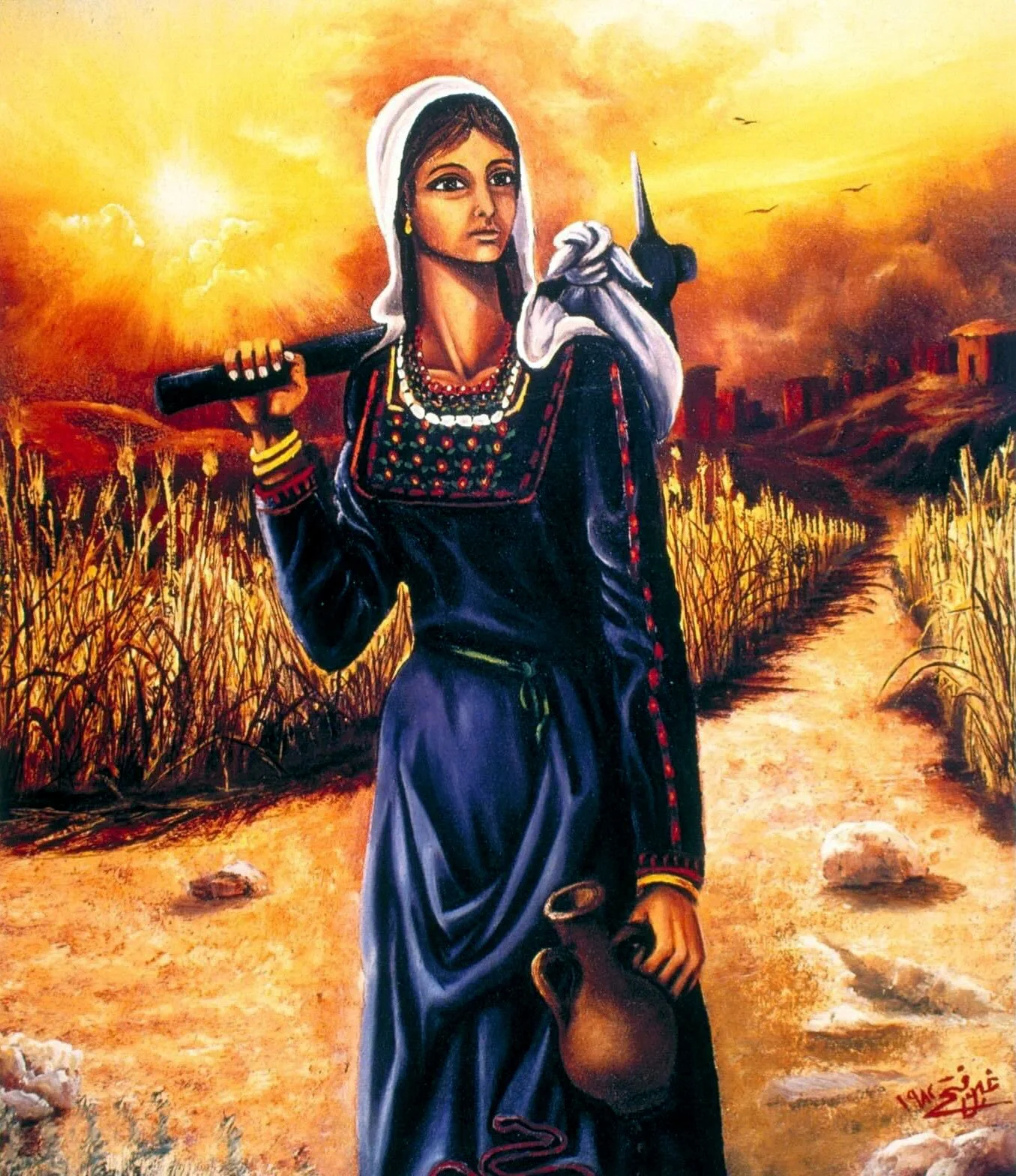
The Palestinian Ministry of Culture said his martyrdom was a great loss to Palestinian art as someone who had embodied all aspects of Palestinian life in his work: camps, the life of a refugee, and the traditions of the country that he immortalized in his work.
Fathi was born in 1947, the year of the UN Partition Plan, setting the tone for the rest of his life. He was born in the village of Harbiya, only to be displaced during the Nakba in 1948 and his mother carried him to the nearby Gaza strip. He grew up in Jabalia refugee camp and spent his life there.
Later, he said, "Life’s harsh conditions cut short my formal education in the sixth grade. That very year, I stepped into labor. Palestinian children are expected to act as men and provide for their families. Amid this, I practiced my hobby—painting... By nineteen, I was married and soon a father to eight."
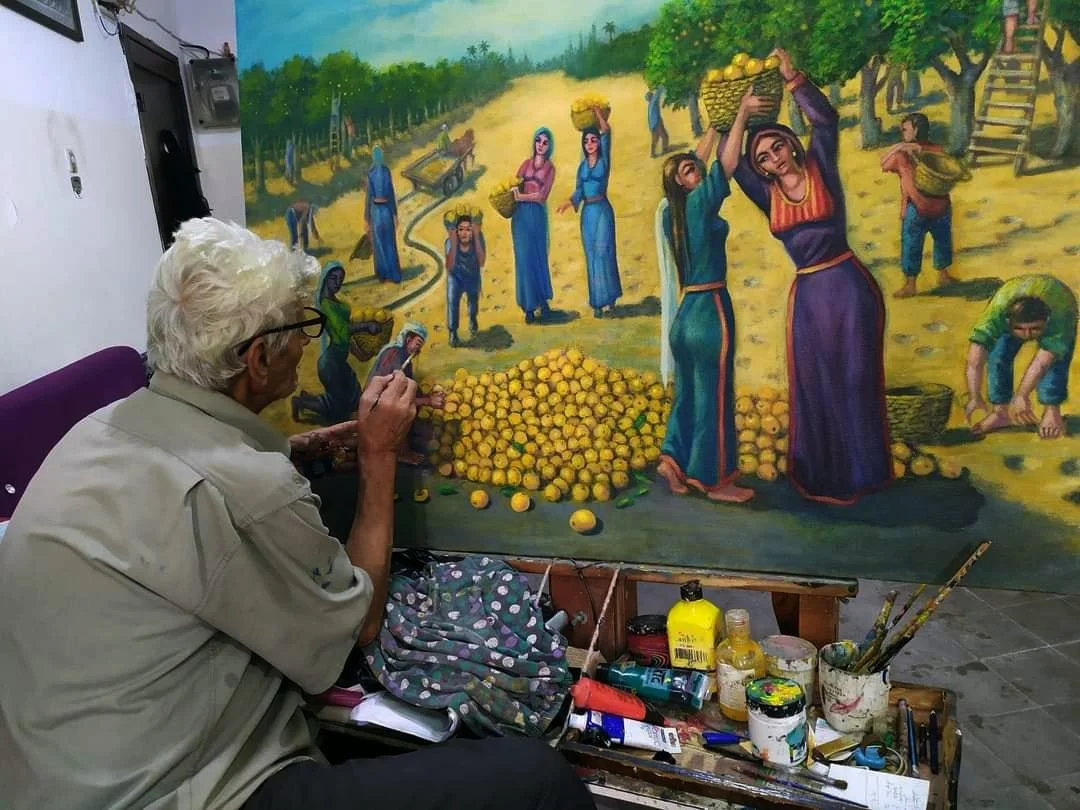
His path of work was selling newspapers and working in a citrus orchard. Even with this labor and all his kids, Fathi kept up his hobby of painting. He would often create his work for eight hours at a time, alongside his wife and the active play of his children. Eventually, art became his full-time job. He would also go on to become an art teacher later.
This time period was crucial for Palestinian art, as others like Ismail Shammout and Tamam Al-Akhal began to depict scenes of the Nakba and national symbology. However, while some had been exiled, Fathi had was living the post-Nakba reality in the Strip, now filled with a large influx of refugees after hundreds of villages across historic Palestine had been destroyed and depopulated.
In the 1970s, particularly after the 1967 Naksa, artists in Gaza and the West Bank started to get more organized. They worked together, including setting up makeshift exhibitions and forming DIY collectives.
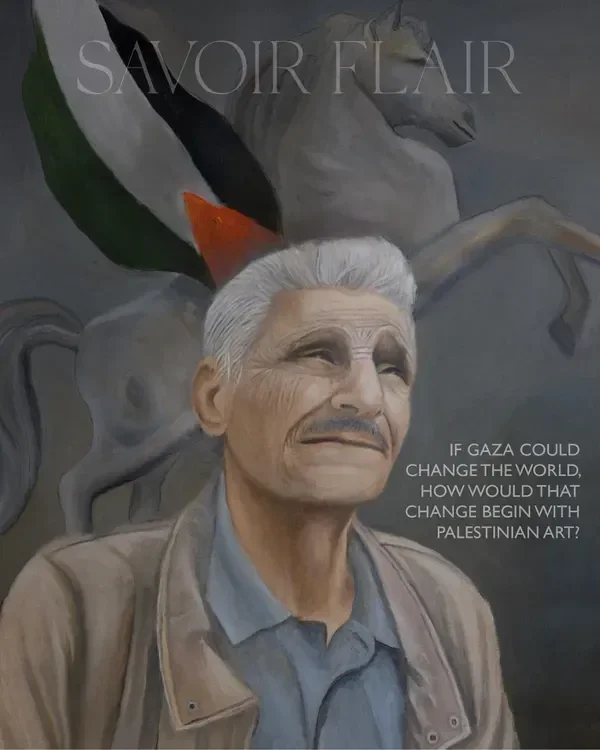
One of his fellow artists was Sliman Mansour, who is still living today. “He learned art by doing, and in the seventies and eighties of the last century, he became one of the most essential artists in Gaza through his expression in his paintings of nostalgia for Palestine before the Nakba and his drawings about identity and liberation" wrote Sliman after Fathi's martyrdom.
The work of artists at this time, often reproduced and distributed through posters, gained attention during as the 1970s went on and "israel" deemed this as a security threat. They started to close exhibitions, confiscate art, and threaten artists. This included then telling them to not paint the colors of the Palestinian flag – green, red, white, and black – under any circumstances. Even if it was just a watermelon. The flag itself had already been banned since 1967, but the colors alone came into a ban in 1980 (and would stay until the Oslo Accords in the '90s).
When the IOF martyred the nephew of Fathi in the early 1980s, he made the decision to paint the boy wrapped up in the Palestinian flag. The artwork went on display at Ghaben’s exhibit in 1984, where the show was abruptly closed. The painting of his nephew, along with six other works, were permanently confiscated. The "israeli" military court found him guilty of breaking their color ban law and claimed his painting created incitement.
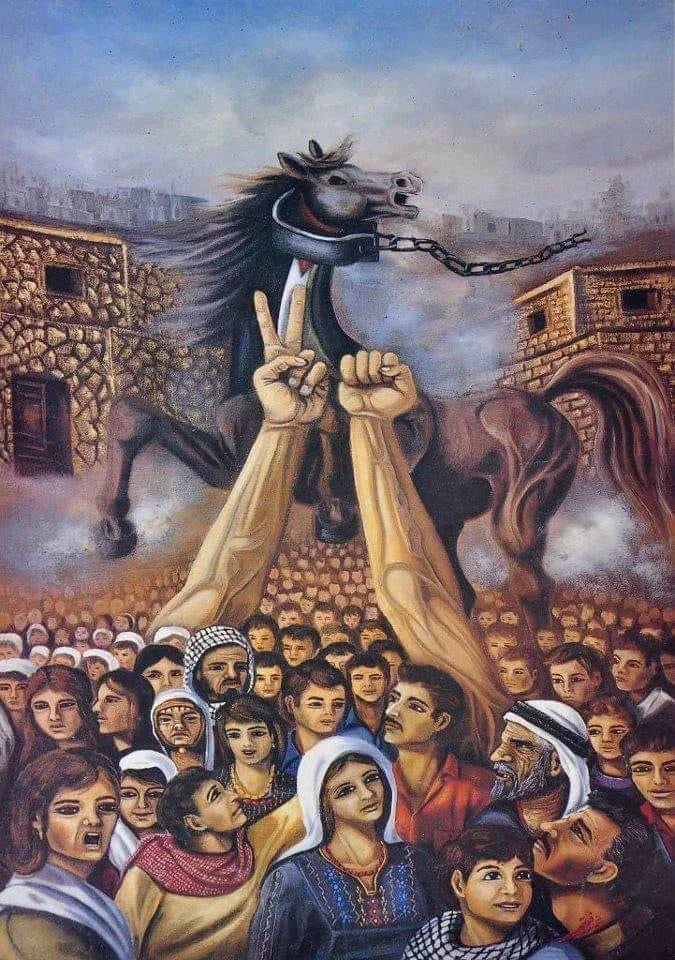
Fathi was imprisoned for several months as a result. After getting released, he is said to have painted the image of a mass demonstration and two arms rising into the air, along with a broken chain, and a horse with a subtle Palestine flag on its neck. Overall, he would be jailed three times during his life.
“I never created artwork to make PR for myself. I consider myself a bright light, a burning candle, regarding the struggle of the Palestinian people. I yearn to express myself through my art and I want the viewer to know that my paintings reflect my soul, a mental, social and deep national ocean of passion and compassion. My paintings are not filled with smiles; they are not loud, flashy or without a deep thought. I draw the national Palestinian issues and the reality of the Palestinian struggle…
Being a sensitive artist soul, I believe the colors appropriate for our life in Jabalia and the individual perception of them are the warm, dark and earthly colors – with a grasp of hope, maybe half of that dark brown, dark blue, but with orange, yellow and a mixture of white and yellow, these light colors reflect glimpses of hope in this hell on earth.”
After a lifetime of work, his legacy in Palestinian art is undeniable.
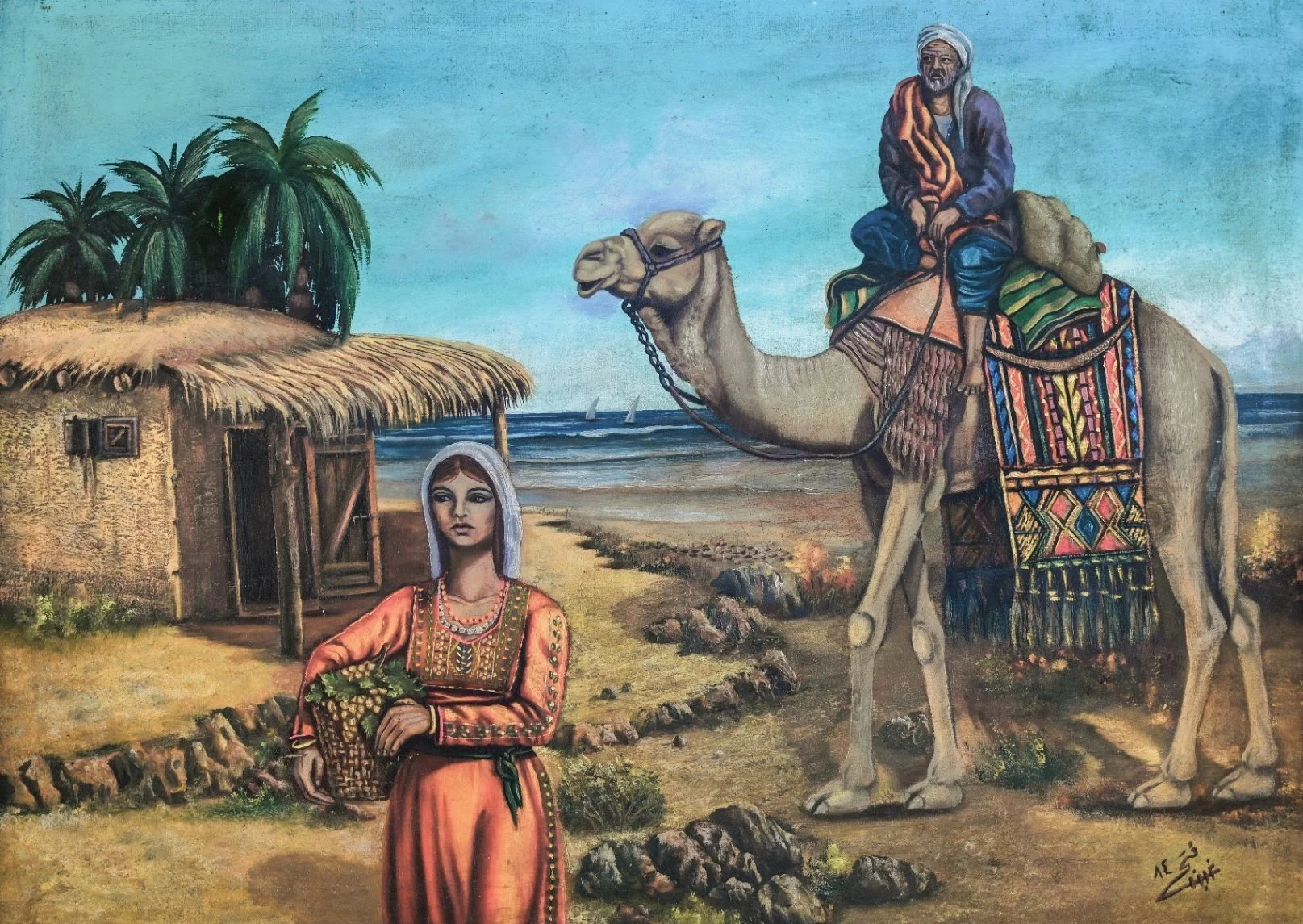
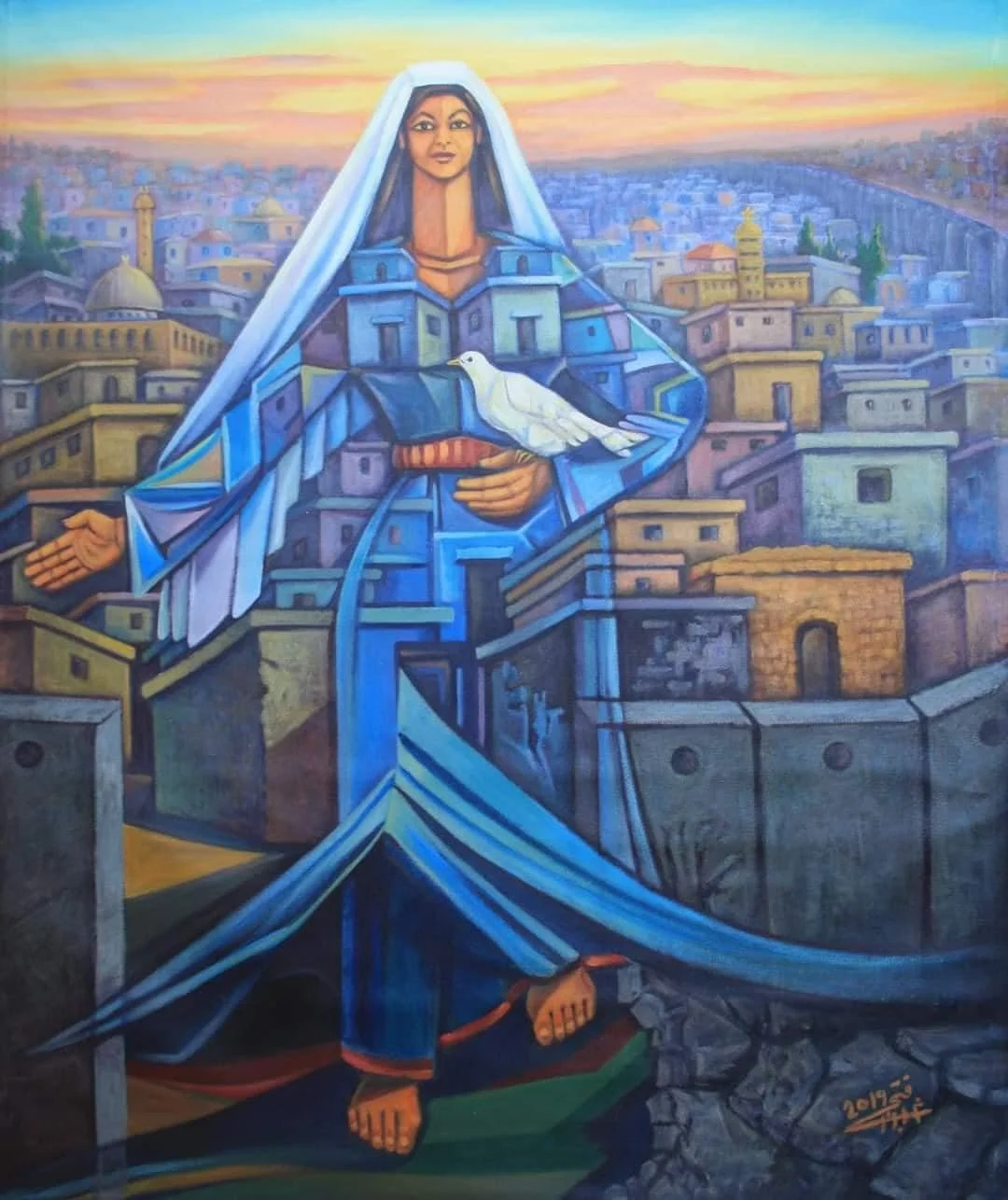
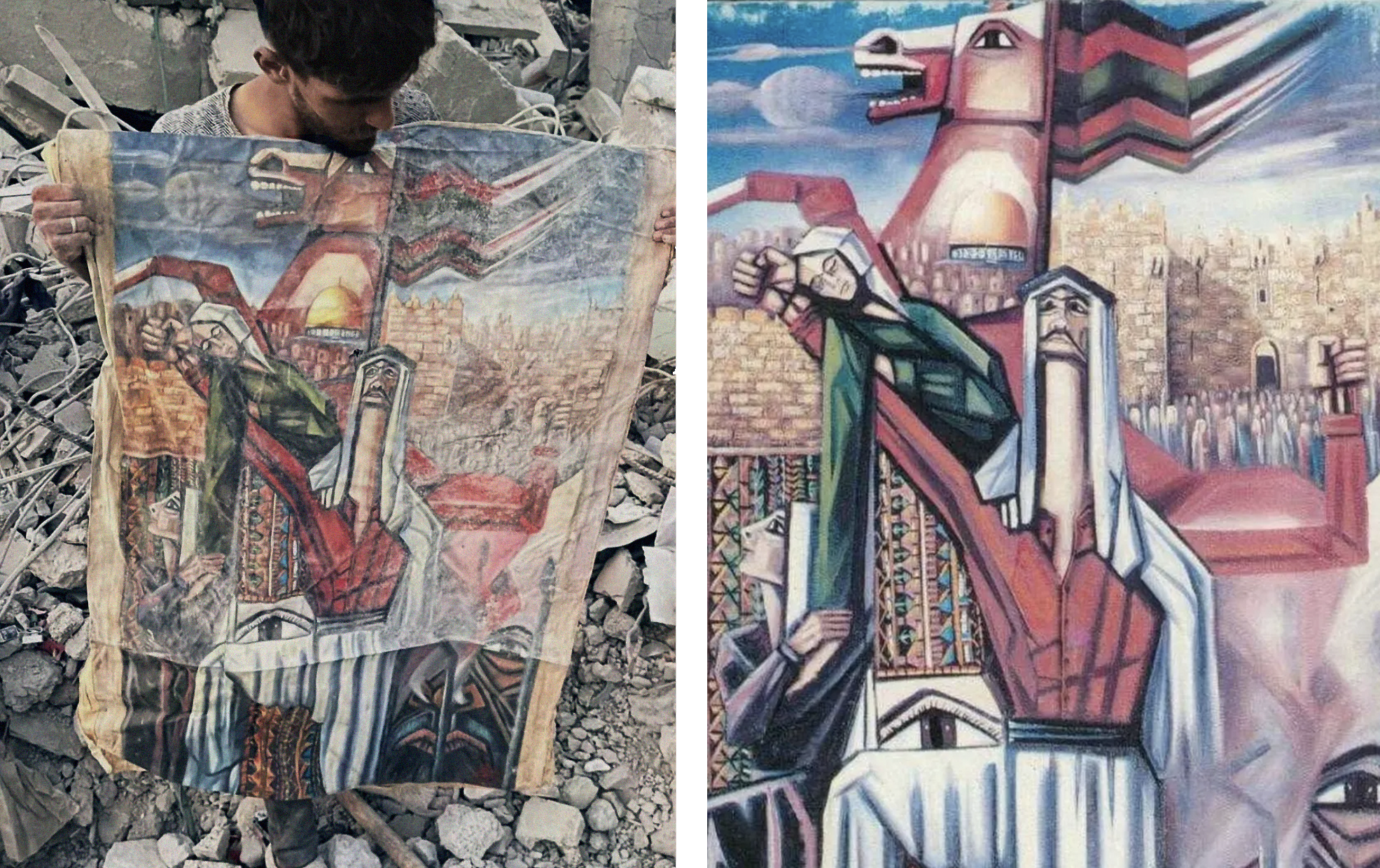
Identity, oil on canvas (1980)
45 years later, it emerged from the rubble in Gaza in 2024
Photo from his remaining sons, who run the @artist.fathi.ghaben_47 page
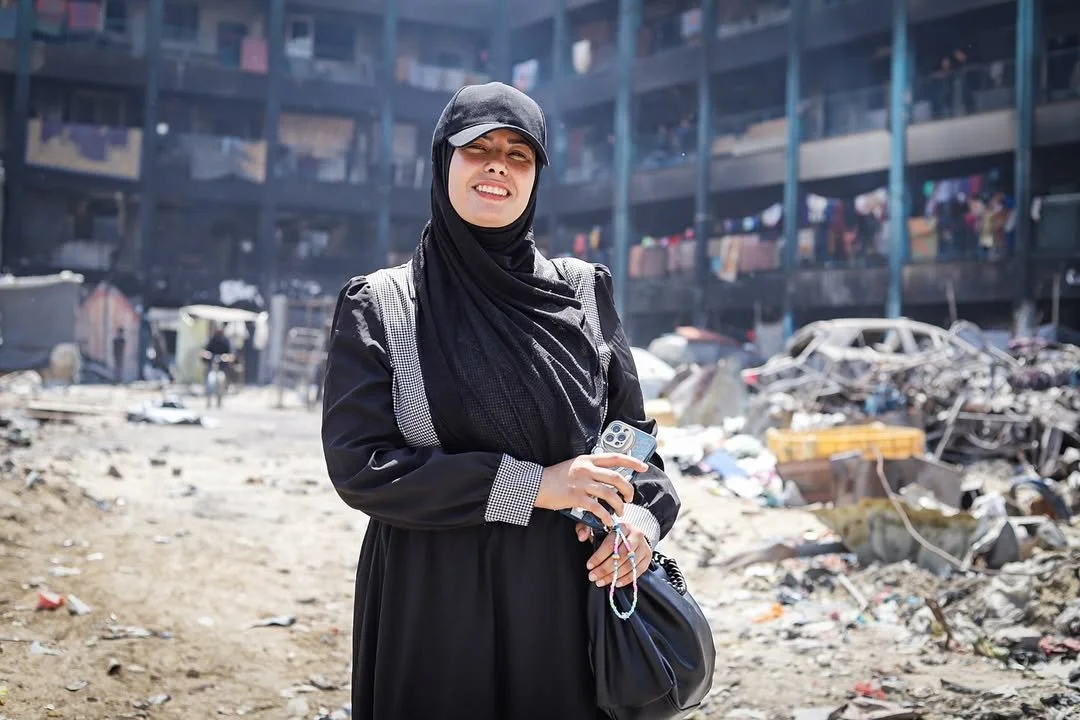
Photo of Mahasen al-Khatib by Fatma Hassouna
Mahasen Al-Khatib
October 2024
On October 14, 2024, an IOF airstrike hit the courtyard of Al-Aqsa Martyrs Hospital and a fire broke out as a result. Engulfed in flames was 19-year-old engineering student Sha'ban Al-Dalou, who reached out his arm amongst the flames in his final breaths.
The image of Sha'ban, captured from afar by journalist Saleh Aljafarawi, went viral and sparked outrage from around the world. It became one of the defining visuals from the genocide.
Digital illustrator Mahasen Al-Khatib, who often drew photos of people, created her own interpretation of the scene. At the top, she wrote "WE ARE BURNING" in all caps, with the letters resembling embers of fire.
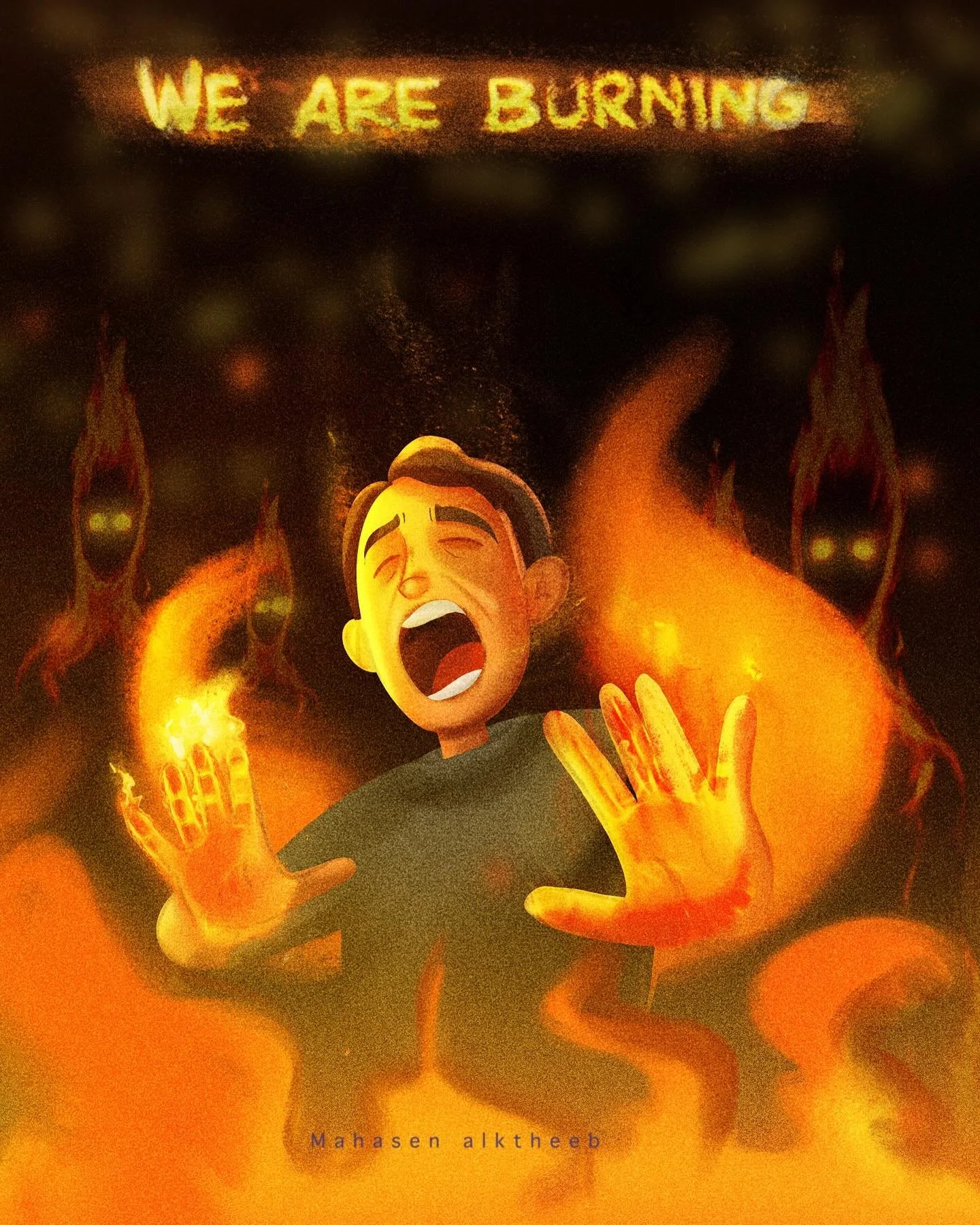
She posted twice on October 18 – one of the illustration as a static artwork, the other a reel showing her process of drawing. In the latter video, she expressed anger and sadness at how nobody can help people burning.
That same day, only hours later, Mahasen was martyred with the rest of her family when the IOF unleashed several airstrikes on Jabalia camp.
Mahasen was from Gaza City and studied locally at The Islamic University of Gaza, where she studied math. Khaled Jadara, a Palestinian visual artist and friend of Mahasen, told The Art Newspaper that there were no institutions offering digital art courses, so instead she taught herself how to design characters and watched YouTube tutorials to learn any software needed. They worked together to troubleshoot any issues on their own, often trading tips and consulting each other on techniques and methods.
After, she found success as a working freelance artist for over a decade. Mahasen did graphic design, illustration, storyboarding, motion graphics, and character design for other Arab countries in particular. “She was super nice, friendly, very hard-working, talkative and always laughing,” Jadara told The Art Newspaper.
In addition to her professional work, she set up courses to teach digital art to others in Gaza. And only two weeks before October 7, she had invested her life savings into opening a private art studio.
During the genocide, her family's home and her studio was destroyed, along with her art supplies, and they were displaced multiple times. They also then faced personal losses as Mahasen's father became a martyr, leaving her to become the main provider.
At 32-years-old, she continued to make work connected to what was happening around her. “In this tough situation, I am a digital artist finding solace and resilience through my art … pixels and colors,” she said. But she also expressed wanting to just go back to what she knew as normal, go back to being able to draw, to be able to work and support herself.
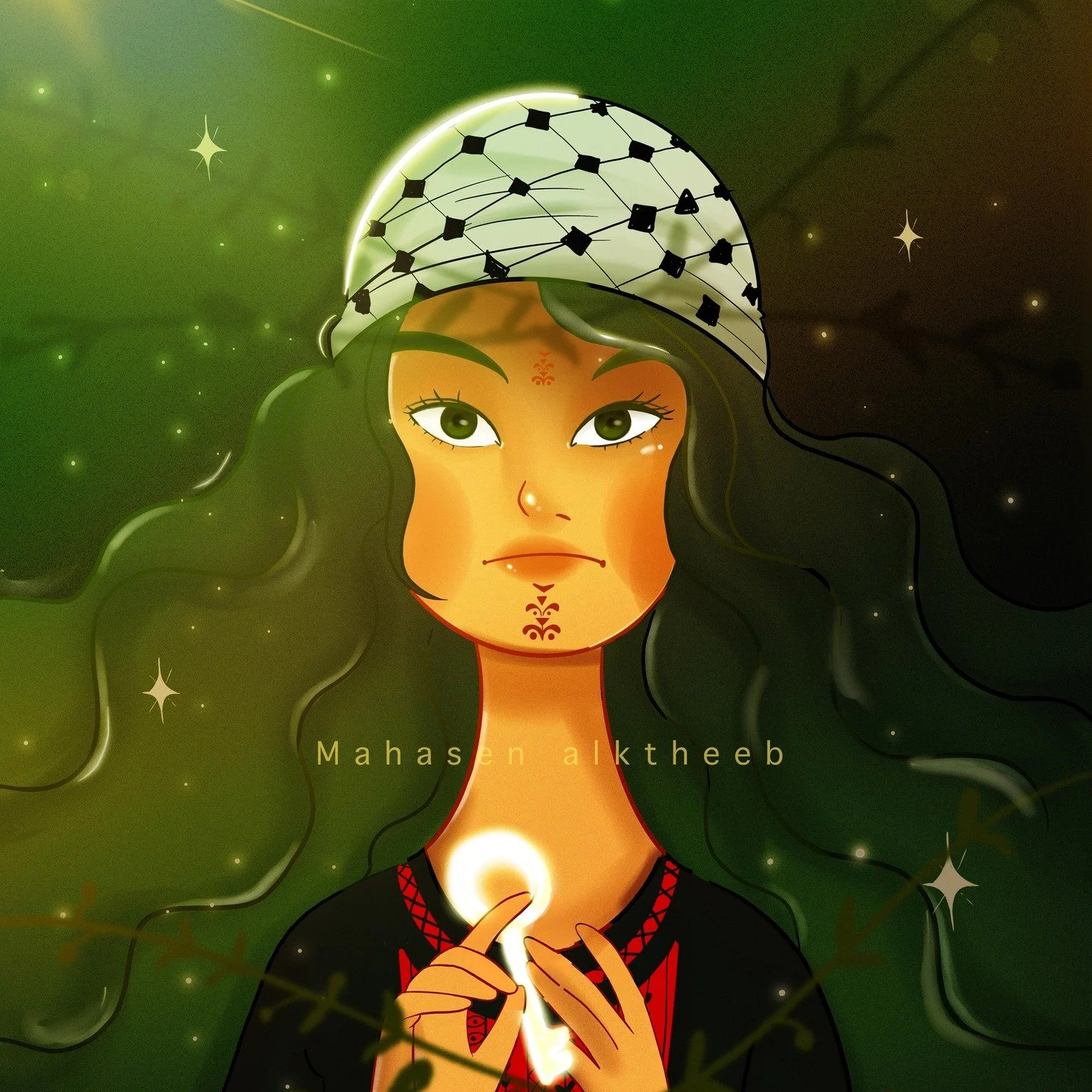
Mahasen garnered a large following on social media during the genocide, documenting both positive and difficult moments. Besides posting, she was active in other ways. For one, she arranged free in-person mentoring for young kids, as well as digital lessons to teach others, despite her own need for help.
She also re-connected with some of her freelance clients and worked on projects for them. Given the digital nature of her work, the lack of electricity available made her process more complicated. At first, she would seek out the limited places to charge for a few hours at a time, giving her just enough time to do some more work. Eventually, she saved enough money aside to get her own mini solar power system to give her electricity.
Mahasen expressed repeatedly in her posts the difficulty of trying to just survive with her family while trying to balance professional work. "I try very hard to work under all the bombing, all the abandonment and all the fear. And the feeling of death every moment," she said in one post. “Work is the best way to escape. Being busy and focused on a project is enough to make you forget hunger,” she wrote in another.
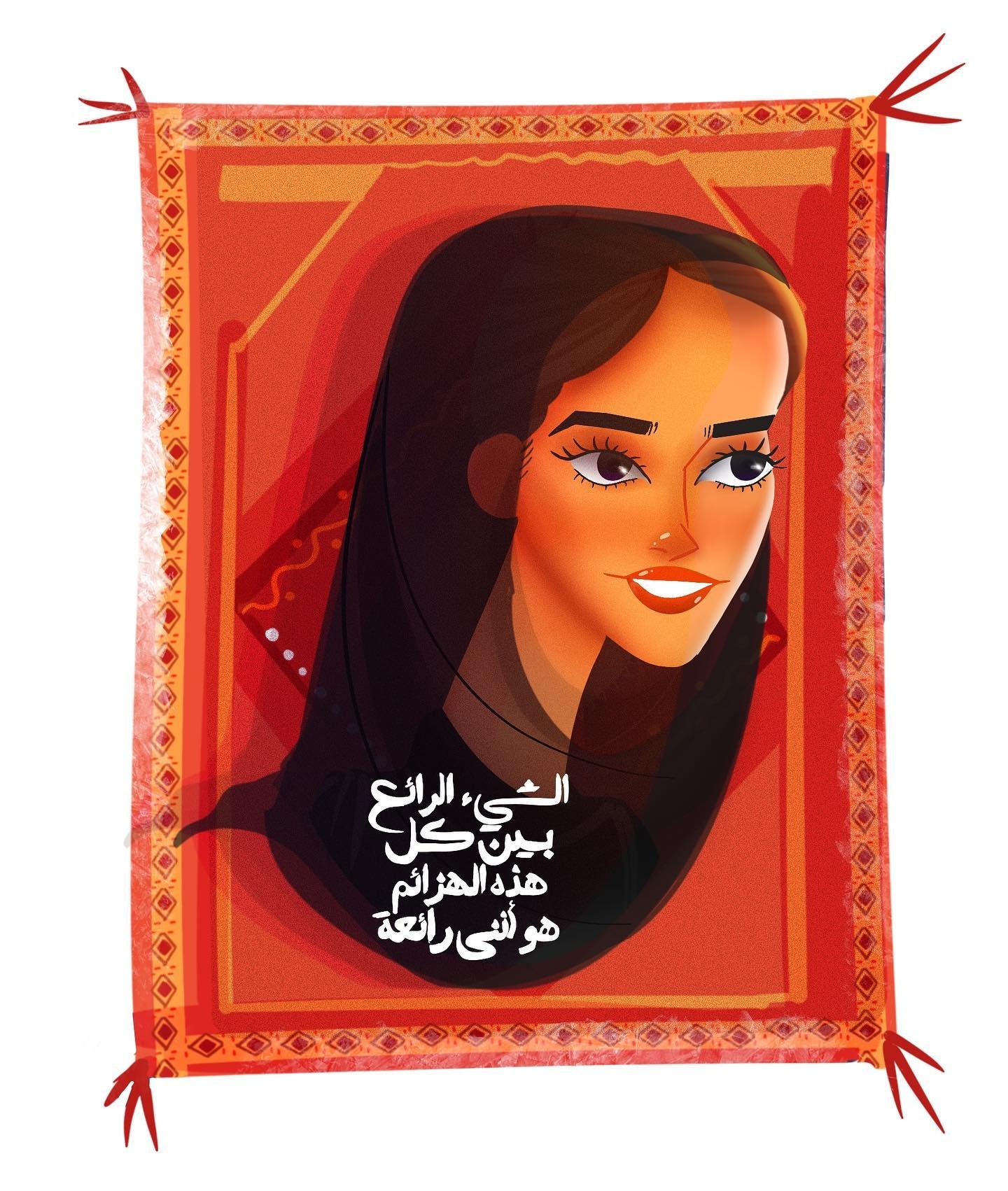
However, in one memorable instance for example, Mahasen's circumstances overlapped with her assignment. “Of course, you know about the famine and deprivation we’re facing here. Desserts, especially cookies, are delicious, but we can’t make them due to high prices and lack of ingredients," she wrote. "Today, I came across a work request to draw cookies. Imagine my feelings. I drew them exactly as I desired—cookies with chocolate chips. Thank God, always.”
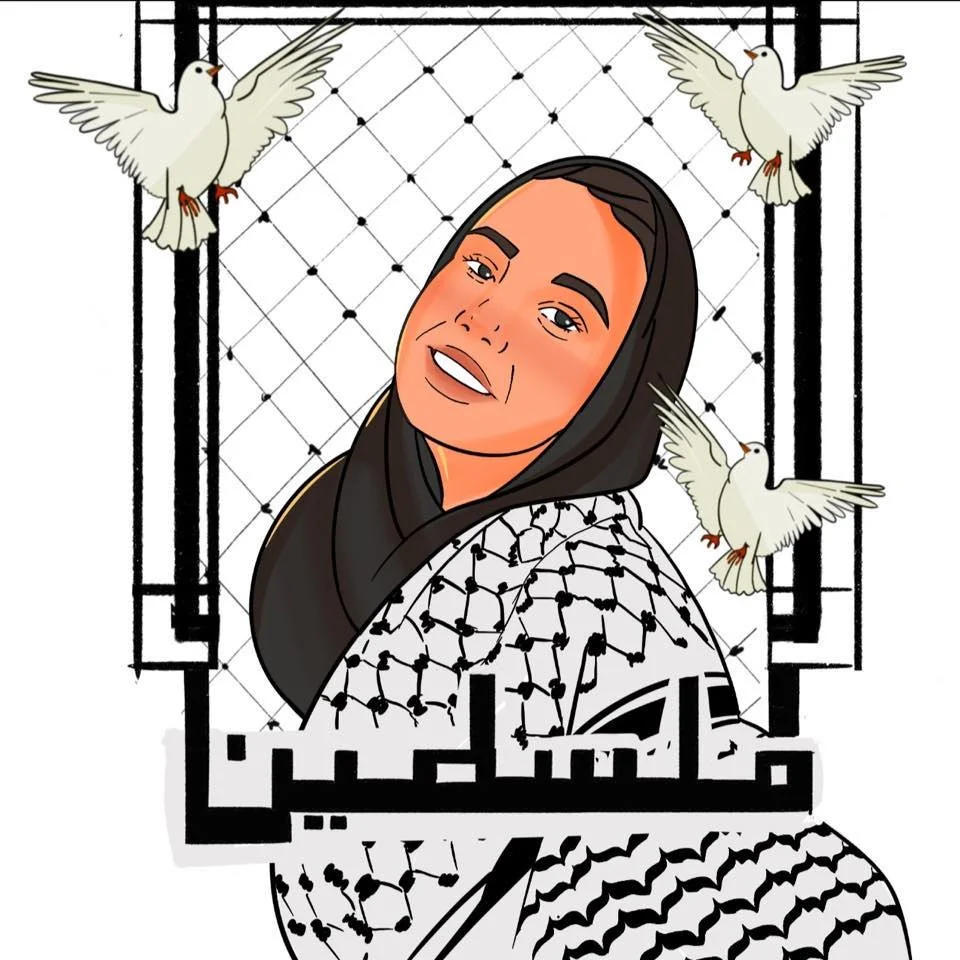
Illustration of Mahasen, drawn by herself
She persisted, but also knew anyone could be targeted at any moment. In January 2024, Mahasen made a post of Facebook with a photo she asked to be used if she were to be martyred. And a week before the airstrikes that took her life, she said, "Wherever you are, death will catch up with you."
“Holding my broken iPad and pen… drawing from where I am. I try not to be afraid, not to be nervous. I try to focus, but I fail. I am scared and anxious. I feel like a helpless person waiting for the moment to die or hear news of the death of a loved one,” Mahasen wrote. Another time, she commented how the circumstances hadn't destroyed the beauty of her drawings but instead increased her strength and determination. And for that resilience, the IOF wanted her and her art erased.
In an interview with Gaza Sky Geeks published five days before her martyrdom, she was asked if she had a message for her fellow artists. "Don't stop, no matter how dark it gets. Do what you can, for everything your hands touch will turn into hope, something miraculous born from the ashes. The first step is the hardest, but it is also the beginning of salvation. Amidst this devastation, we are the ones who create beauty, we are the ones who will redraw life."
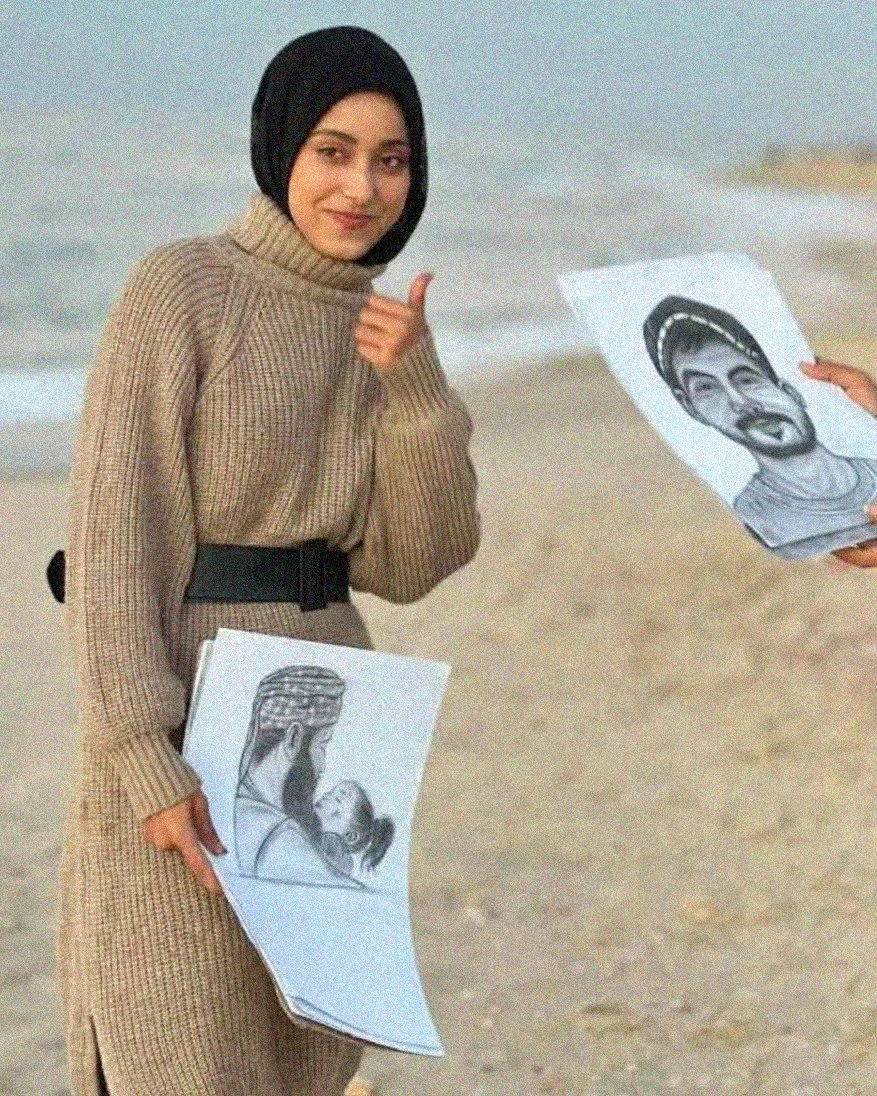
Photo of Dina, photographer unknown
Dina Zaurub
April 2025
While artists around the world in solidarity have made art as tributes to the martyrs of Gaza, those who lived there also took on the task. The person who became most known for this was Dina Khaled Zaurub, a 22-year-old artist in the Gaza strip.
Dina had been a recognized artist for at least a decade. In 2015, she won an award for the best drawing on children’s rights in armed conflict, given out by Al Mezan Center for Human Rights (which is based in Jabalia). She was also later recognized by UNRWA and the Ministry of Education for her work.
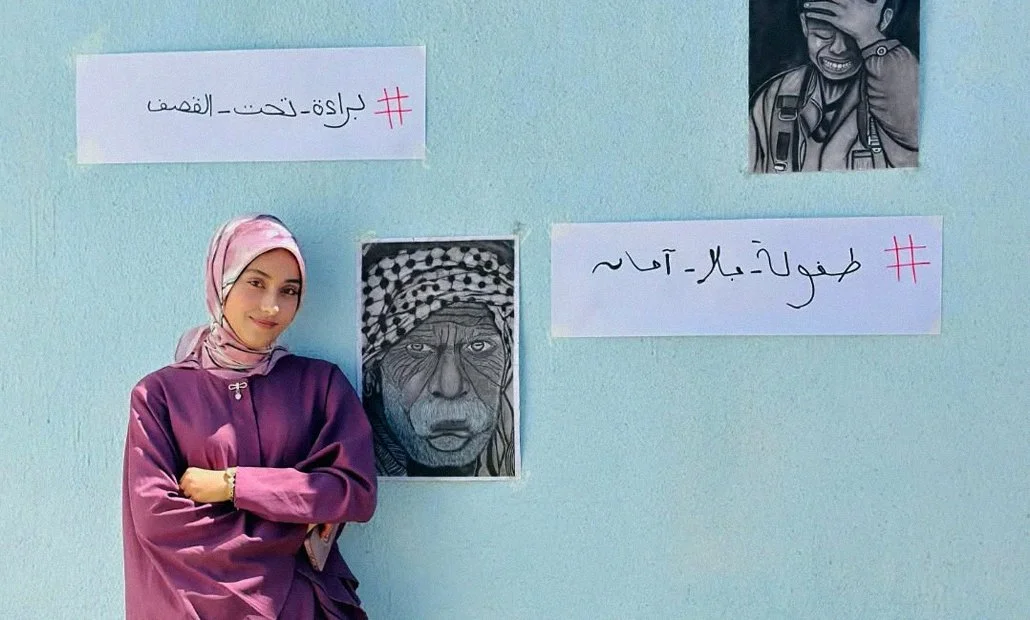
In her pieces, she focused on people. Over the genocide, Dina made an array of portraits of martyrs, honoring those whose lives were taken. These drawings were seemingly done mostly in black and white, using simple materials such as charcoal, likely for necessity from what was available.
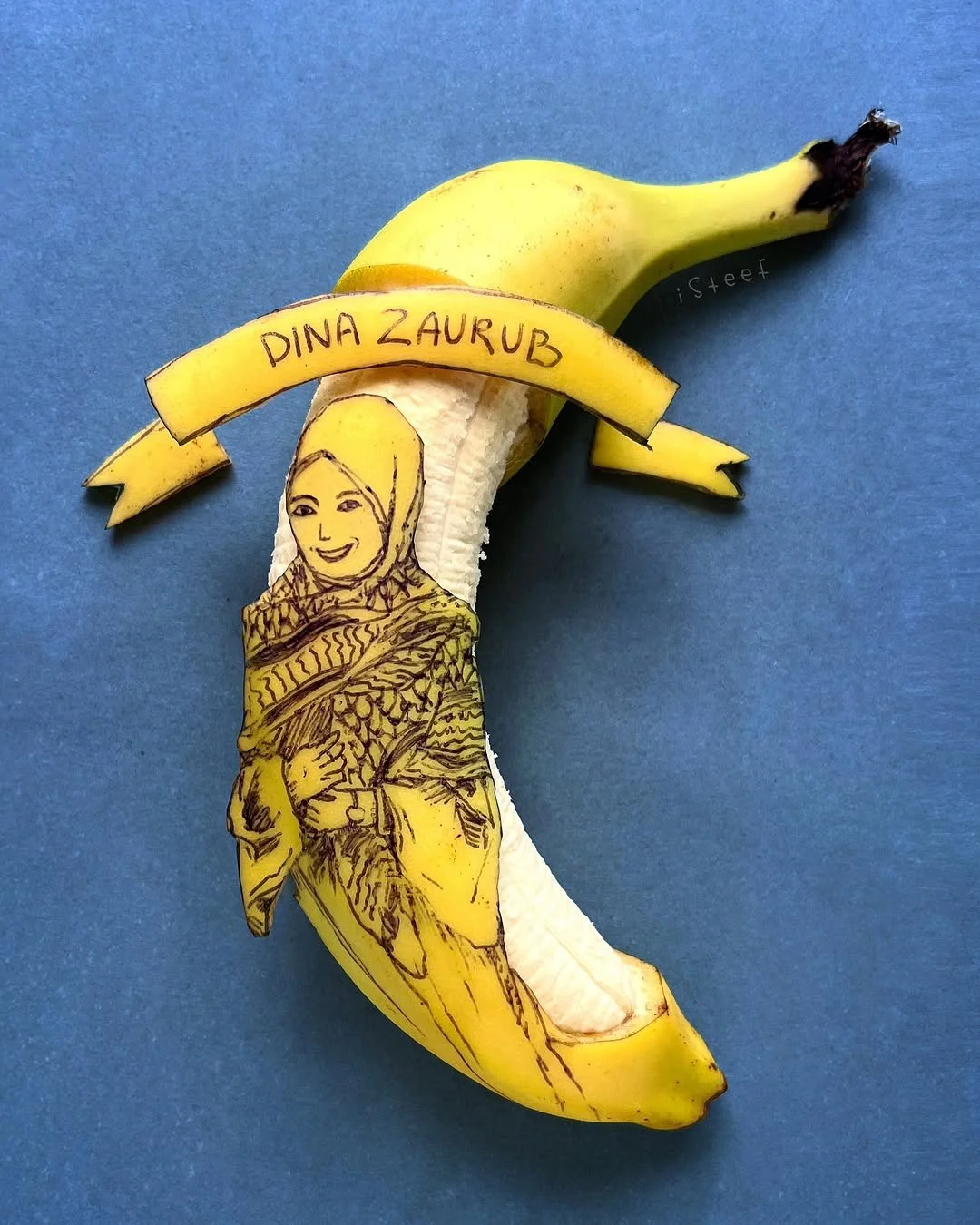
Tribute to Dina Zaurub by Stephan Brusche (isteef)
One of those martyrs was her friend and journalist Ahmad Abu Al-Roos, who was martyred hours before the January 2025 temporary ceasefire. Dina shared online about his loss, noting:
الله يرحمك ي أحمد كنت خير صديق يشهد الله كنت دائمآ تحكيلي هشوفك احلى رسامه طالعه من غزة هيك رحت ي أحمد قبل ما أحقق حلمي والله بدري ي صديق"
May God have mercy on you, Ahmed. You were the best friend. God is my witness. You always used to tell me,'“I will see you, the best artist from Gaza.' That’s how you left, Ahmed, before I achieved my dream. By God, it was too early, my friend."
Dina and her family were originally from Rafah and were displaced multiple times, eventually living in Khan Yunis in a tent. At one point during the genocide, she wrote:
بنحاول نرقع ونعمل شبه بيوتنا عشان ما نحس إنا متغربين عن بيوتنا وحاراتنا وناسنا وأهلنا وحبايبنا والله إشتقت وحنيتت لريحه البيت 💔"
We try to stay calm and work like our homes so that we do not feel that we are alienated from our homes, streets, people, family and loved ones. I swear I miss and miss the smell of the house 💔"
Dina nonetheless continued to make her work, as well as help with some aid initiatives, especially with young kids.
On International Children's Day, on April 5, 2025, she hosted an event at Al Wafaa Orphanage Village. A week later, on Sunday April 12, 2025, she and her family were all targeted and martyred by an IOF airstrike.
In response to the news about her martyrdom, many on social media asked “Now that she’s gone, who will draw Dina Zaurub?”
In her last Facebook post, from the day before her martyrdom, Dina posted photos of her sitting serenely at a seaside cafe. The caption that accompanied it simply said:
كلها حنيه🫂🩵🦋"
It’s all about tenderness.”
Dorgham Qreiqea
March 2025
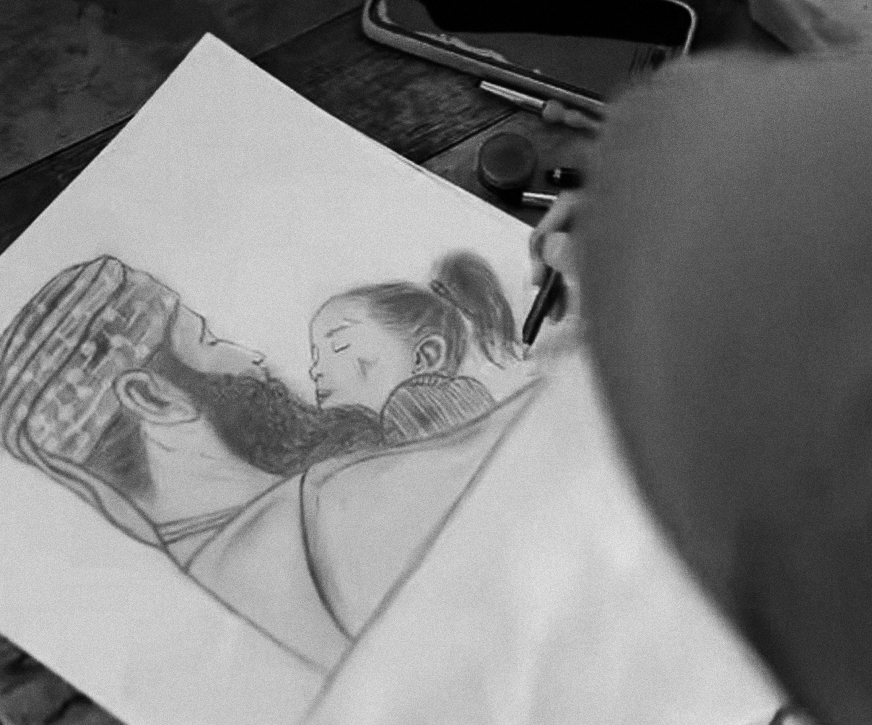
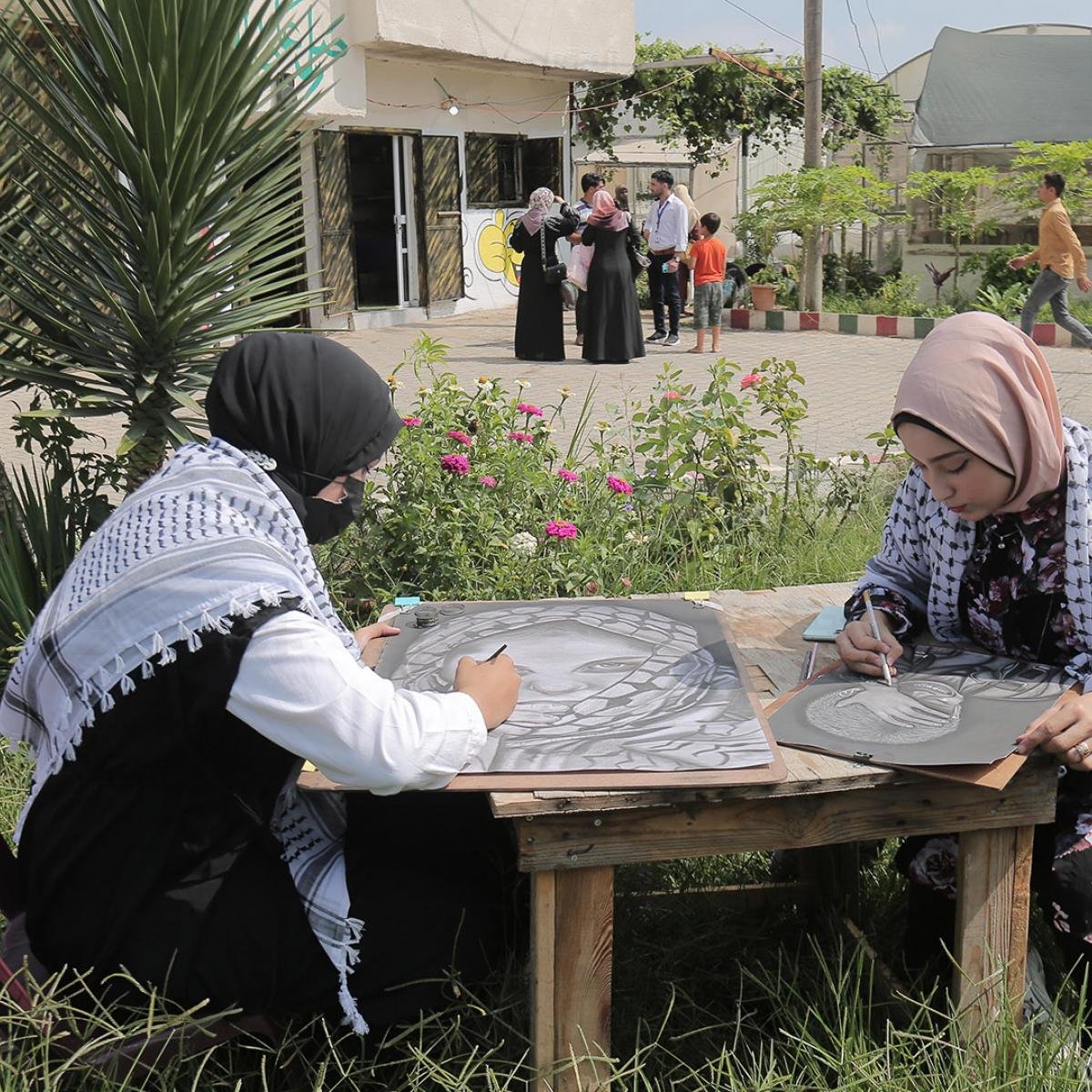
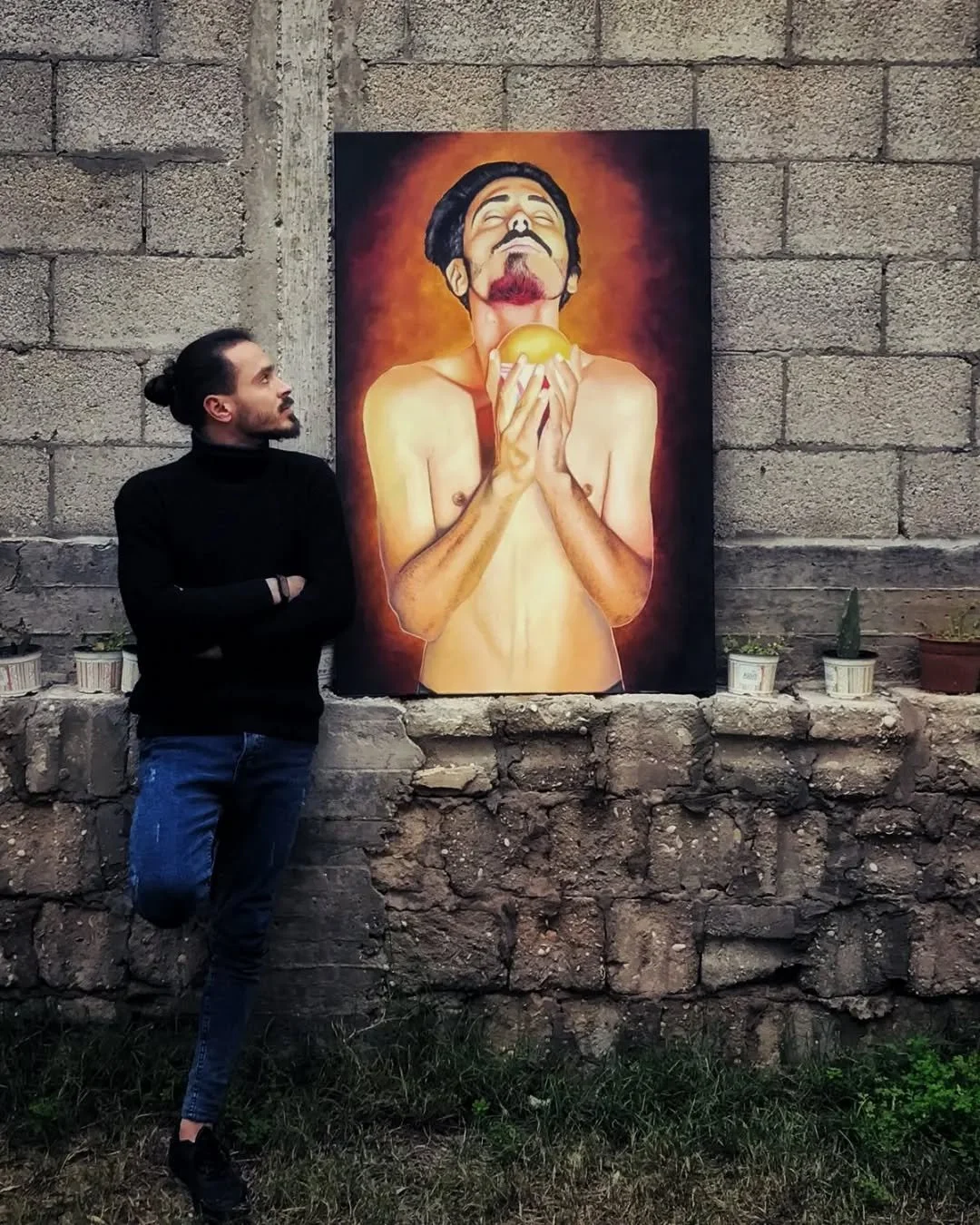
Gaza-based artist Dorgham Qreaiqea was a 28-year-old self-taught painter, primarily using oil, who also studied interior design.
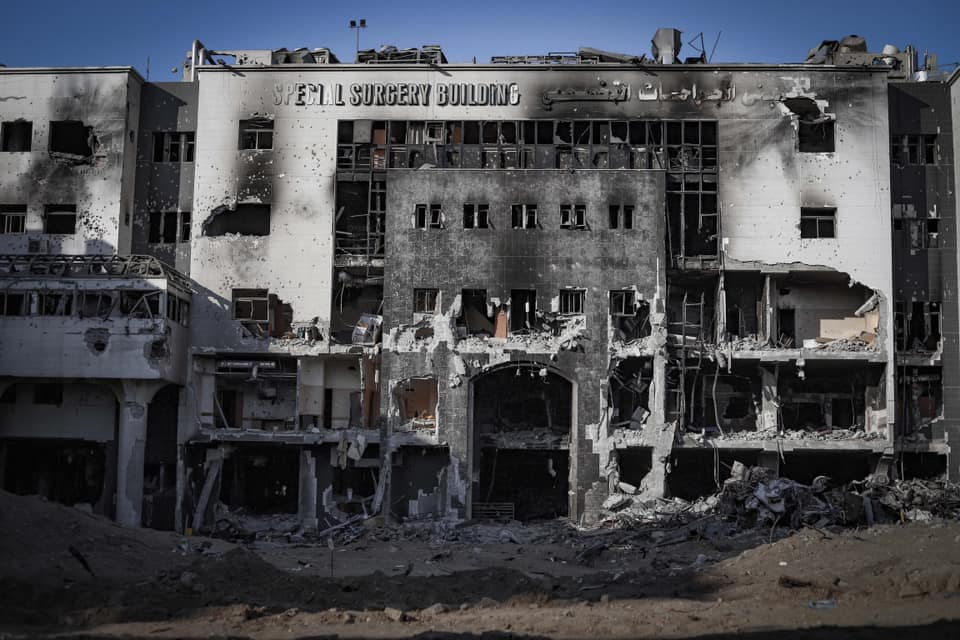
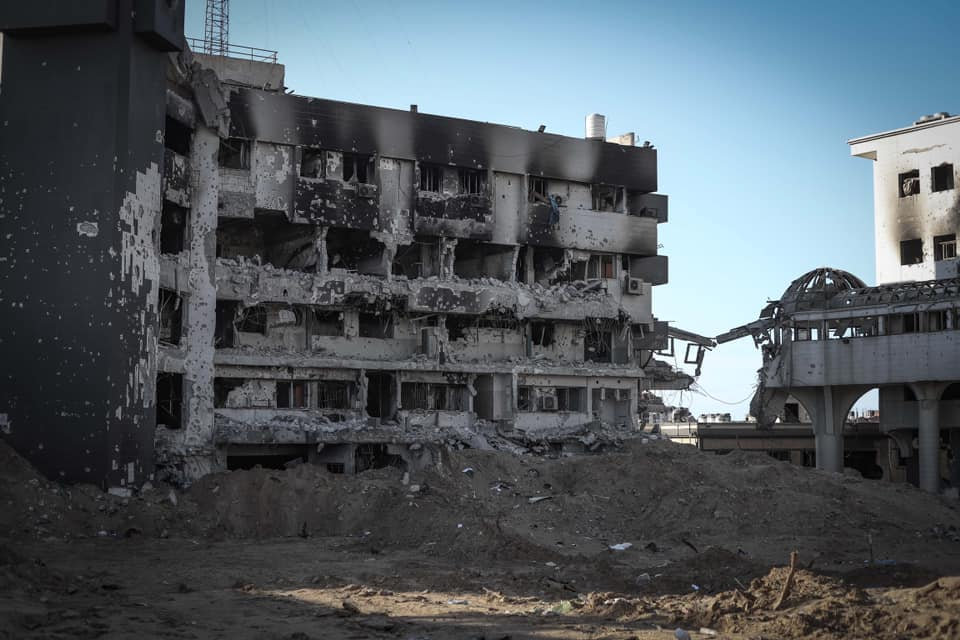
During the genocide, he and his family had been displaced several times from the north. In November 2023, he and his mother were even trapped in Al Shifa Hospital during the 13-day siege. This came after they had already survived another attack prior at Al-Alhi Baptist Hospital the month prior. His mother was injured and unable to walk, but they survived without any daily needs. They were displaced to Khan Yunis after and his mother had several operations at the European Hospital there, though she was unable to be evacuated to Egypt for further treatment.
They continued to be displaced to other areas, such as Rafah, in the months that followed. During this time, Dorgham was active in the community and working on different activities for kids, many art-related. The main one was the “Cinema Camp” where he would set up a sheet or screen and play mostly animated films for children to watch. He even included tickets for it, and popcorn when it was possible. He also organized other activities like art therapy, plays, swimming, games, and more.
However, it was a time of loss as in these past months he lost his two sisters, his aunt and her daughter, as well as his cousin. Several of whom he could not find under the rubble. But he was determined to continue on and bring joy to children however he could.
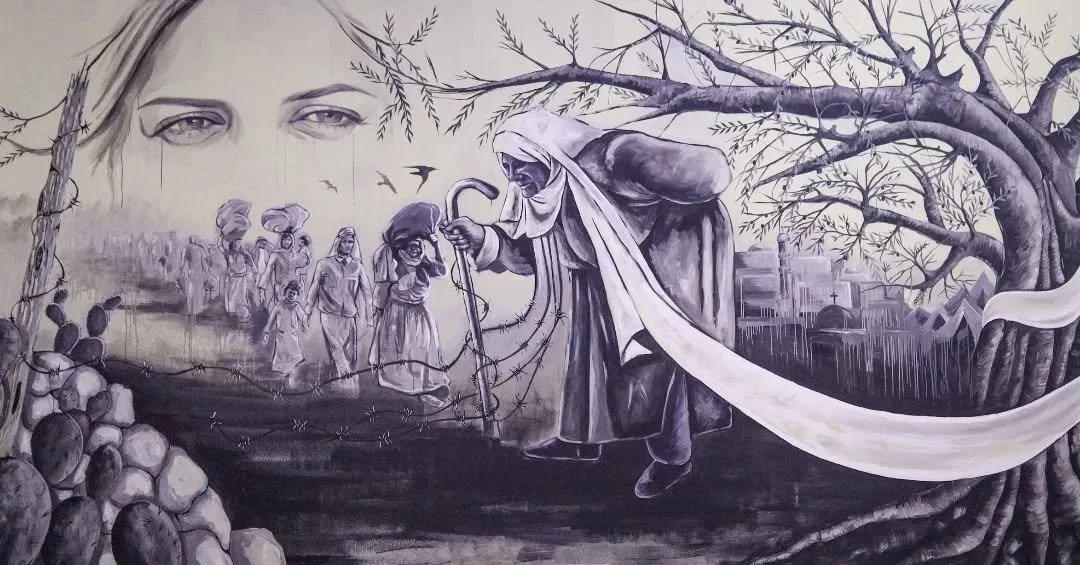
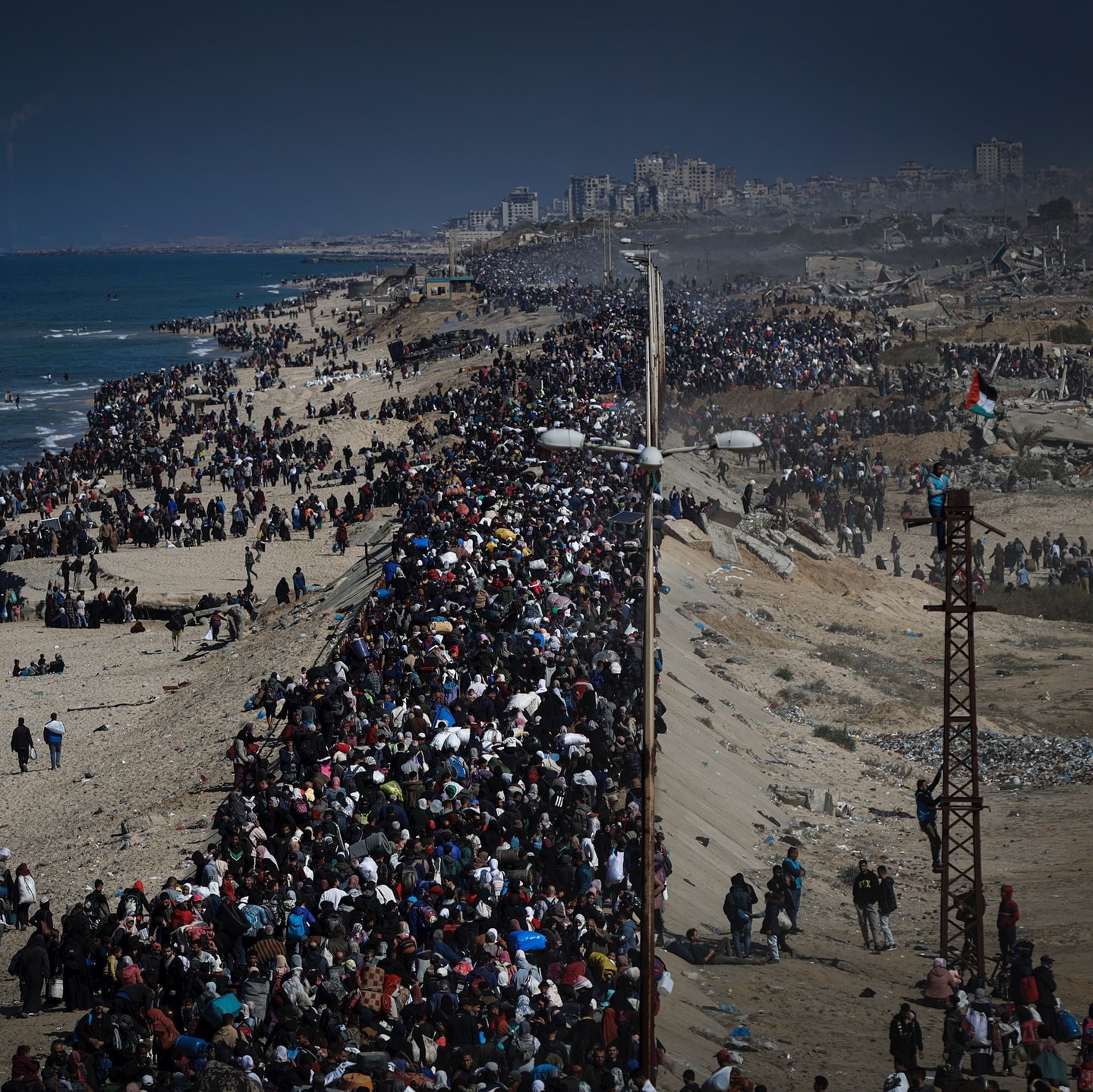
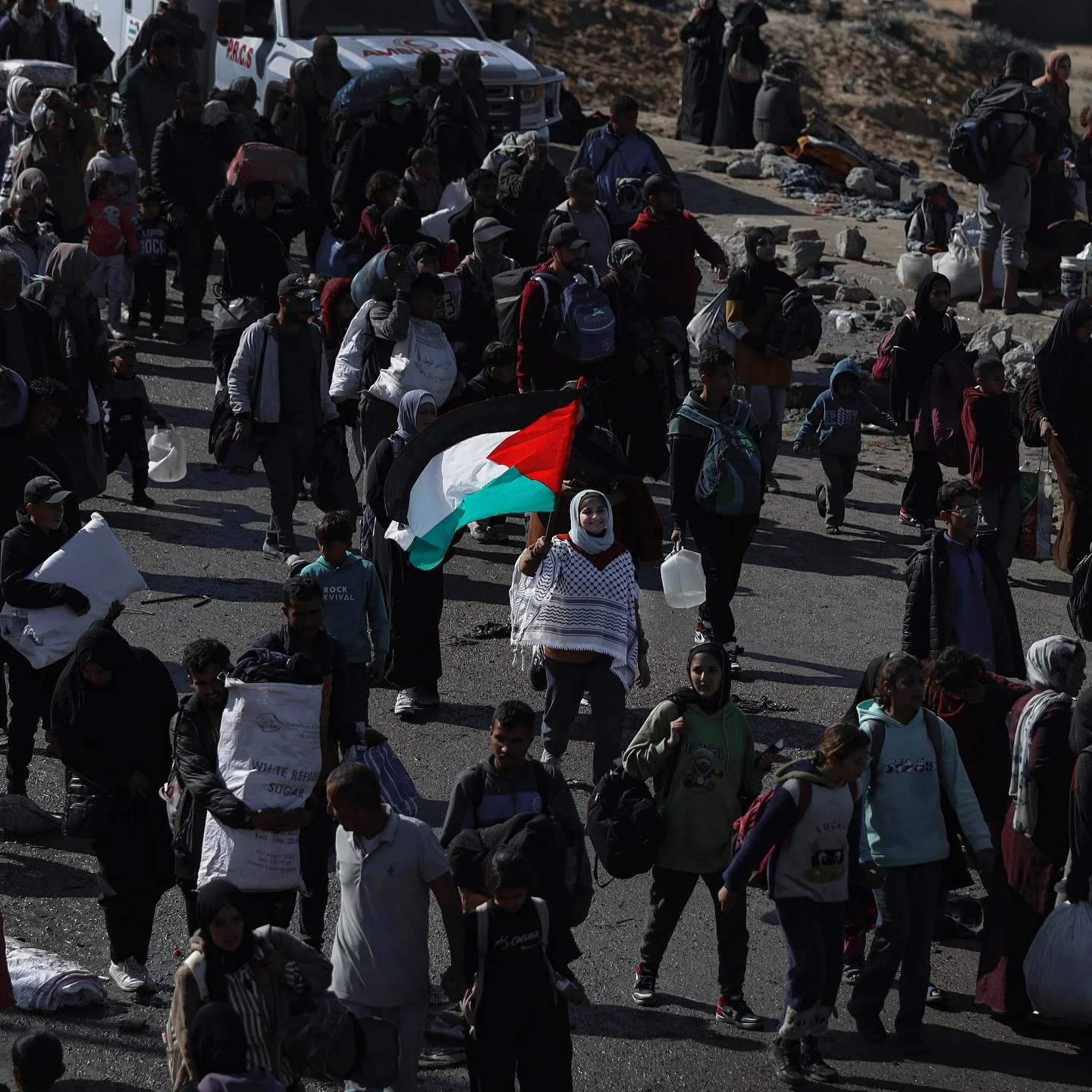
In January 2025, the Qreaiqea family was part of the Great March of Return to northern Gaza after the initial "ceasefire" deal, though they came back to find their family home in ruins.
Dorgham was devastated to lose so much artwork he’d made over the years. The collection of pieces were intended for his first exhibition, which he wanted to call Until A Chair Grows Wings. He shared about the experience:
“These works were more than paintings. They were a part of my soul, of my dreams, that I have always dreamed of sharing with the recipient. What happened is not just destroying things, it is an attempt to erase memory, culture and humanity. But as it is said, 'Hope is not killed until the soul dies' - and art is my soul that will not die.”
Only a couple of months later, on March 18, 2025 – the day when the January 2025 ceasefire was officially broken and all-out “israeli” airstrikes continued – he and the majority of his 30+ person family were martyred when an IOF airstrike targeted what was left of their already-demolished home in Gaza City.
“Art for me is not just painting on paintings; it is a way to express suffering, about life, and hope after all... However, I believe that art cannot be destroyed. As long as there is a creative spirit, art will live in us.”
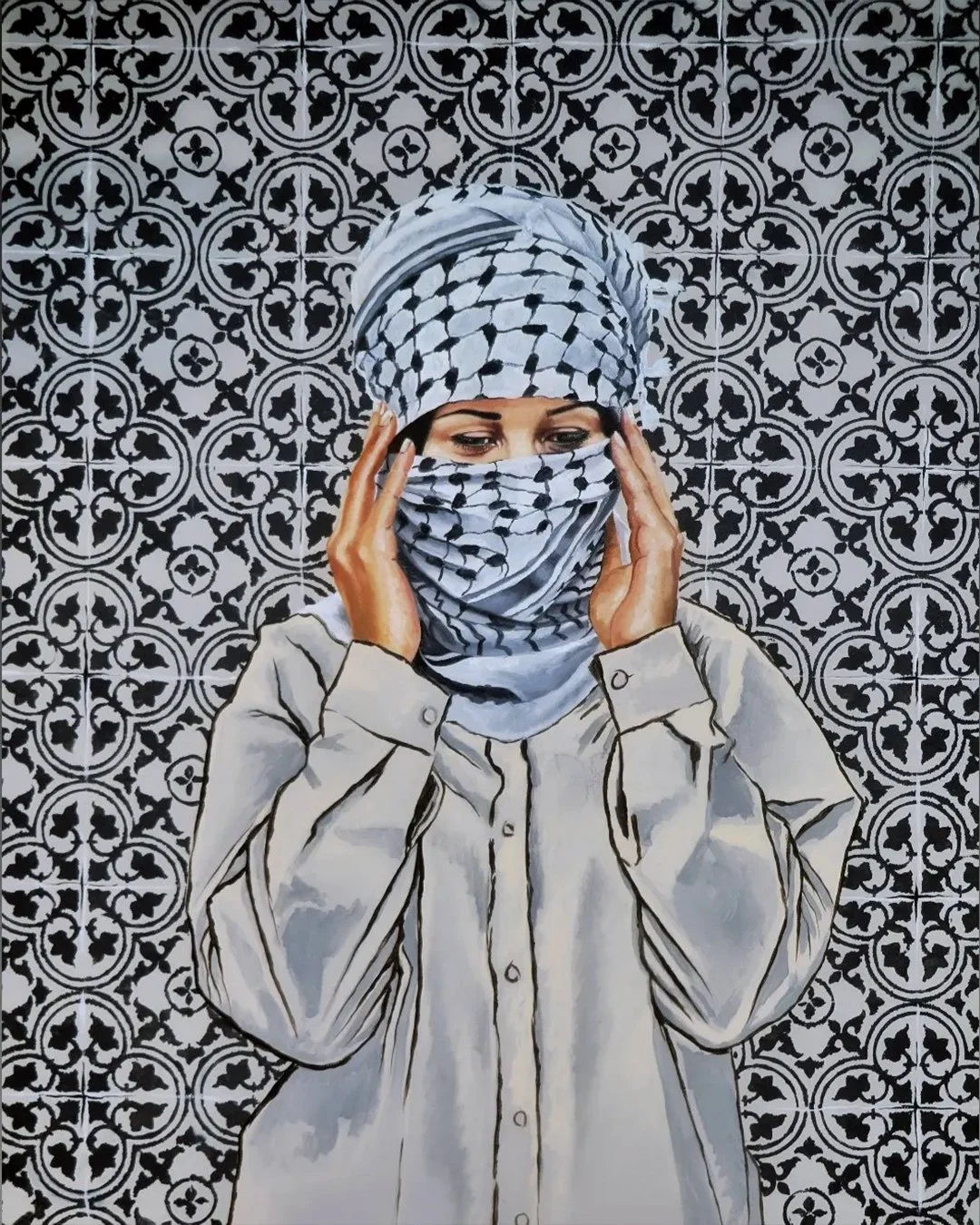
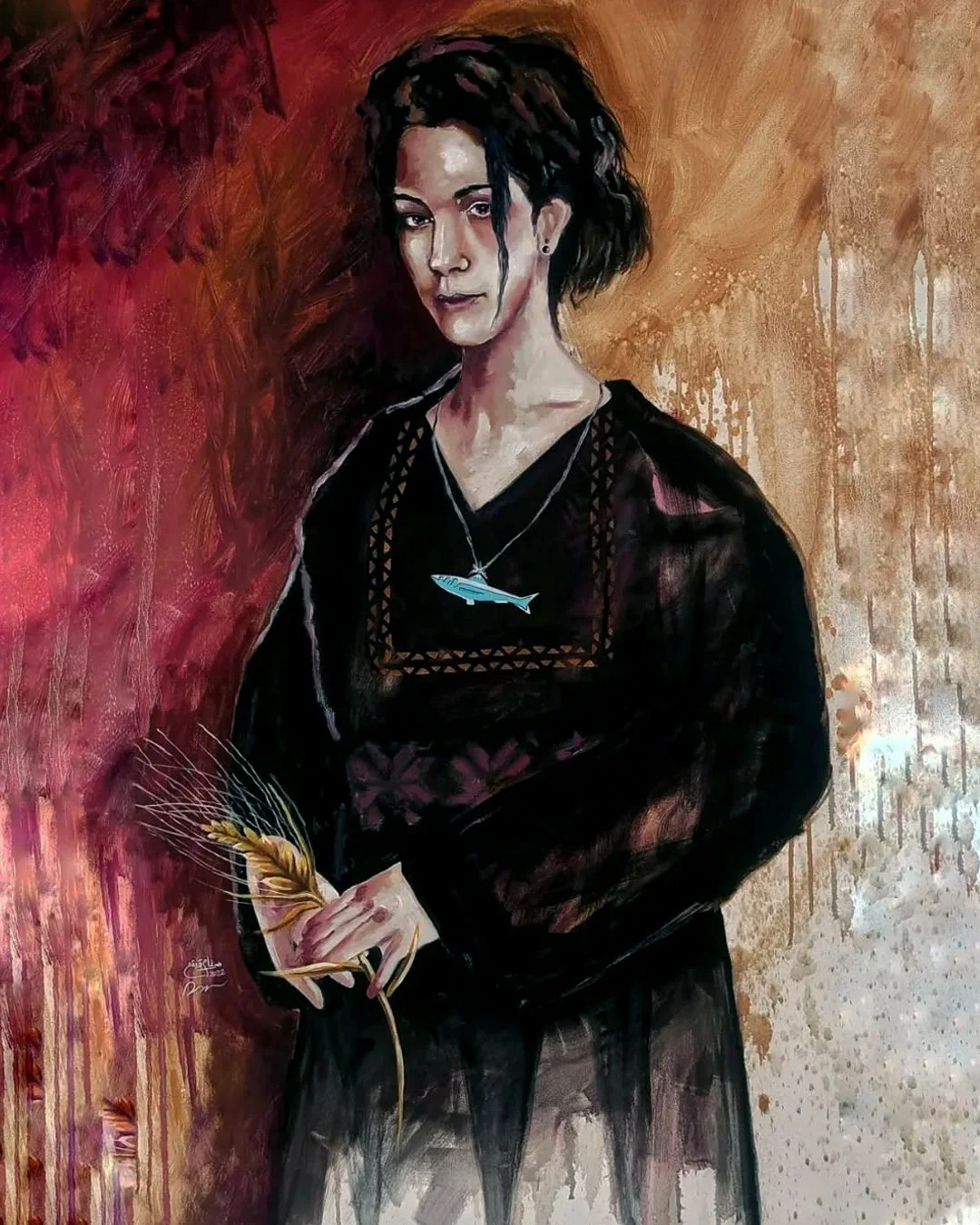
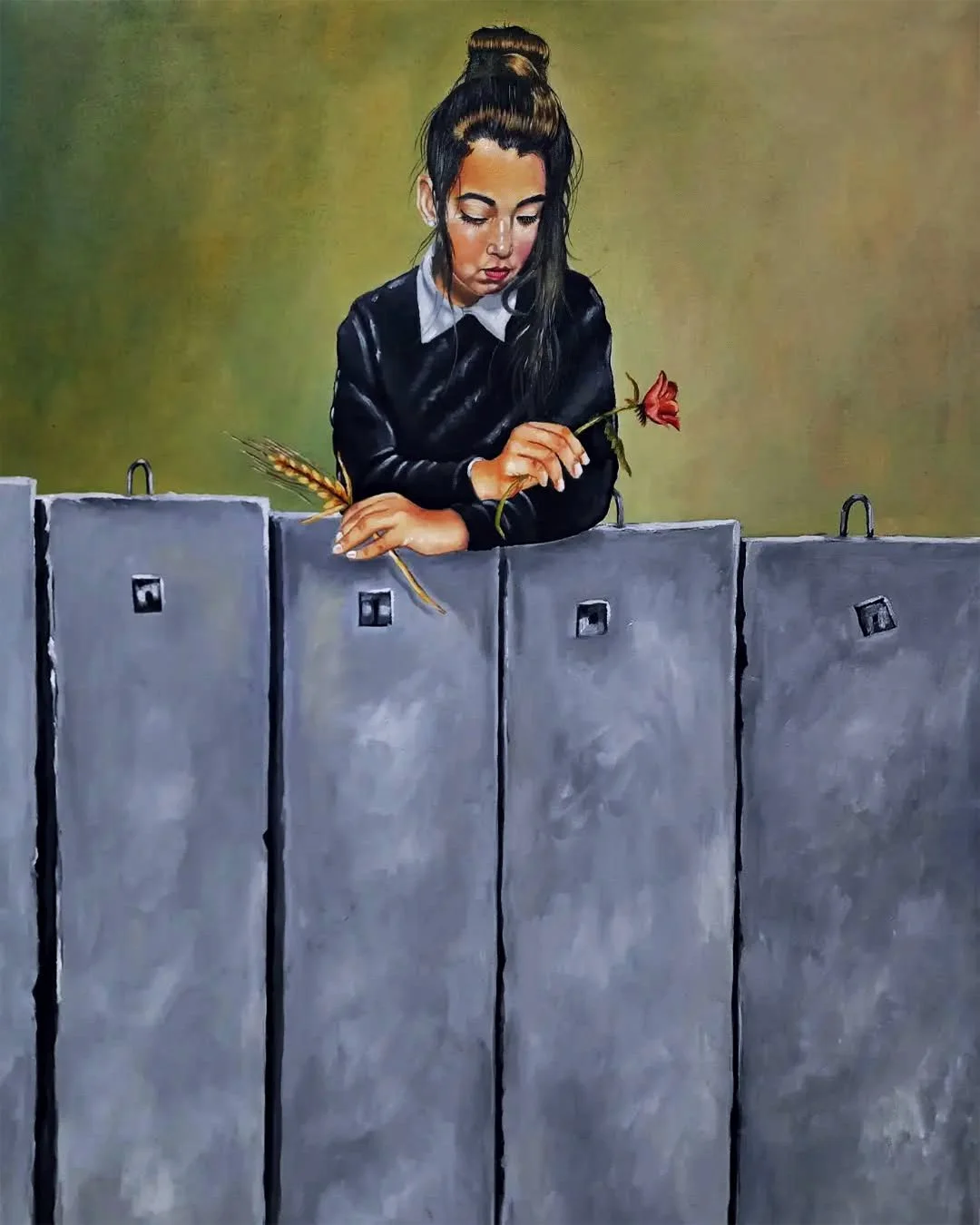
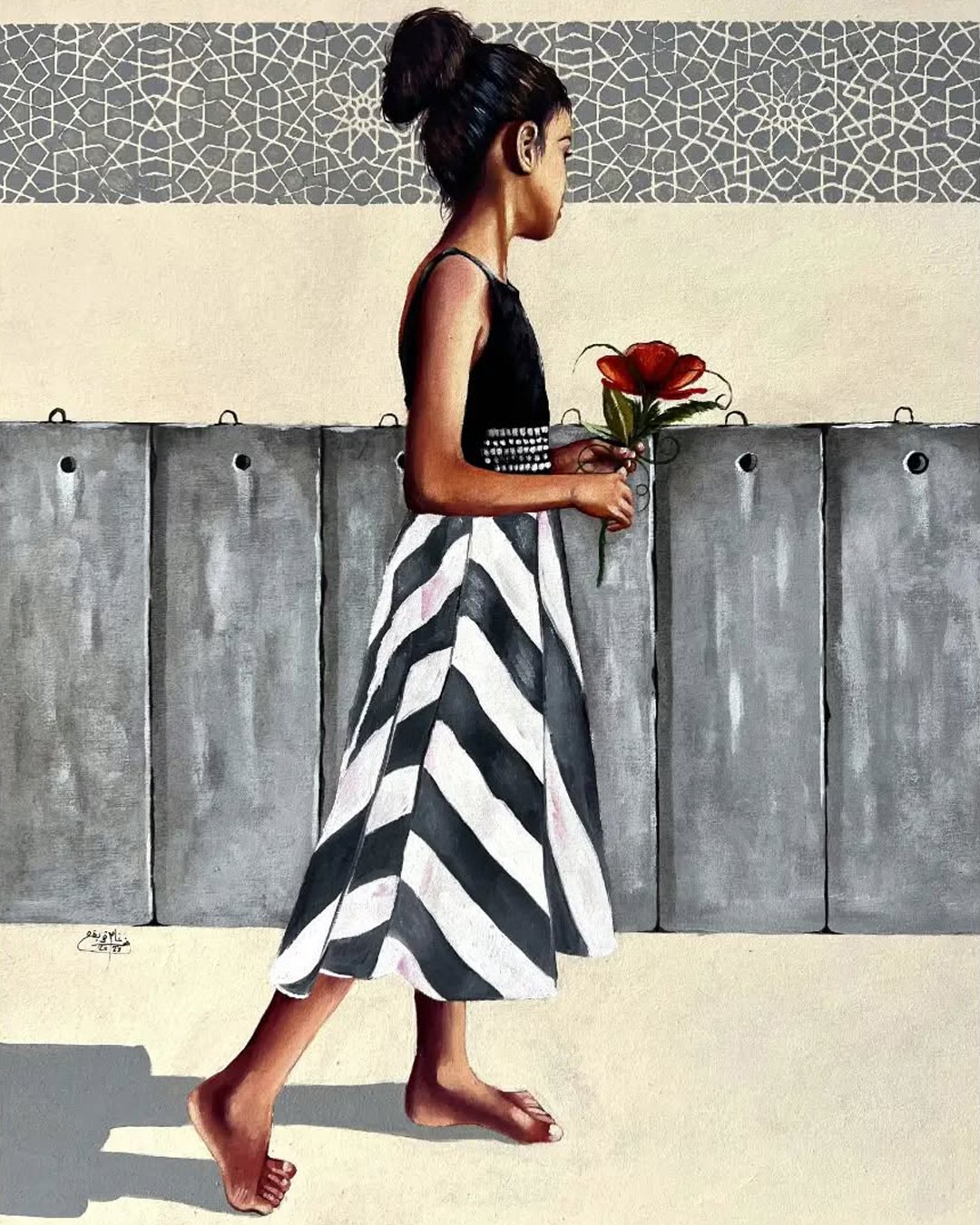
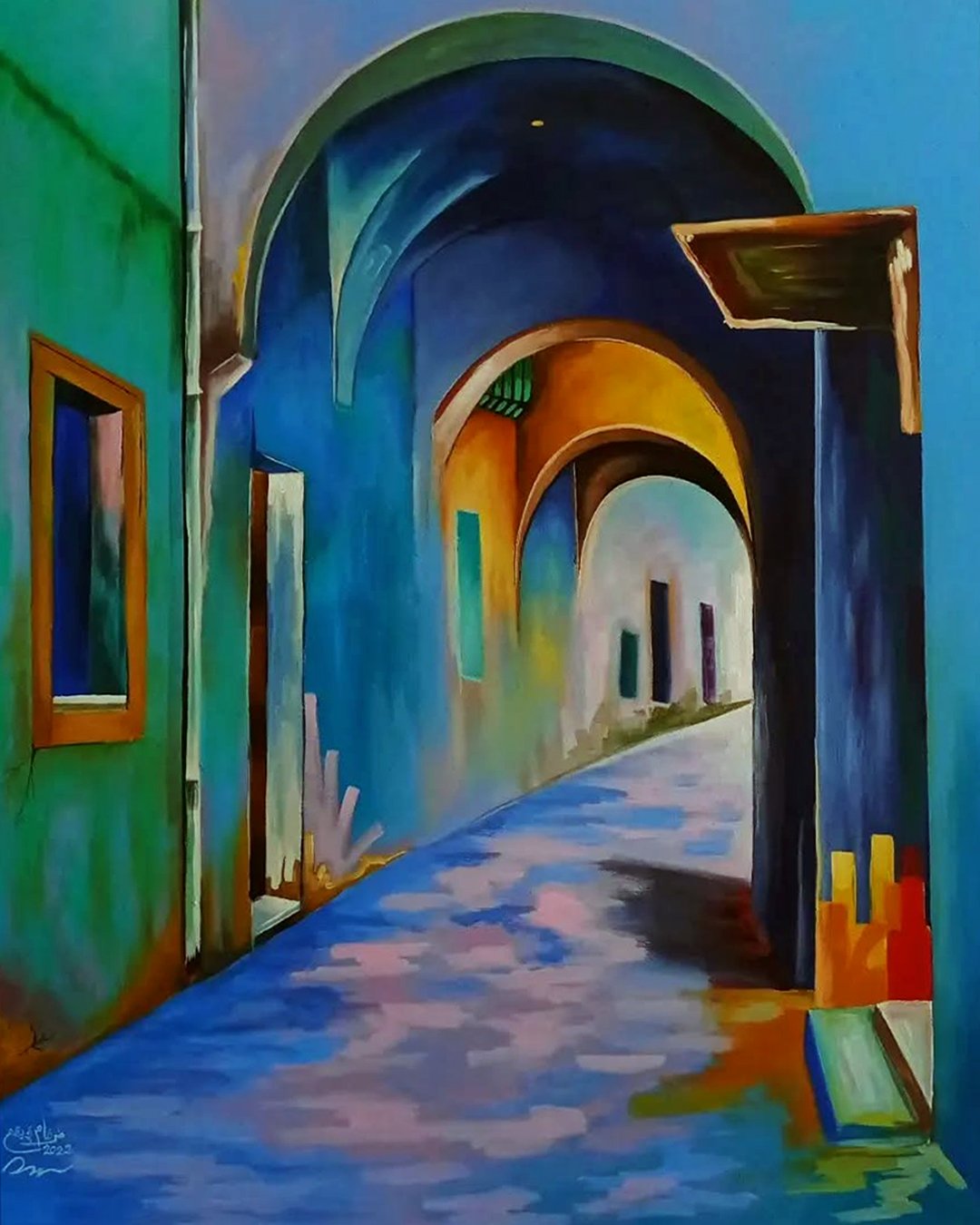
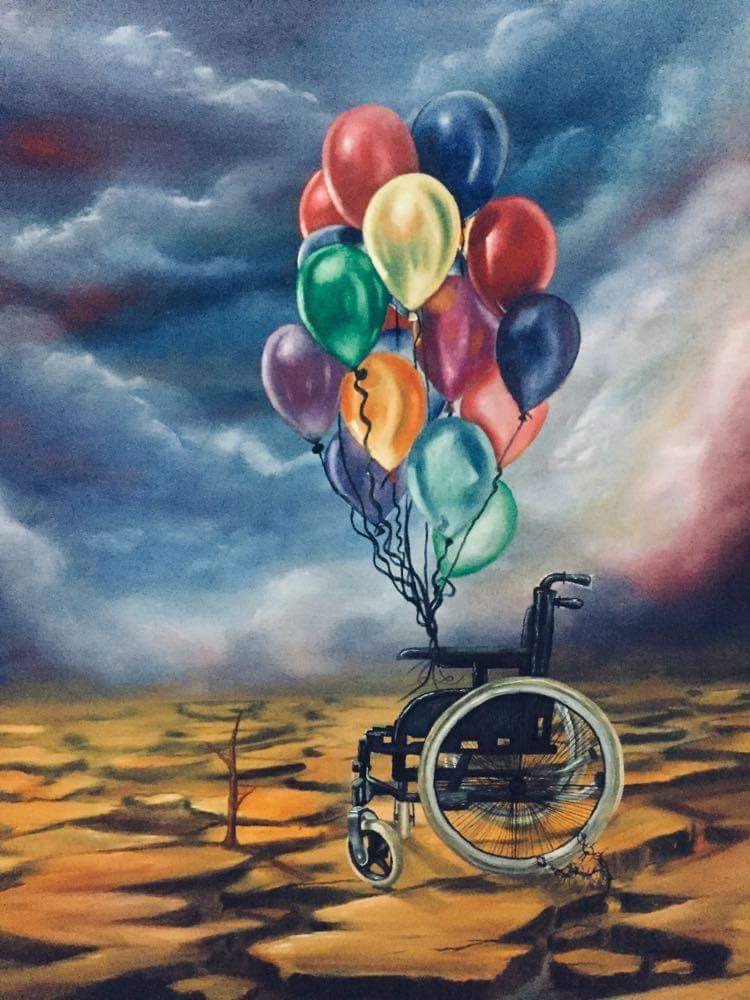
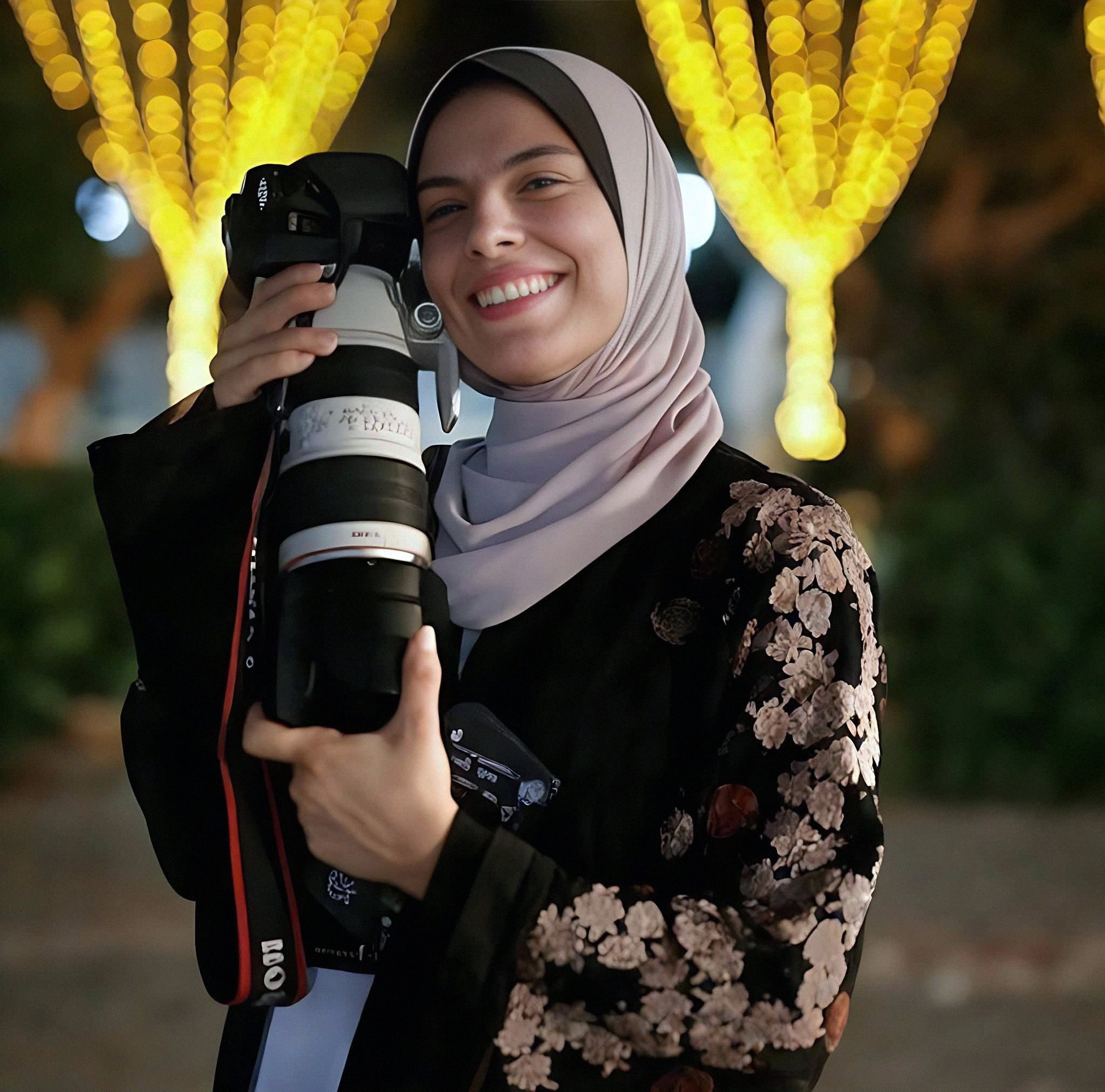
Fatma Hassouna
April 2025
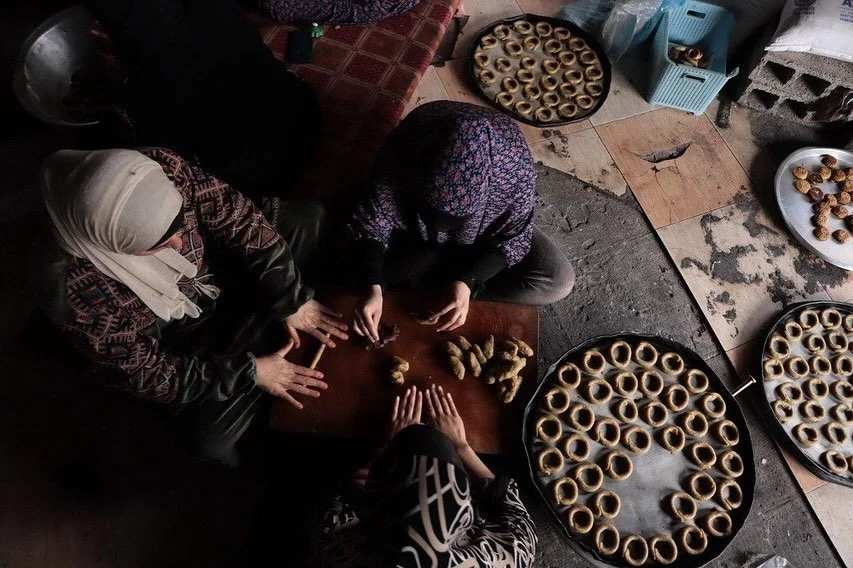
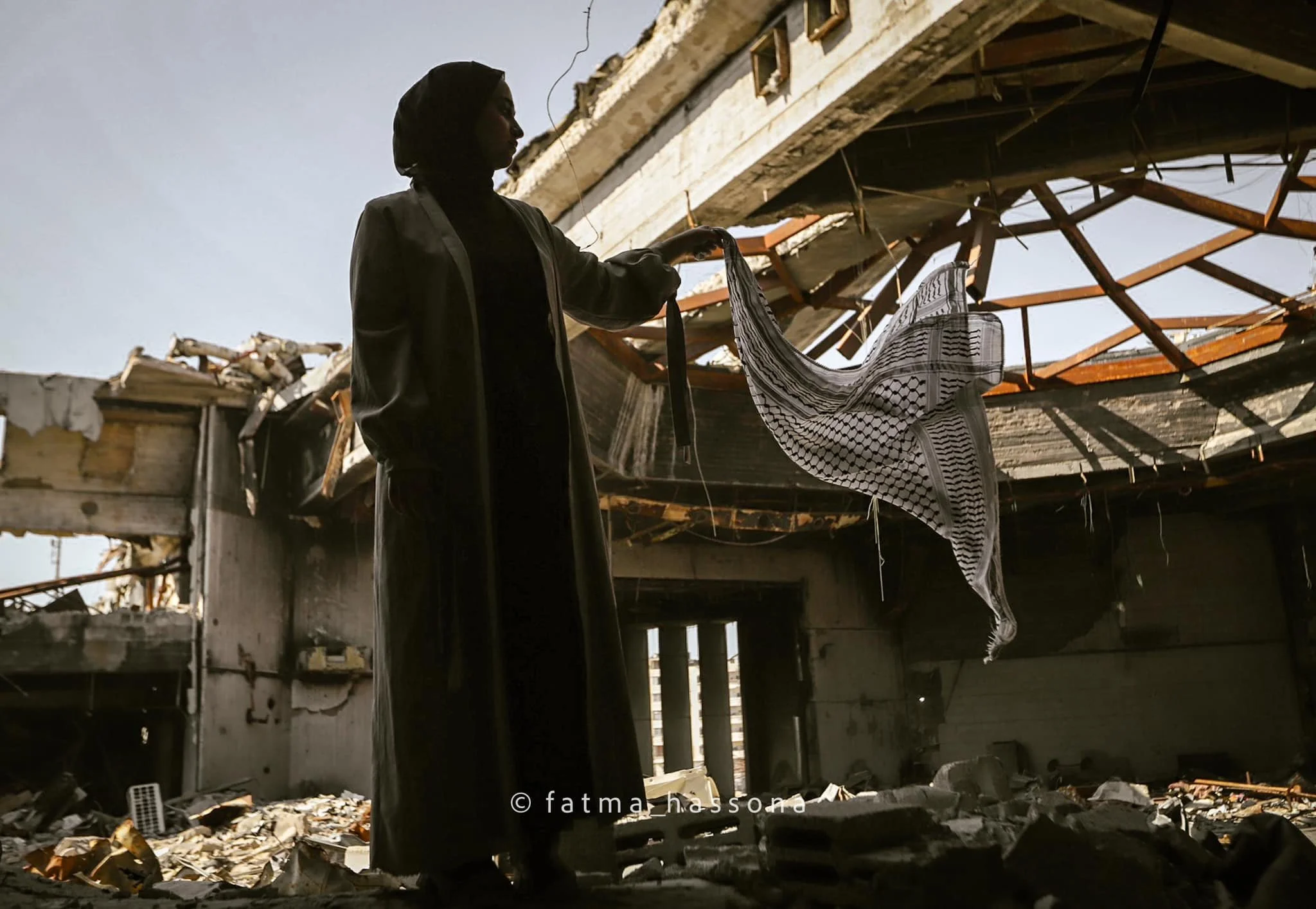
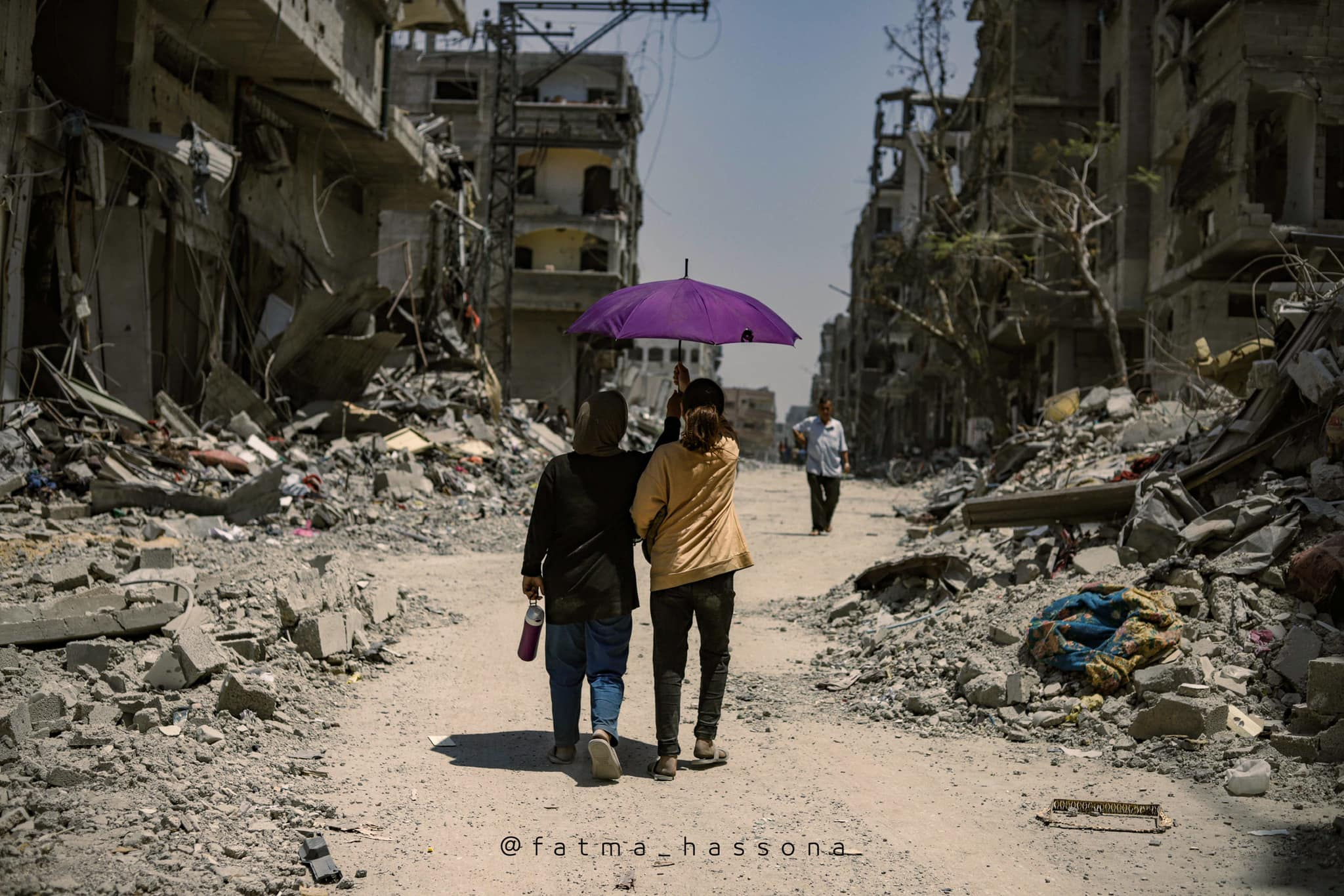
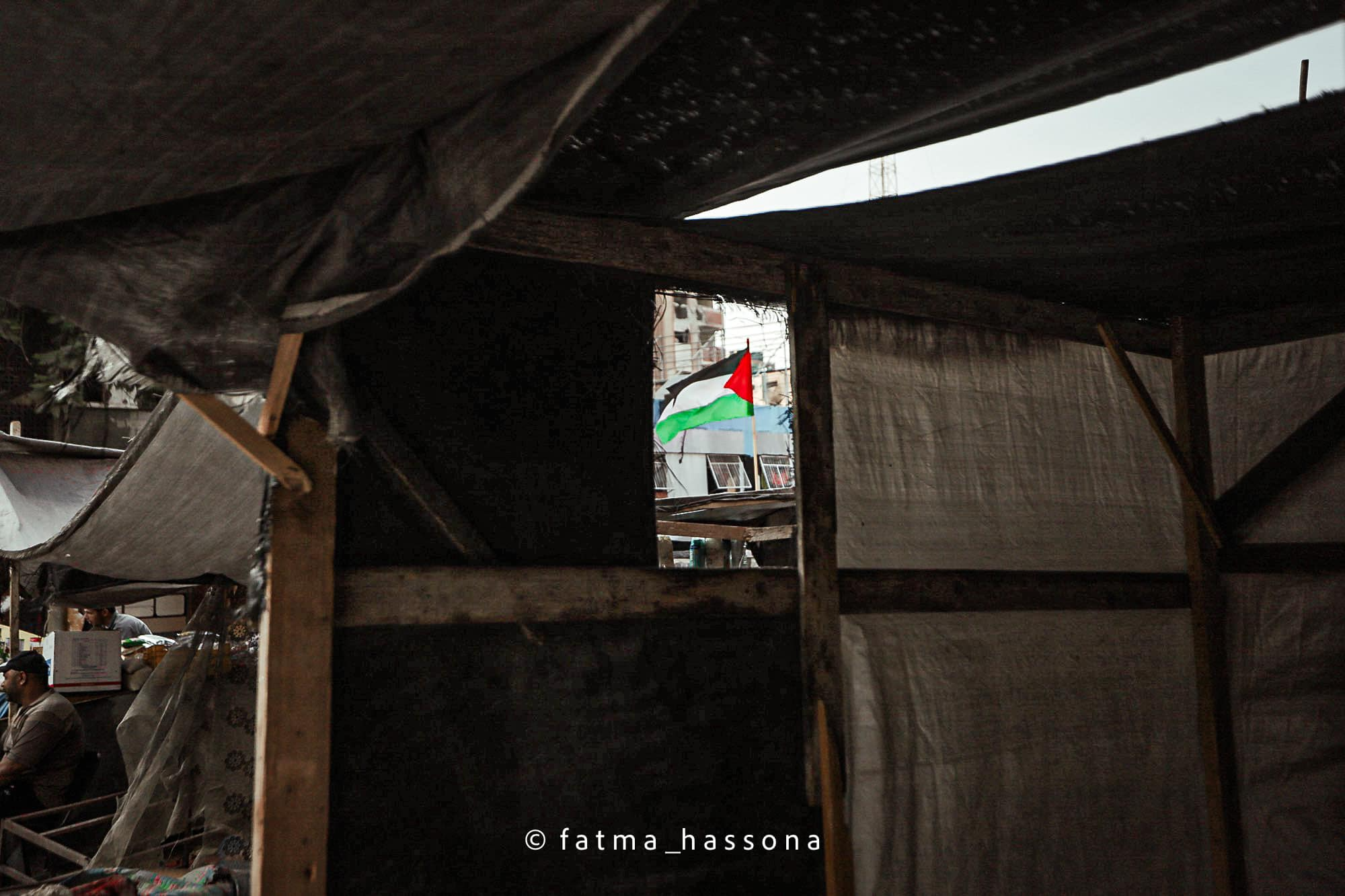
"I really believe that pictures can be a weapon," said photographer and martyr Fatma Hassouna. "My camera is as powerful as a gun."
Fatma – whose nickname was Fatoom – was a 25-year-old Gaza-based artist, most known for her photography in the past year. She took on the responsibility of visual journalism in documenting northern Gaza under genocide. She also wrote poetry and sang music.
She had graduated from the University College of Applied Sciences in 2022. The school is in Gaza City, where Fatma was born and raised. A little over a year later, her life would change with everyone else. In early 2024, several of her family members were martyred.
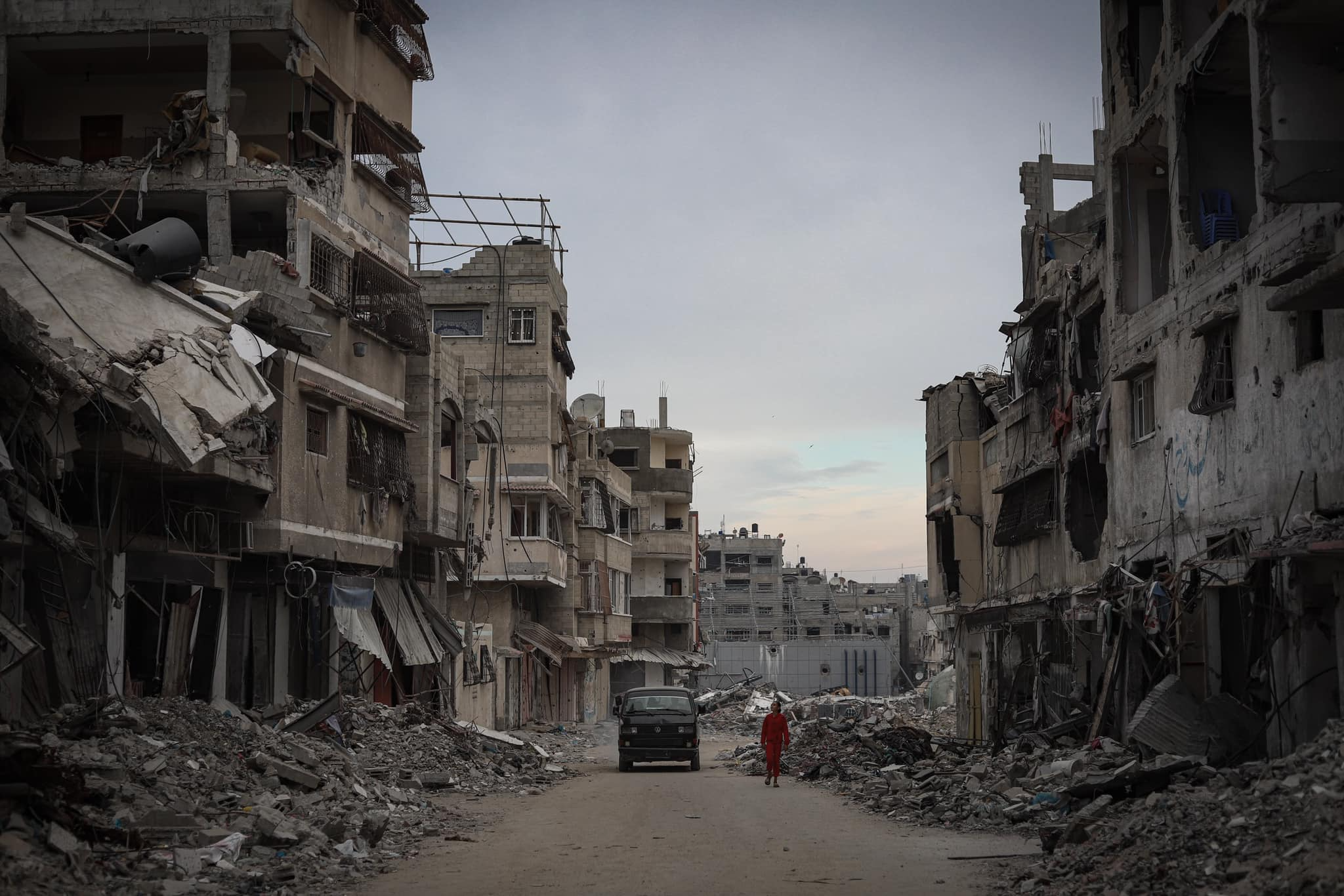
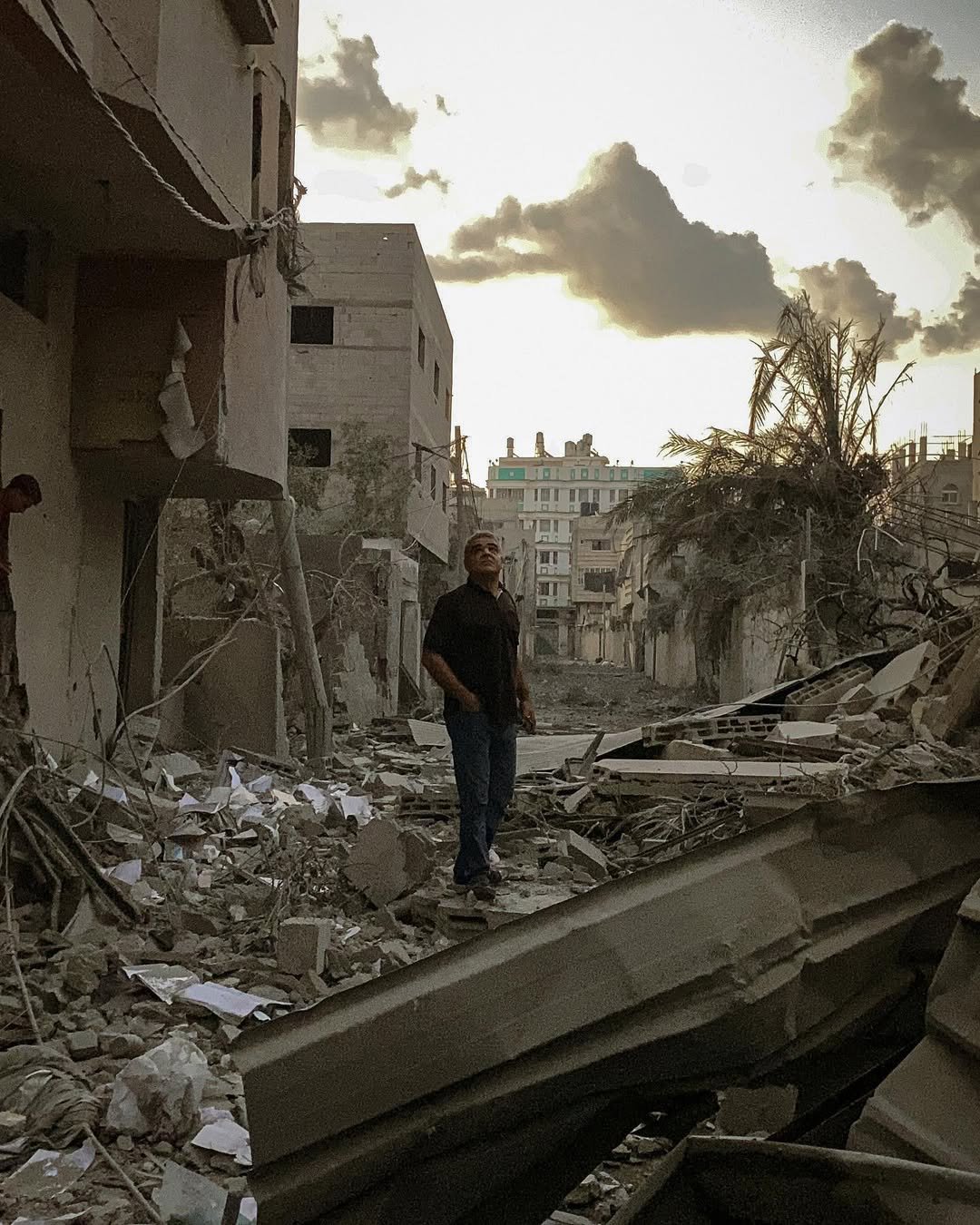
In the past year, she frequently shared photos online that documented the harsh realities. It was a firmly held belief that her Canon DSLR camera was an effective tool to showcase what was happening to her and those around her.
Over the years, Fatma photographed for Untold Palestine, the Tamer Foundation for Community Education, and Plan International. She was also a member of the editorial team for the literary group Yara’at Al Adabi.
In early January 2025, she had announced her engagement on Facebook. She was excitedly preparing for her wedding, despite the circumstances.
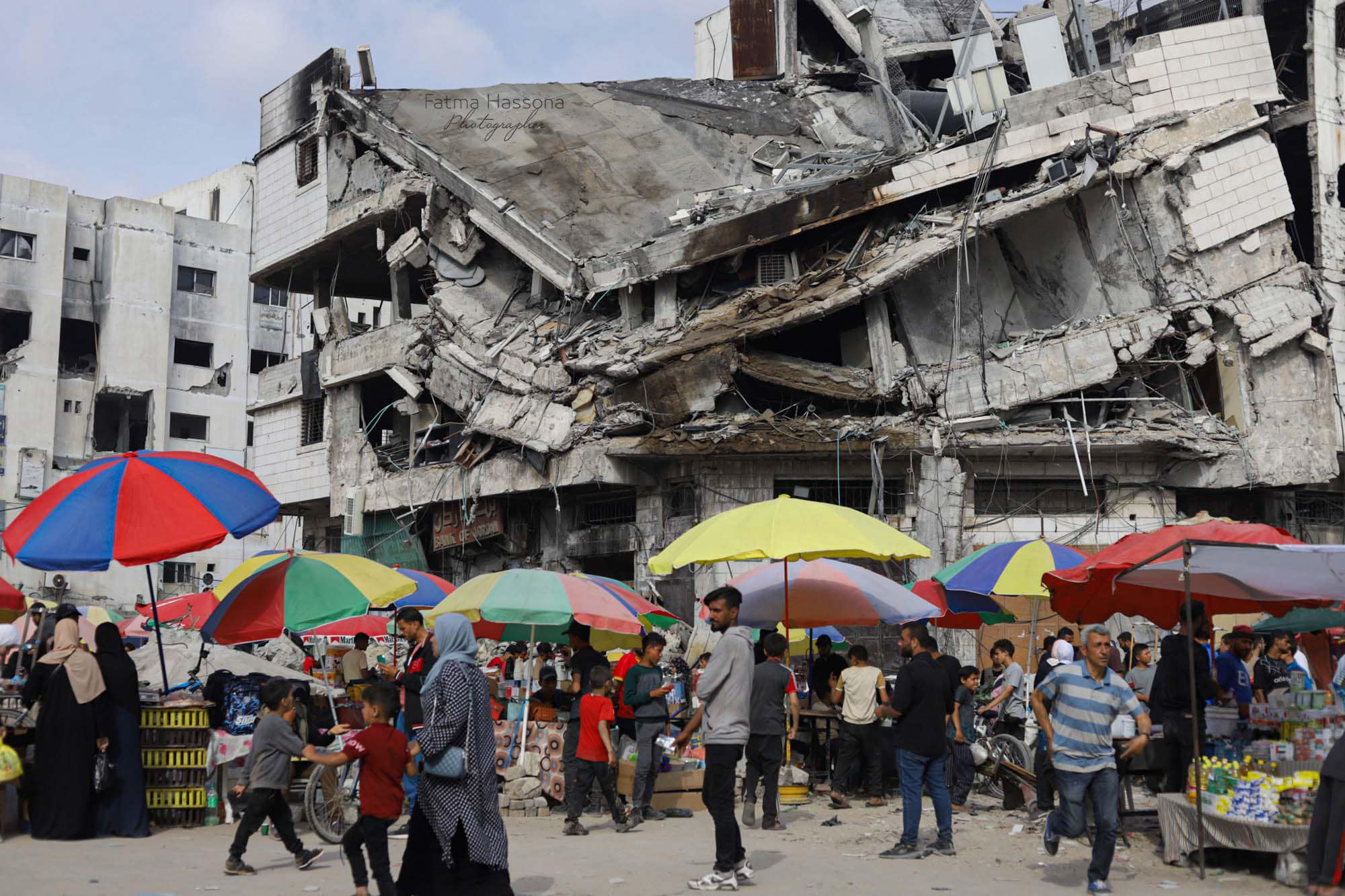
Iranian-French film director Sepideh Farsi had been remotely working with Fatma, featuring her in a new documentary called “Put Your Soul on Your Hand and Walk.” On Tuesday, April 15, it was announced that it would be heading to Cannes Film Festival for its premiere in May.
The next day after the Cannes announcement, on April 16, the IOF hit the Hassouna home in Gaza City with a targeted airstrike. Fatma was martyred, along with 10 members of her family. Her parents, who survived but were injured in the same attack, lost all six of their children. One of Fatma’s sisters was pregnant.
Knowing that she would be potentially targeted like fellow artists and journalists who documented the reality, Fatma had said, “If I die, I want a resounding death. I don’t want to be just breaking news, or a number in a group. I want a death that the world will hear, an impact that will remain through time, and immortal images that cannot be buried by time or place.”
The documentary had its world premiere in the ACID program at the Cannes Film Festival a month later, on May 15, where Sepideh Farsi held up a photo of Fatma at the screening. There was also an event displaying her photos taken in Gaza, printed and displayed for Cannes attendees to view.
As the film continues to be shown around the world for months and years to come, her death will only become louder. Her photos leave behind a legacy to show she is not just a number.
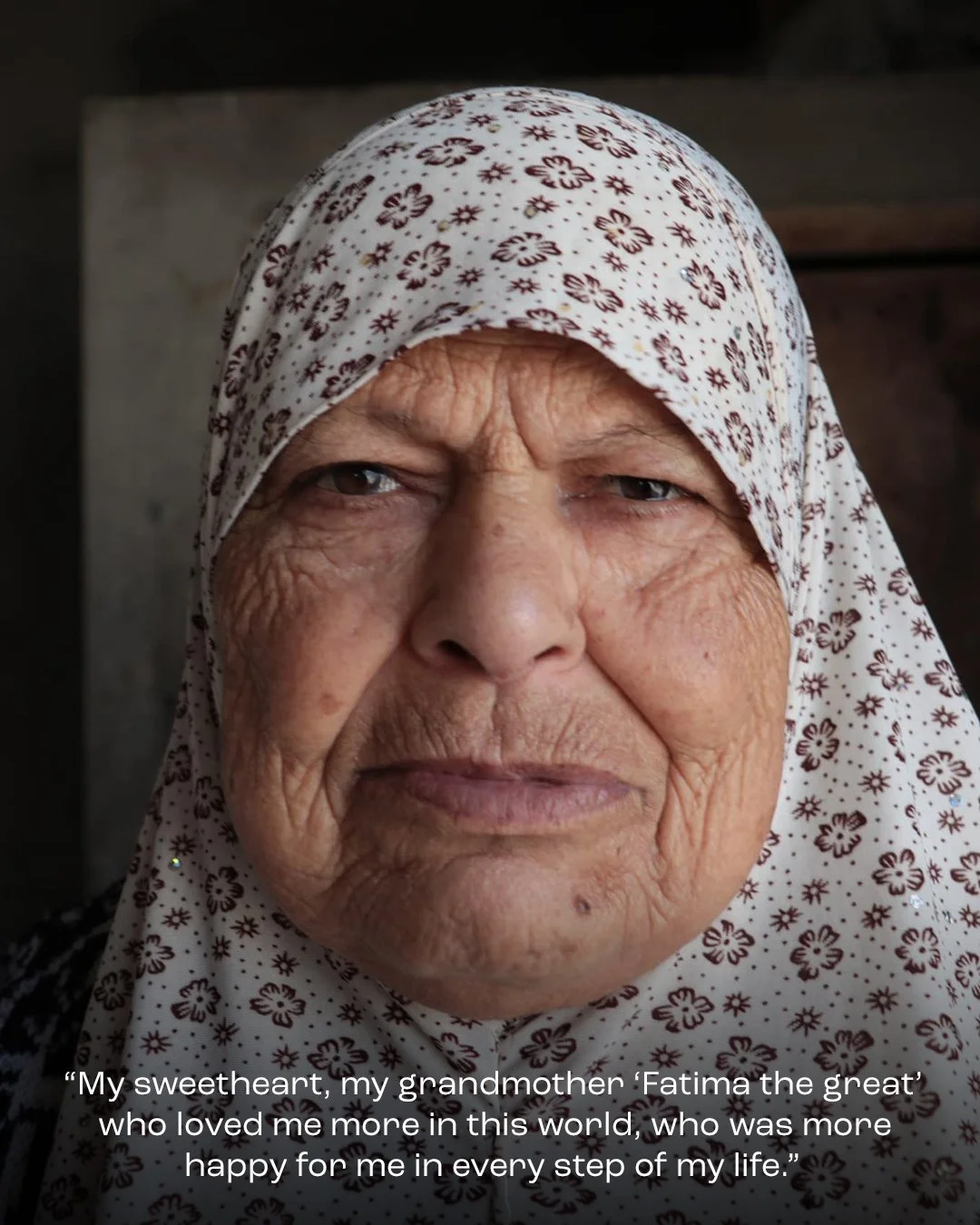
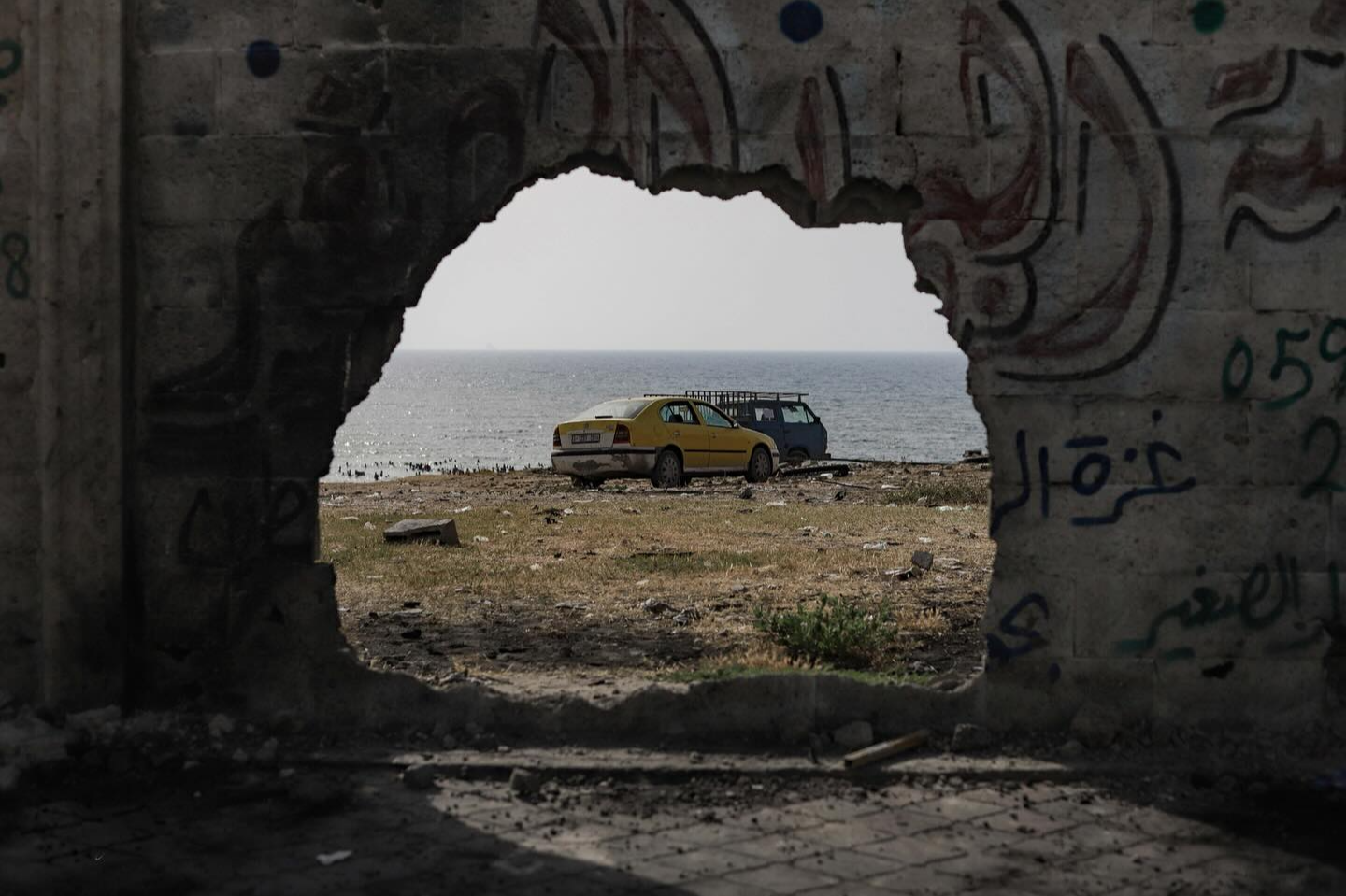
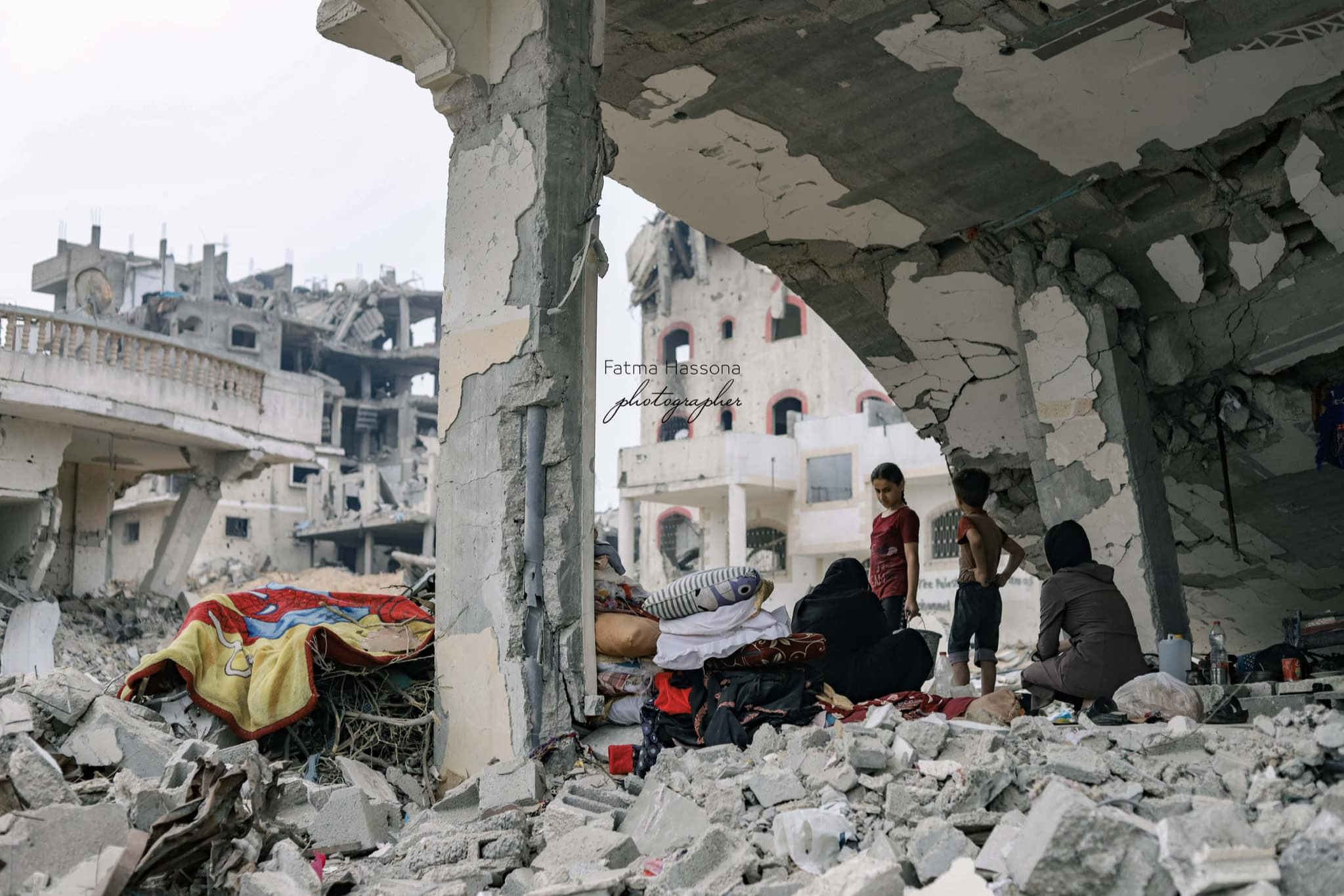
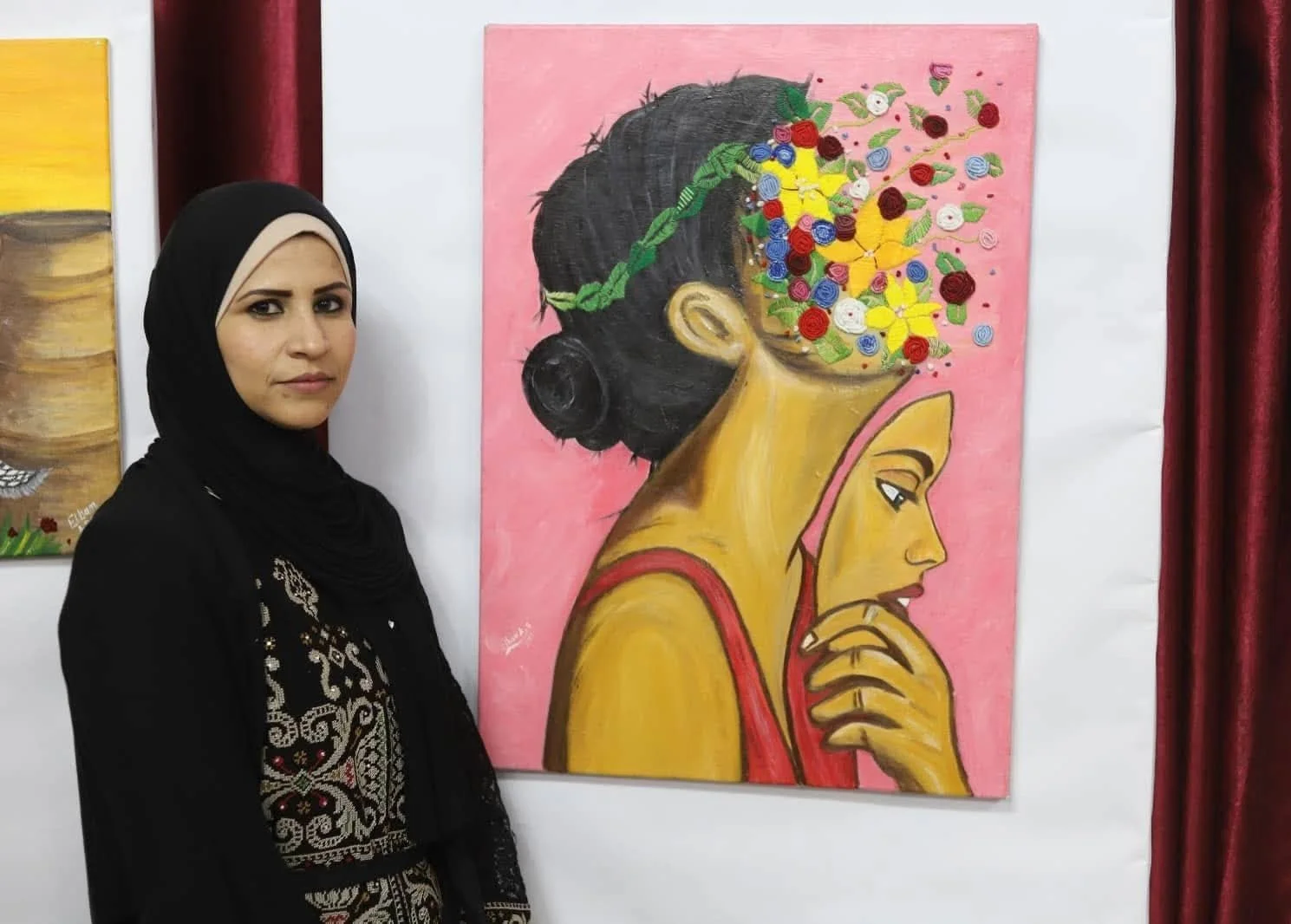
Elham Al-Badi
May 2025
Nakba Day is an annual day of dedicated remembrance for the ongoing catastrophe and expulsion of Palestinians from their land by Zionist militias in 1948.
Around 15,000 people were martyred; 750,000 displaced; 500 villages destroyed.
The date of May 15 for Nakba Day was chosen to align with the first day of Palestine after the so-called "state of israel" was officially declared by the first Prime Minister (read: war criminal), David Ben-Gurion, ending the period of the British Mandate that had taken place after WWI.
Some view the Nakba as a lens to describe the catastrophe of ongoing displacement and occupation, referring to that the displacement and death that has never ended.
The 77th Nakba Day came on May 15, 2025, and the genocide on Gaza raged on. That day, an IOF airstrike targeted a medical center in Jabalia camp. One of the martyrs was Elham Al-Badi, a 33-year-old multidisciplinary artist in Gaza who was from Beit Lahia in the north.
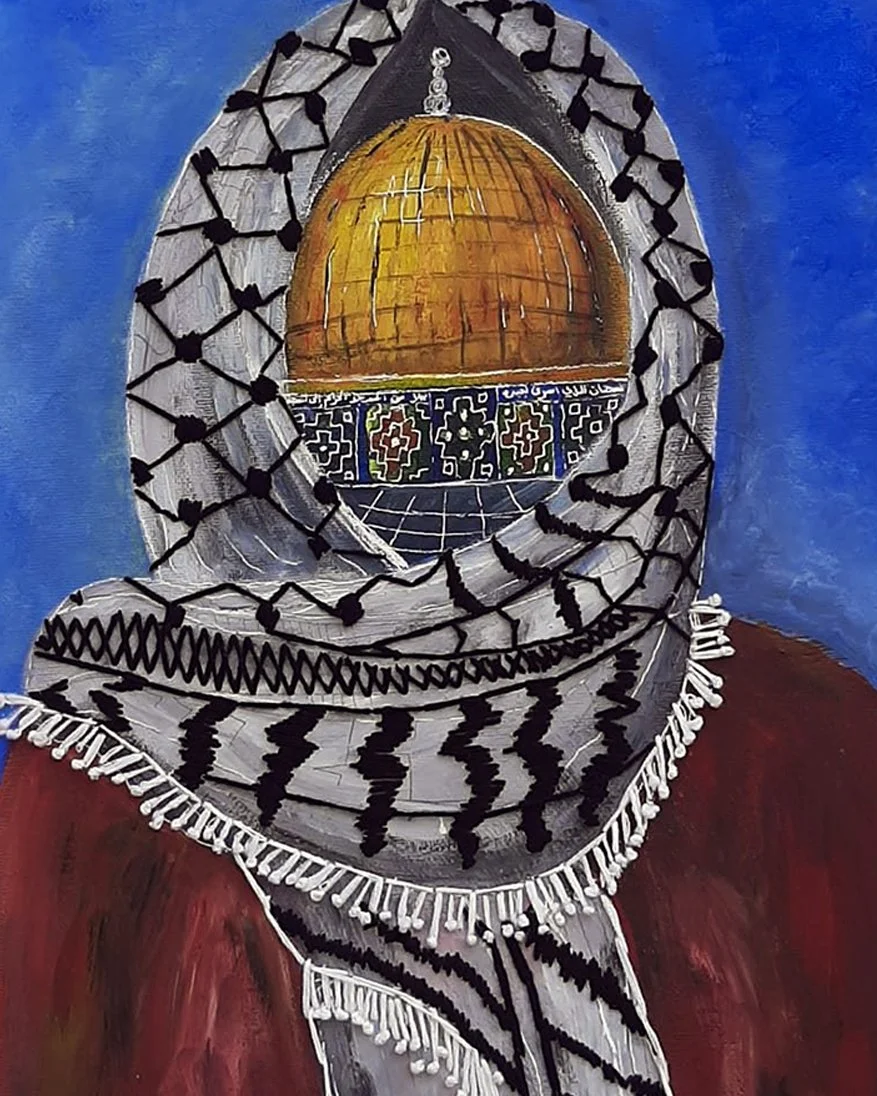
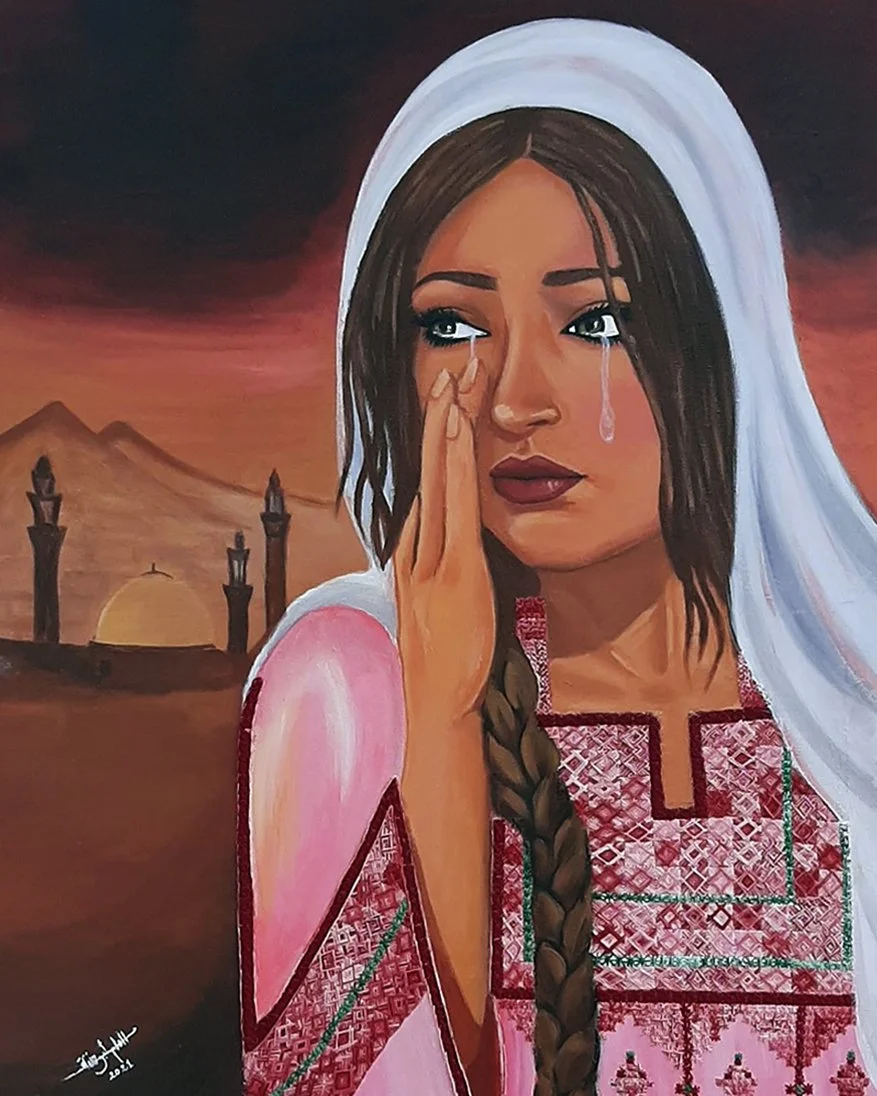
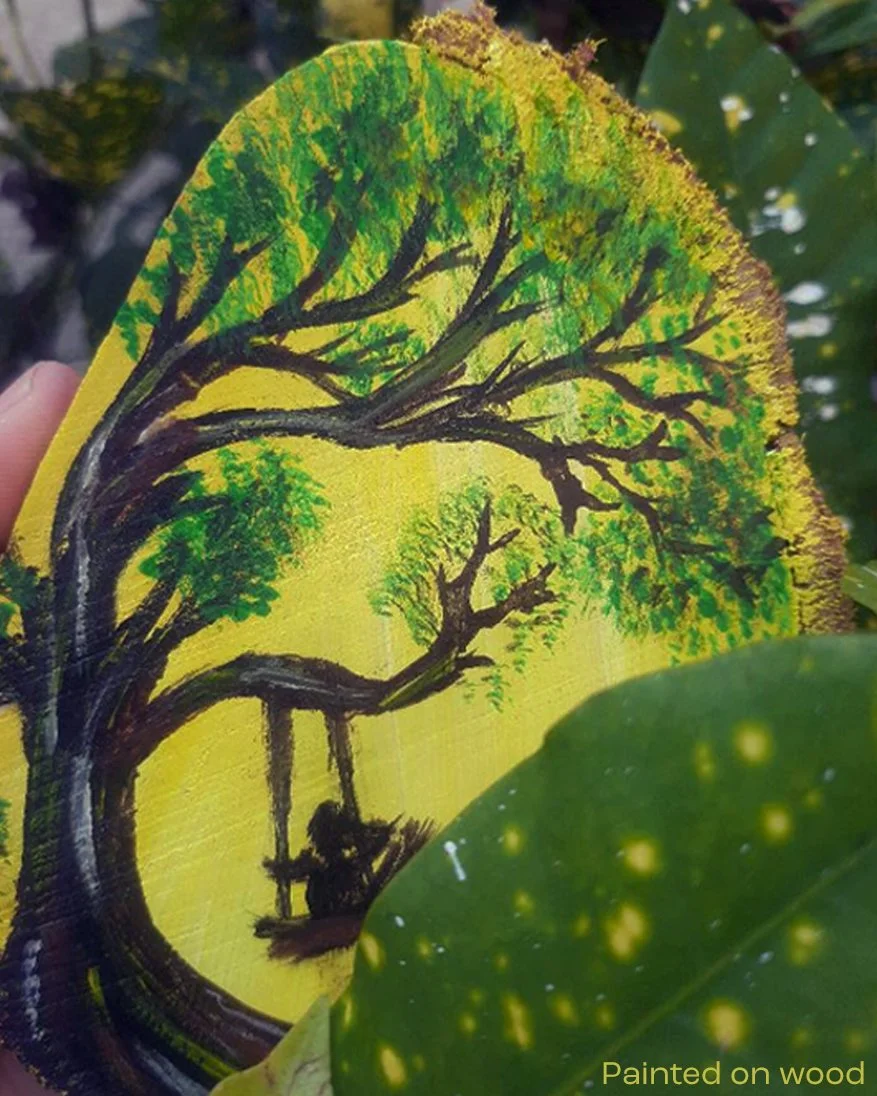
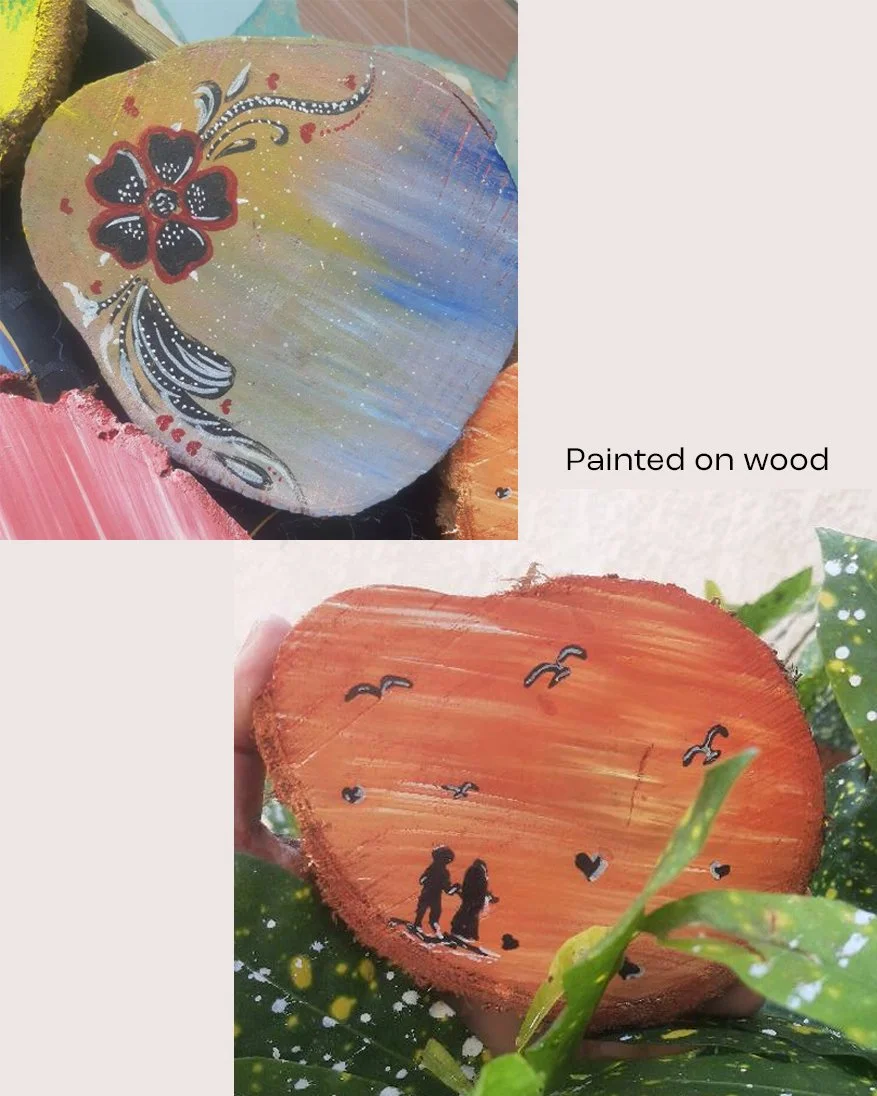
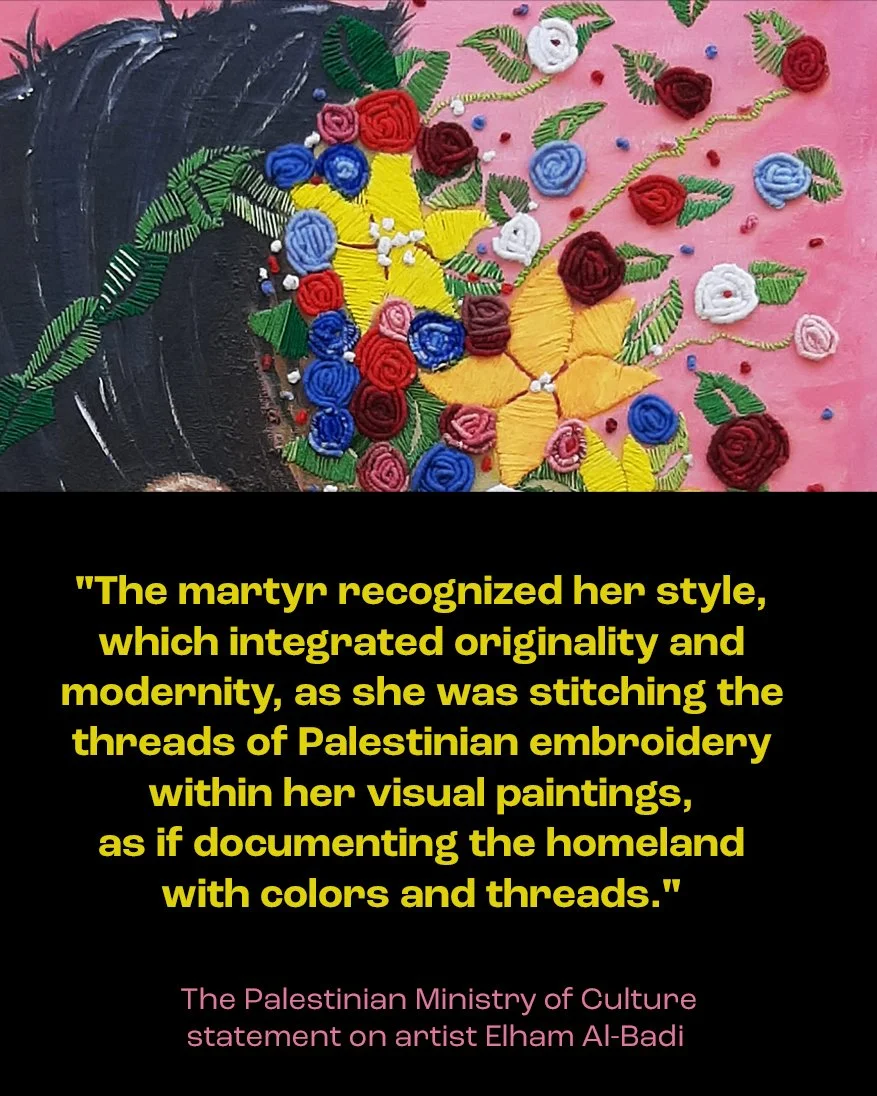
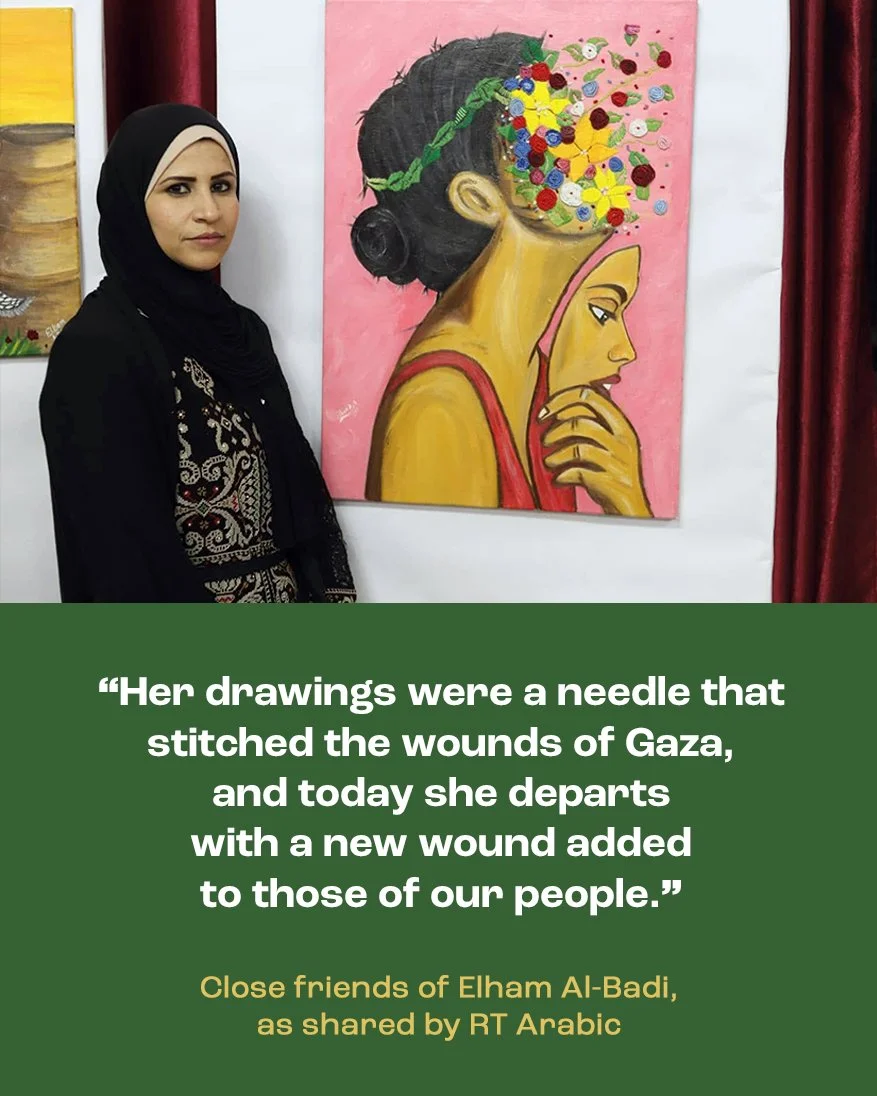
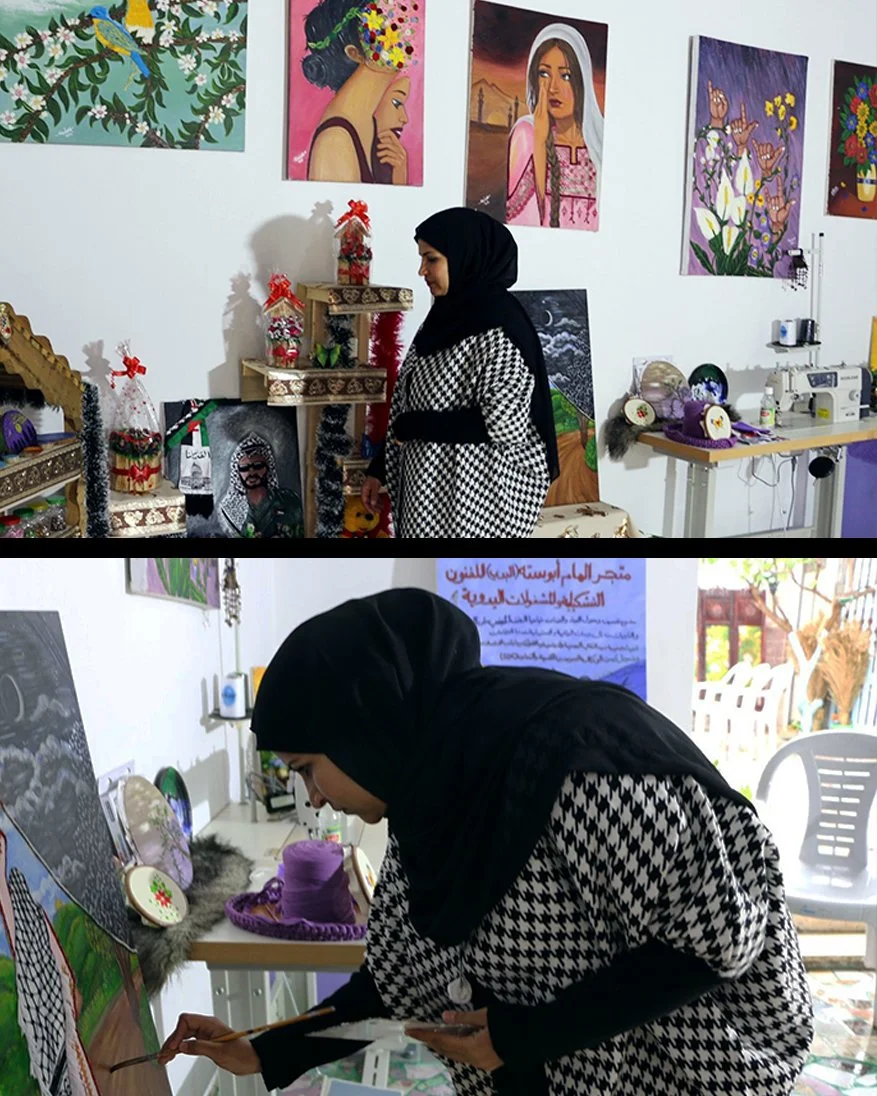
Elham had studied fine arts at the University College of Applied Sciences in Gaza City. The art she made afterwards involved painting and handcrafted pieces. She made work in each medium, but she also brought them together in certain instances – such as creating acrylic paintings with embroidered fabrics and pieces as part of it. This gave her a unique style.
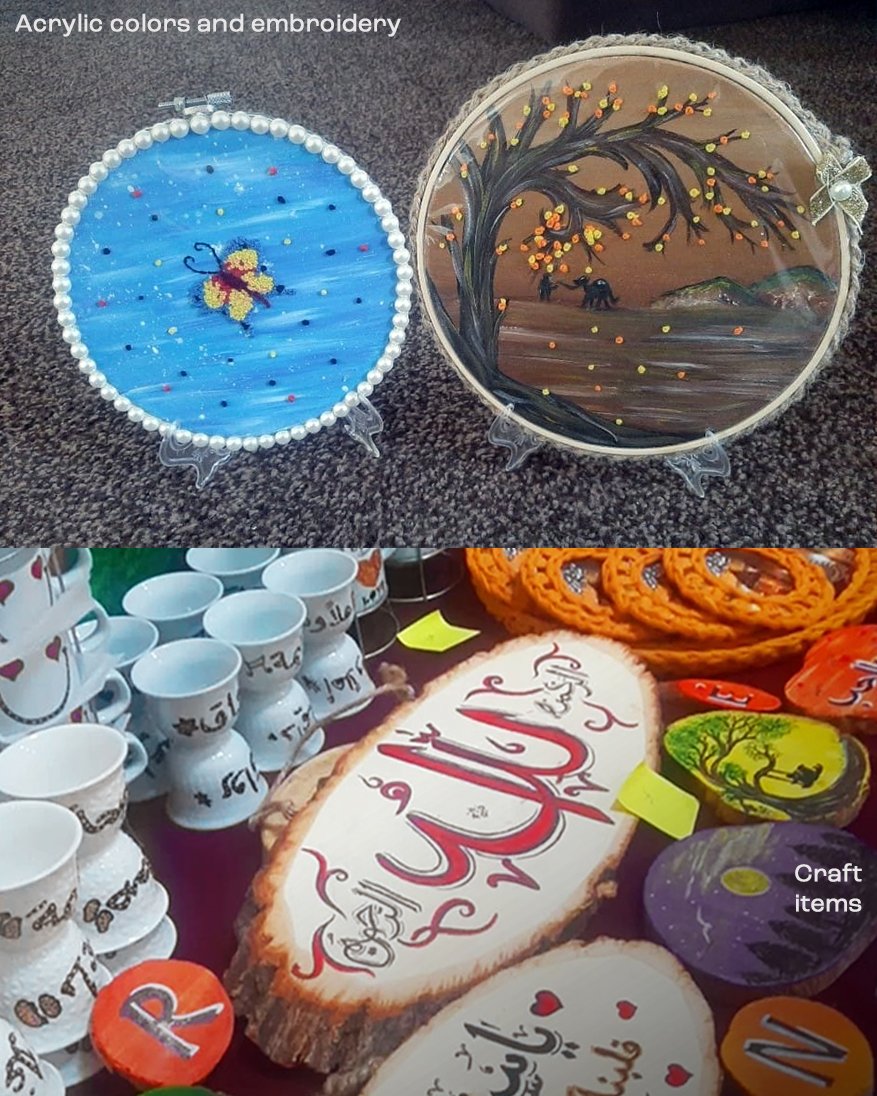
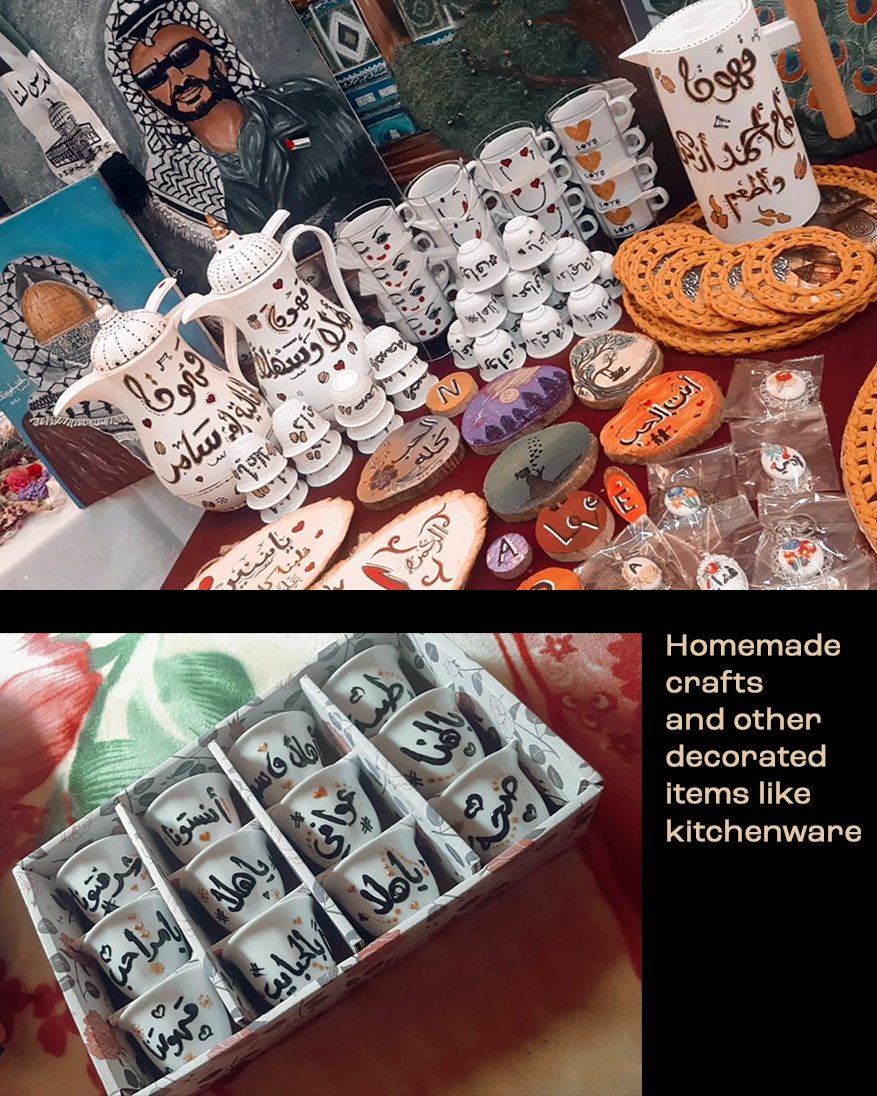
She took commissions for craft items – like keychains, cutlery, home decorations, and clothing modifications – helping provide additional income to her family.
Elham was involved locally as an active member of the Art Committee of the Beit Lahia Club Youth Committee and a member of the Seed group of Fine Arts. She had also worked with the Abdul Shafi Health and Community Association on an art exhibit to help improve access of women and girls affected by gender-based violence and helping survivors to have access to multi-sectoral protection and response services.
During the genocide, however, her husband was reportedly martyred in October 2023 and a year later her family was displaced during the escalated invasion on the northern Strip at that time.
In a statement after the Nakba Day attack, the Palestinian Ministry of Culture put out a statement. "The martyr recognized her style, which integrated originality and modernity, as she was stitching the threads of Palestinian embroidery within her visual paintings, as if documenting the homeland with colors and threads."
Her friends also reportedly told RT Arabic that "her drawings were a needle that stitched the wounds of Gaza, and today she departs with a new wound added to those of our people."
Frans Al-Salmi
Ismail Abu Hatab
June 2025
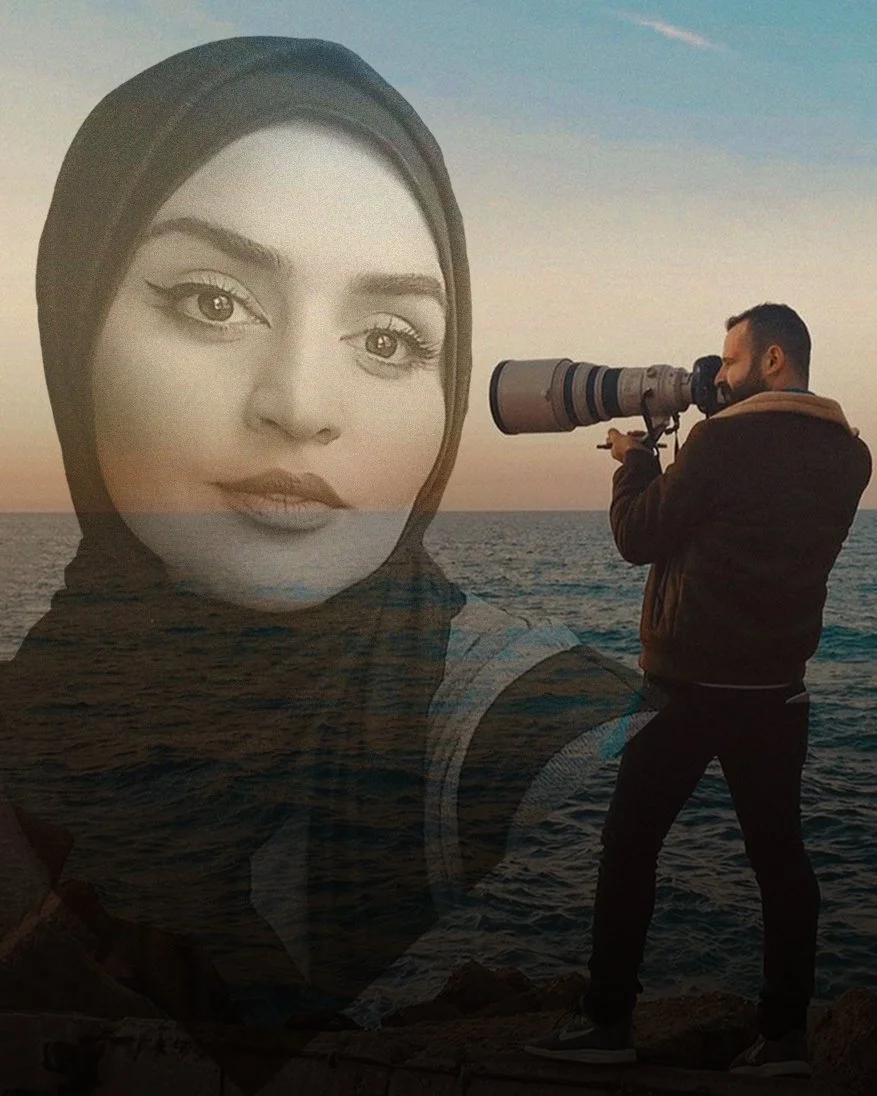
"I feel that drawing and visual arts always conveys the message more clearly to people," said the martyr Frans Al-Salmi, a 36-year-old visual artist who had graduated with a fine arts degree from Al Aqsa University and went on to work across painting, murals, sculpture and digital art.
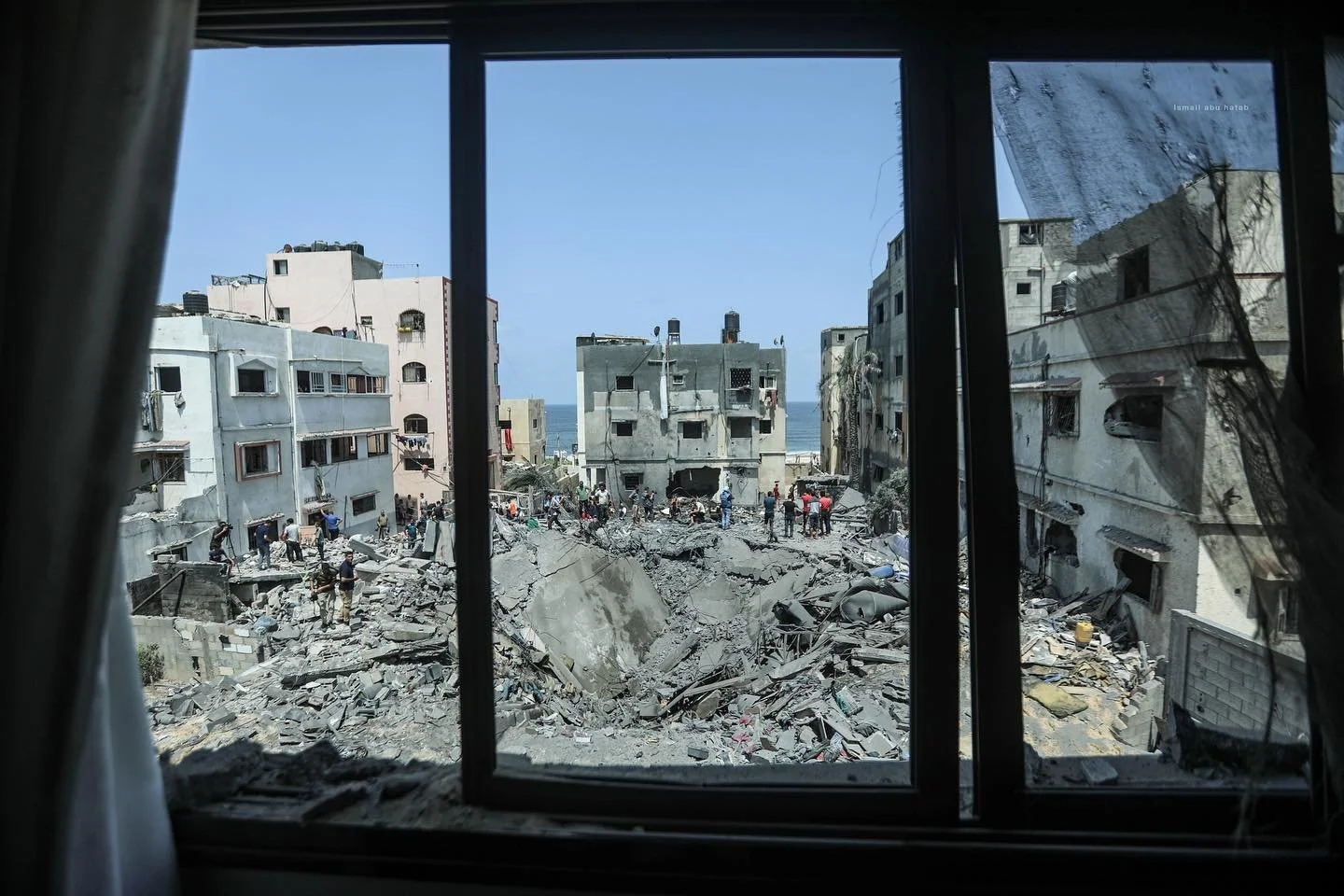
On Monday, June 30, 2025, an "israeli" airstrike targeted Al Baqa Cafe, which was a beachfront location in Gaza City, in the central area of the Strip.
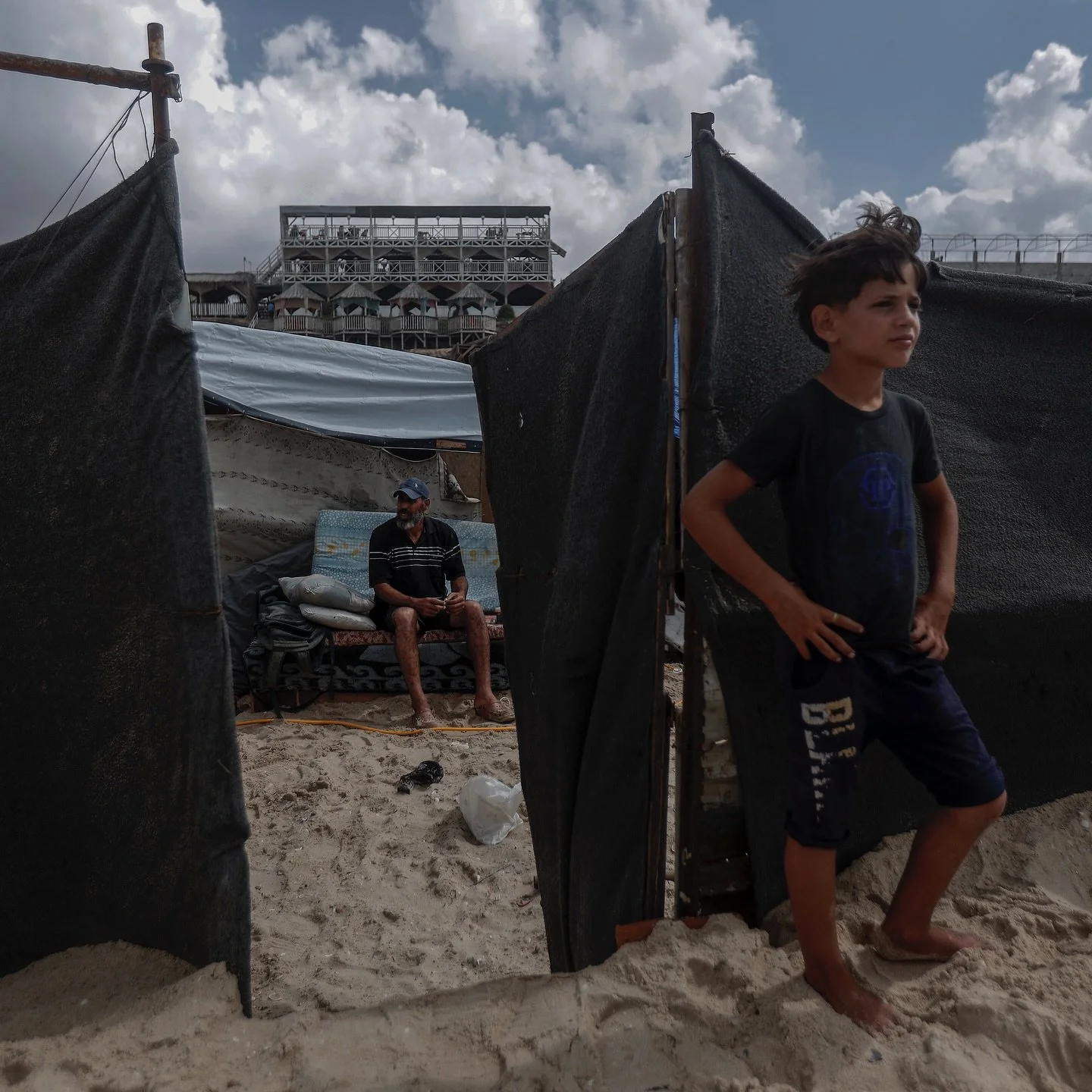
Al Baqa was one of the few spaces left for Palestinians to come together in community. Not only was it in a beautiful location overlooking the Mediterranean Sea, but it still had relatively strong internet connection. This made it a go-to destination for journalists, such as Bayan Abu Sultan who was injured in the strike.
However, over 30 people there did not survive. On that fatal day, Frans was there along with Ismail Abu Hatab, a friend and fellow artist. They were both martyred. Ismail was a 32-year-old filmmaker, photographer, and journalist who had started his own media production company cLight in 2018.
Both of them had already faced difficulties during the genocide, as had everyone in Gaza. In November 2023, Ismail was injured in an airstrike while filming a documentary on the Palestinian struggle and had to recover for a year. As the terror unfolded around him, he was limited in his mobility. For Frans, her brother also suffered an injury from shrapnel and her father passed in December 2023 from lack of medical treatment. They were both displaced.
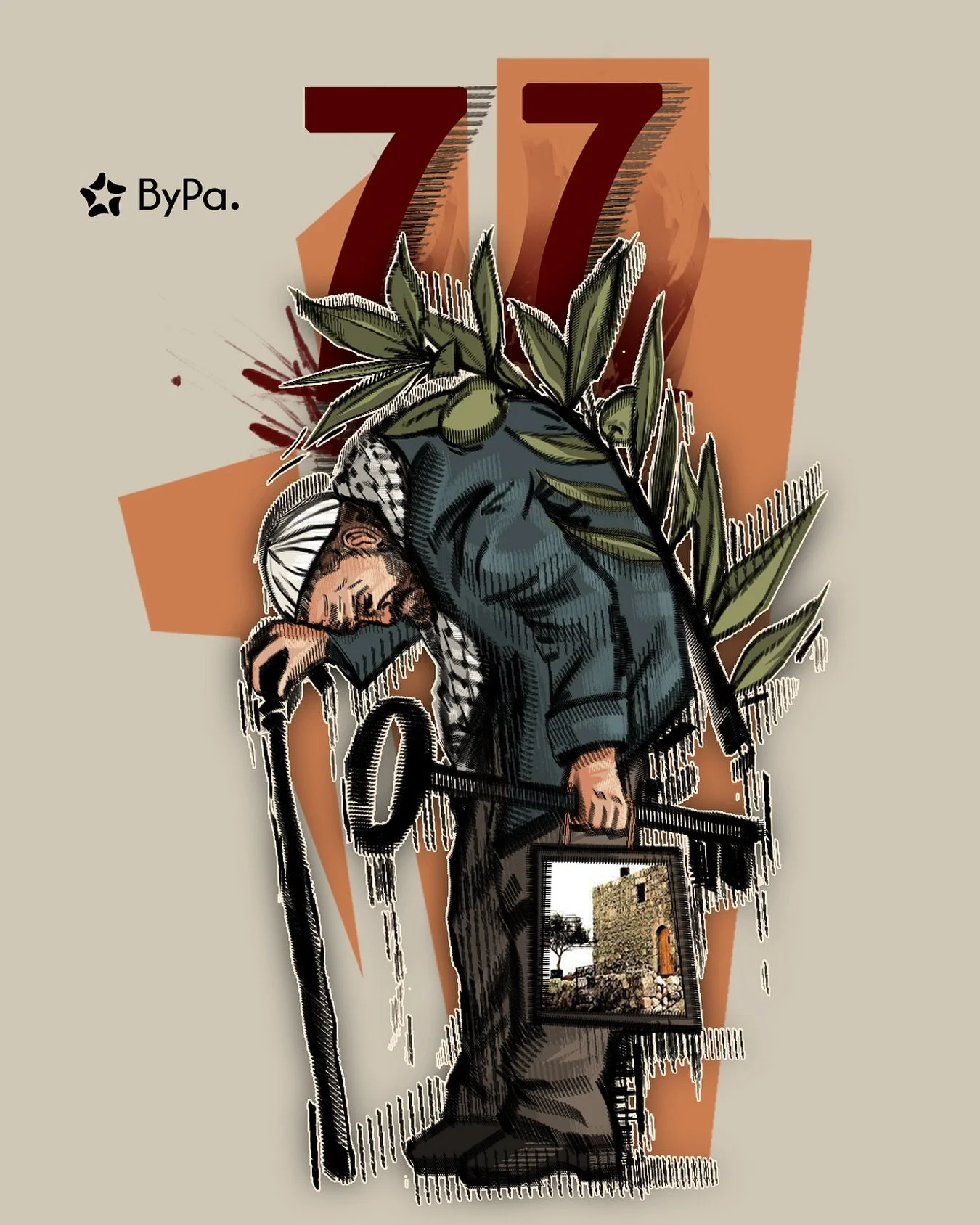
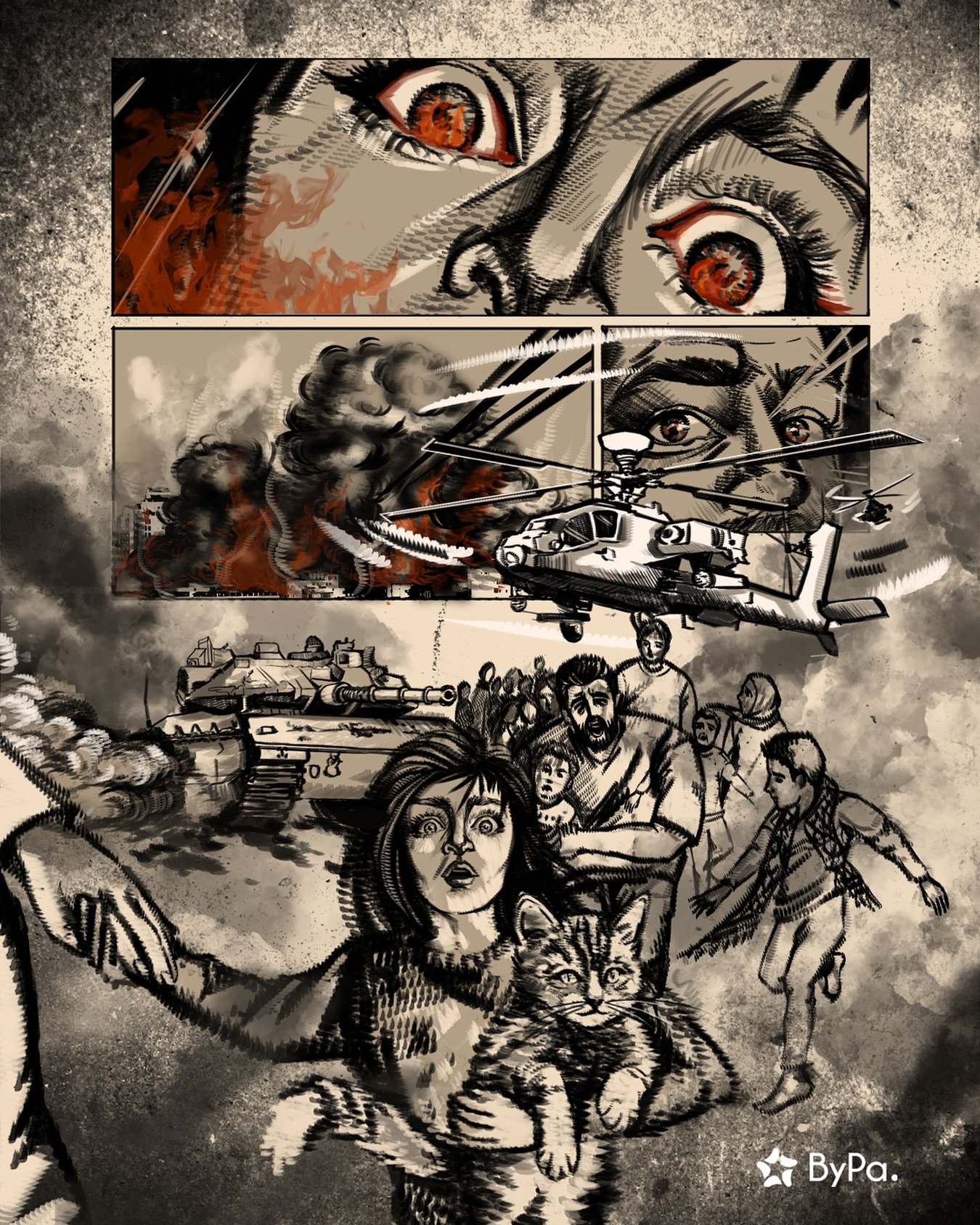
When Ismail was healthy enough again, he began to take photos and videos. But his mission could not be contained to just that. He felt it was imperative for independent voices in Gaza to speak for themselves. He started ByPa, short for By Palestine, as a platform to share these stories. Frans hadn't been sharing art publicly at all since the genocide began, and seemingly not even making any in private. However, Ismail brought her into the fold of By Pa and had her make a handful of artworks in Spring 2025 before they were martyred.
In April, when Frans posted on her Instagram for the first time in two years, she shared a flyer she drew for a remote U.S. art exhibition of Ismail's work. In the caption she wrote, "When you start painting again during the brutal genocide so a part of you can come back to life... this was my friend’s idea (Ismail) to revive the spirit of life within me, allowing the colors to return and tell fragments of his photos."
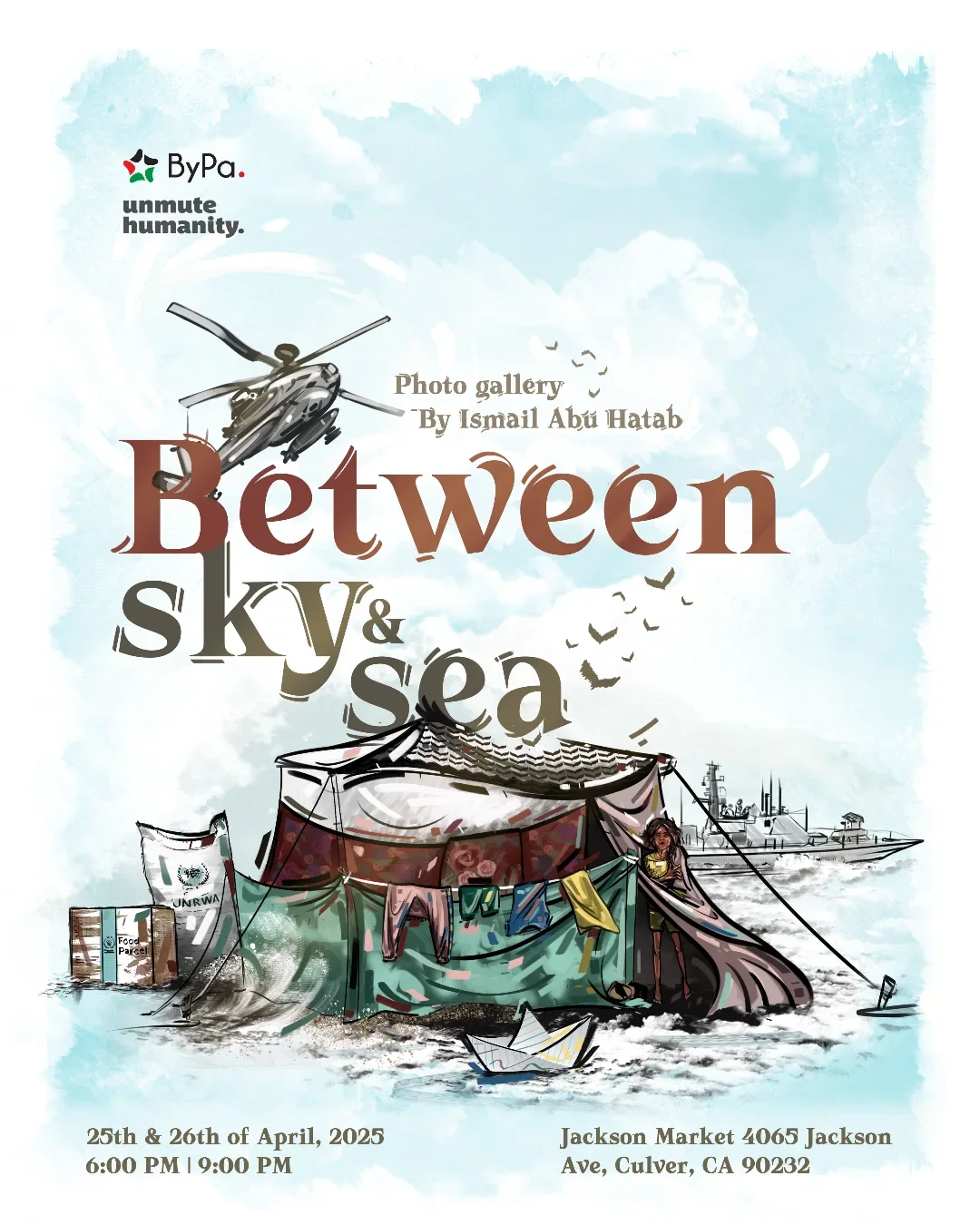
Ismail had encouraged her to start making art again, and it seemed to have revitalized her creative spirit. "We still love life and our passions, despite all the hardships," Frans wrote at the end of the post.
The event the flyer was for, organized through By Pa, was called Between The Sky and Sea. Ismail arranged for the exhibit to feature real sand from Gaza, transported to Gaza, inside a torn up aid tent. The speakers blared sounds of recorded street sounds of Palestinians talking, the sounds of the shore, and more. But the center of it was Ismail's photos and video clips. From over 12,000 miles away, he had devised this innovative and sensory art experience for people in California to take in.
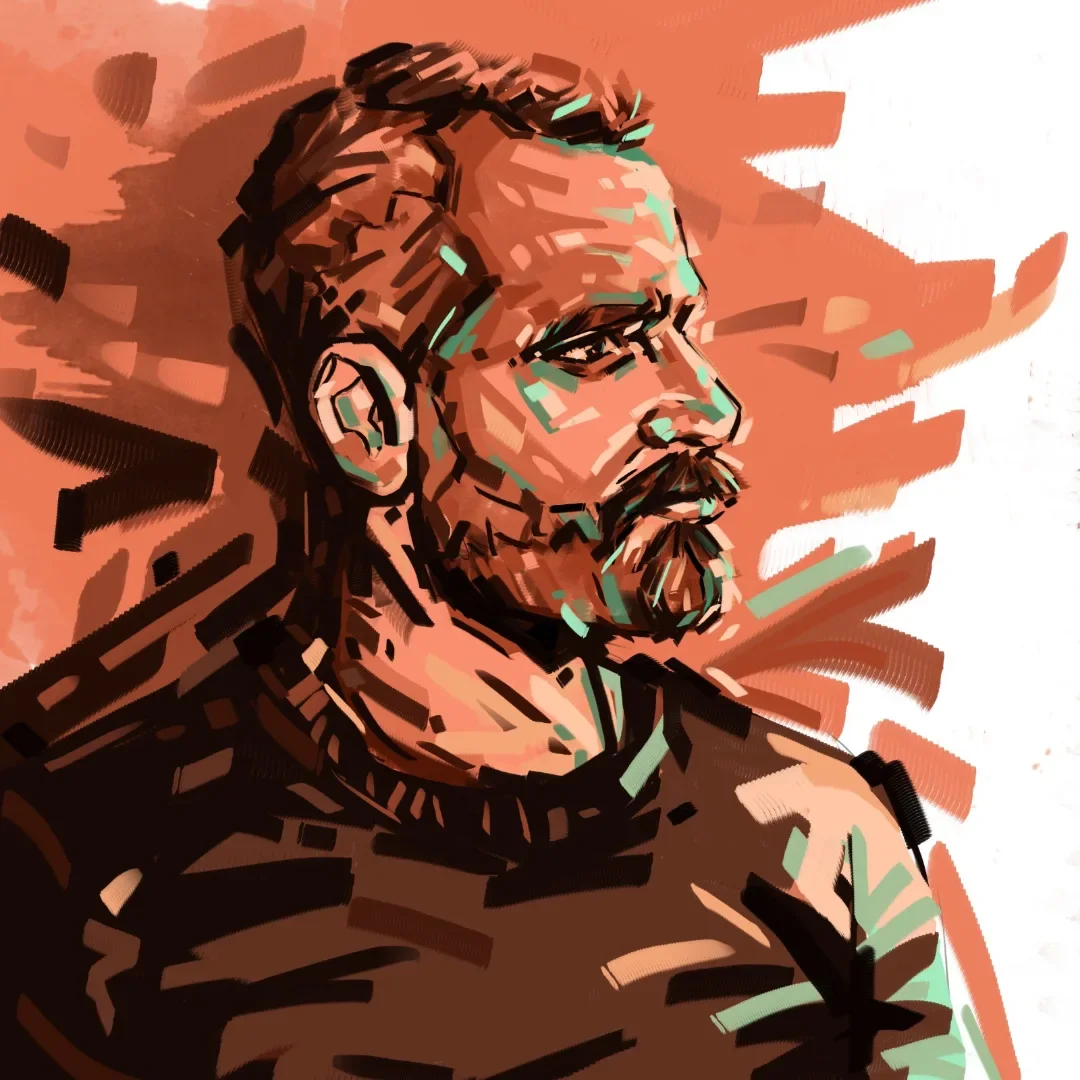
About a month before their martyrdom, Frans had made an illustration of Ismail that utilized orange and brown tones with thick brush lines to create a portrait of him. He made it his profile picture on Instagram.
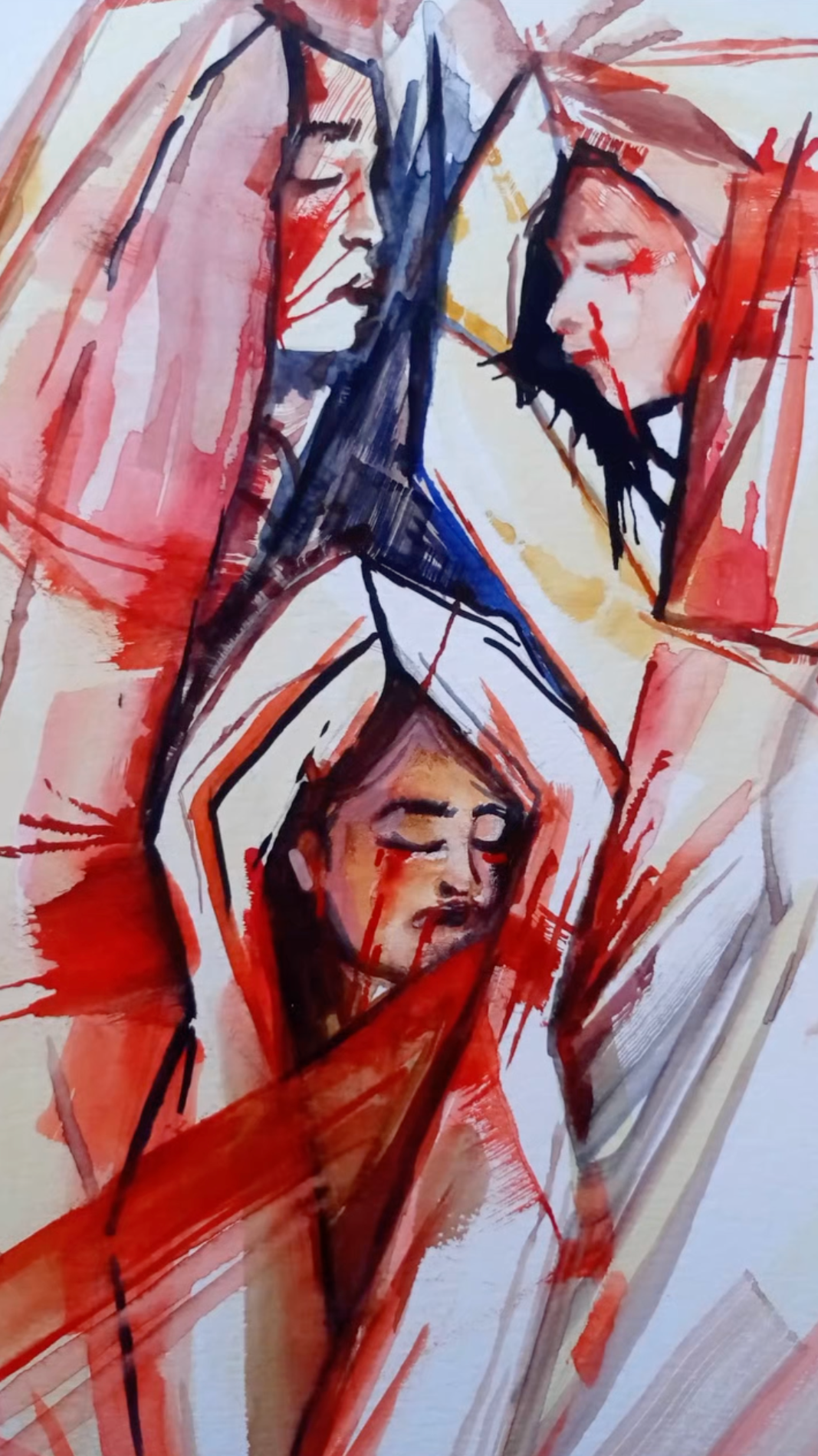
Frans' last painting, showing three martyred women with splatters of red paint for their blood, is a visually-arresting piece. But it became a haunting reflection when the images of Frans after the attack were eerily similar. The artwork and her picture were placed side-by-side in an image that spread on social media.
Tributes came in for after for both, including from fellow artists.
Gaza-based photographer Suhail Nassar shared a set of photos and videos with Ismail, writing that he had seen him just two days before, not knowing it would be the last time shaking his hand. After one picture of him, Suhail wrote, "beneath the sky you once filmed. Your name is now the light, we follow in the dark." Another image in the set, a portrait of Suhail that Ismail had taken, he wrote, "There, at the seaport we went back to together, you took my favorite photo of me, as if capturing a farewell I didn't yet know."
Hala Sabbah, Co-Founder of the grassroots Gaza aid initiative The Sameer Project, was one of the people who posted a tribute. She wrote, "Mutual aid teams are connected and Frans did water distributions for the Sameer Project during our partnership with Reviving Gaza. This genocide is taking the best of us, rest in power Frans 💔"
Rafiq Al-Salmi, her brother and one of Frans' ten siblings, told The Art Newspaper: "I want the world to know that my sister loved art and aspired to become a shining name in it.”


Mohammed Abu Layeh
September 2025
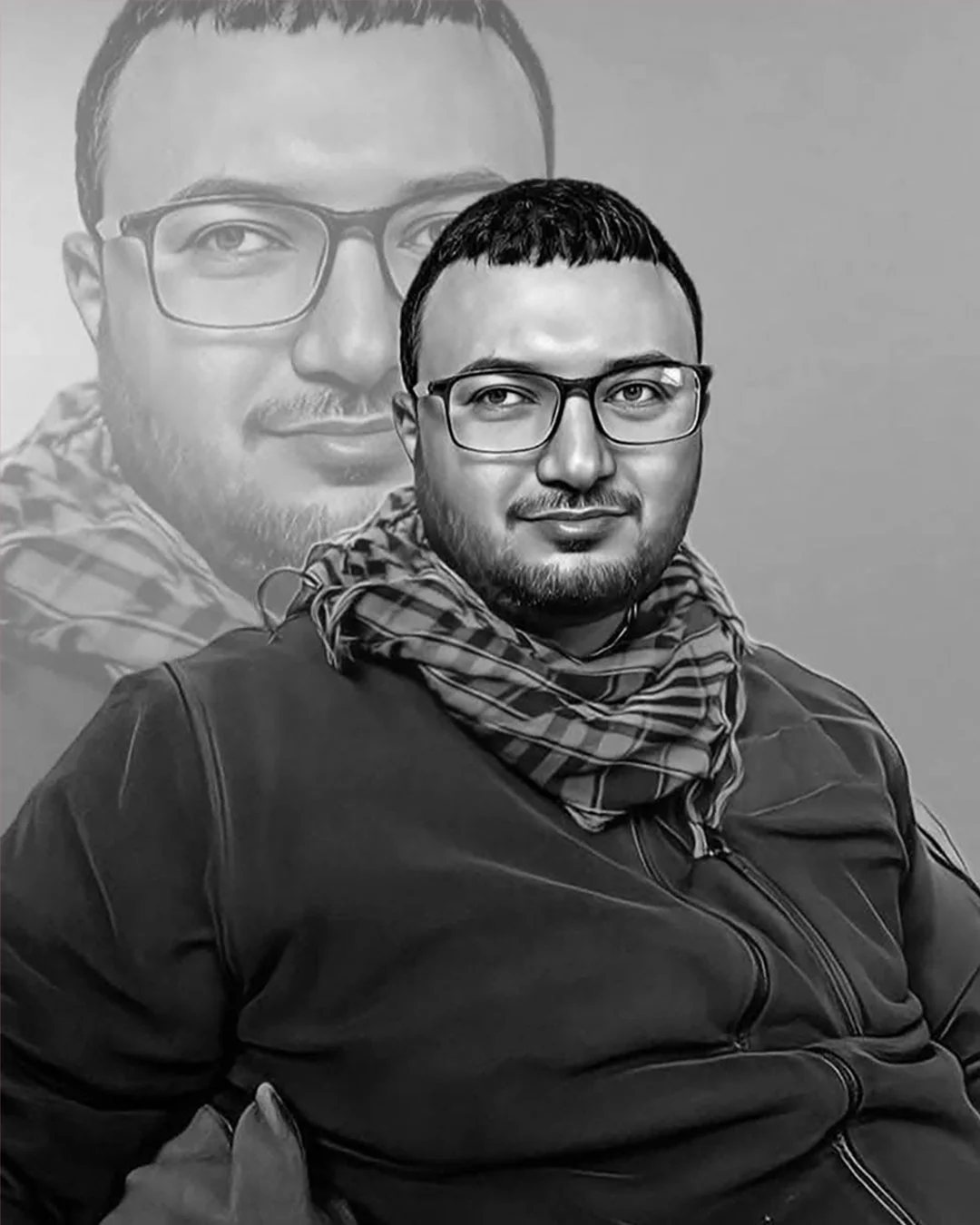
Mohammed Abu Layeh – محمد أبو اليلة – was a 38-year-old Palestinian fine artist, muralist, teacher, and leader in the local Gaza arts community. He loved drawing since he was young. Living in Gaza under blockade and siege, he had to “find a creative way to express what was on his mind,” notes a profile from 2019, “in terms of rejecting the Zionist enemy, immortalizing Palestinian history, and the strength of this mighty people who are steadfast despite suffering.”
Mohammed started drawing in elementary school and his family discovered his talent. His uncle was an artist already, doing drawing and calligraphy. He encouraged Mohammed in this early stage. In middle school, Mohammed was further guided and motivated by his art teacher, Professor Yasser Al-Madhoun.
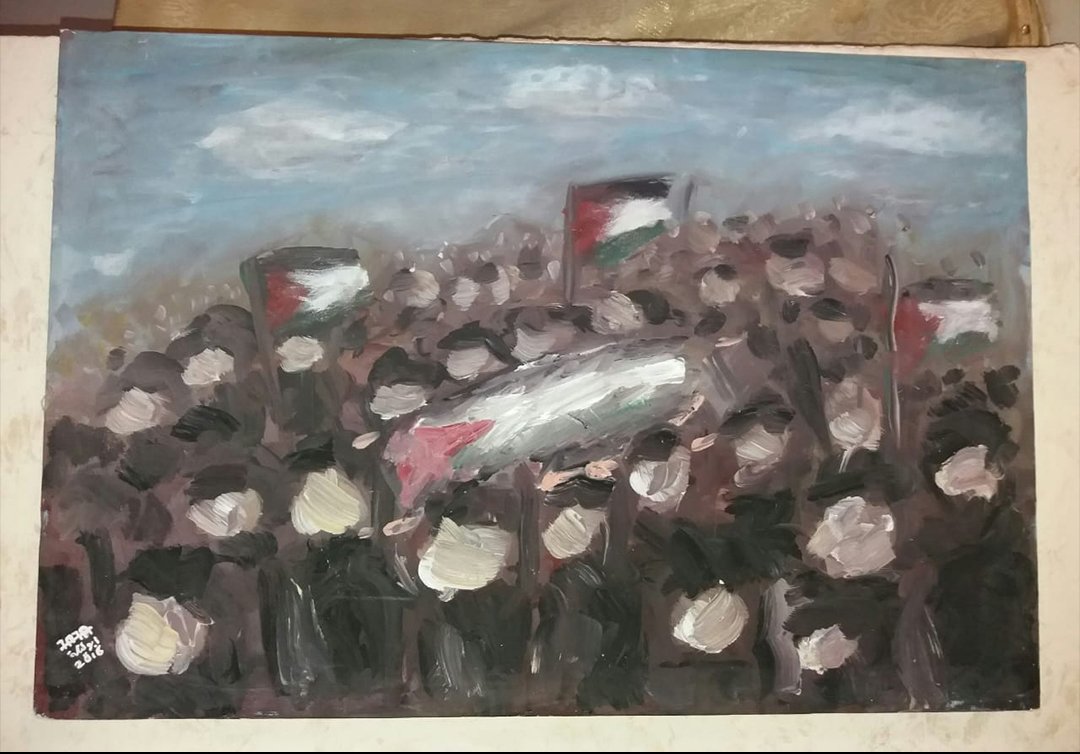
The most important step, Mohammed says, came when he got his art education at an academy being run by The Palestine Red Crescent Society (PRCS). He studied under Professor Bashir Al-Sinwar and the artists Abdul Raouf Al-Ajouri, Mohammed Al-Tabous, Abdul Nasser Amer, Mohammed Al-Hawajri, and Raed Issa. He also graduated with a degree in design from Al-Azhar University in Gaza.
Mohammed integrated the abstract and expressive schools of style into his work.
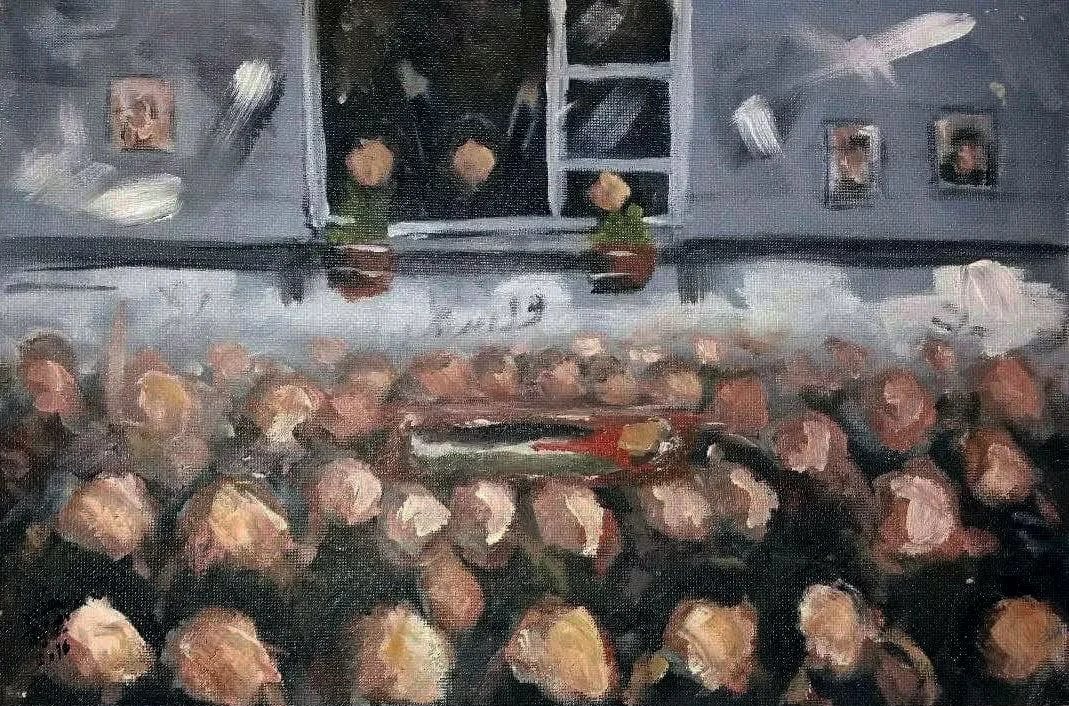
“The topics of my paintings are multiple, the most important of which are the Palestinian issue and the stages of the Palestinian person's daily suffering from assassinations, bombing by Zionist enemy forces, and the funeral of martyrs.”
Over the years, his art was exhibited locally and internationally. However, like many, he was unable to leave Gaza. He also spoke about the difficulty to afford and access certain art materials due to their situation, as well as the lack of ability to have large exhibition spaces and overall opportunities for Gazan artists.
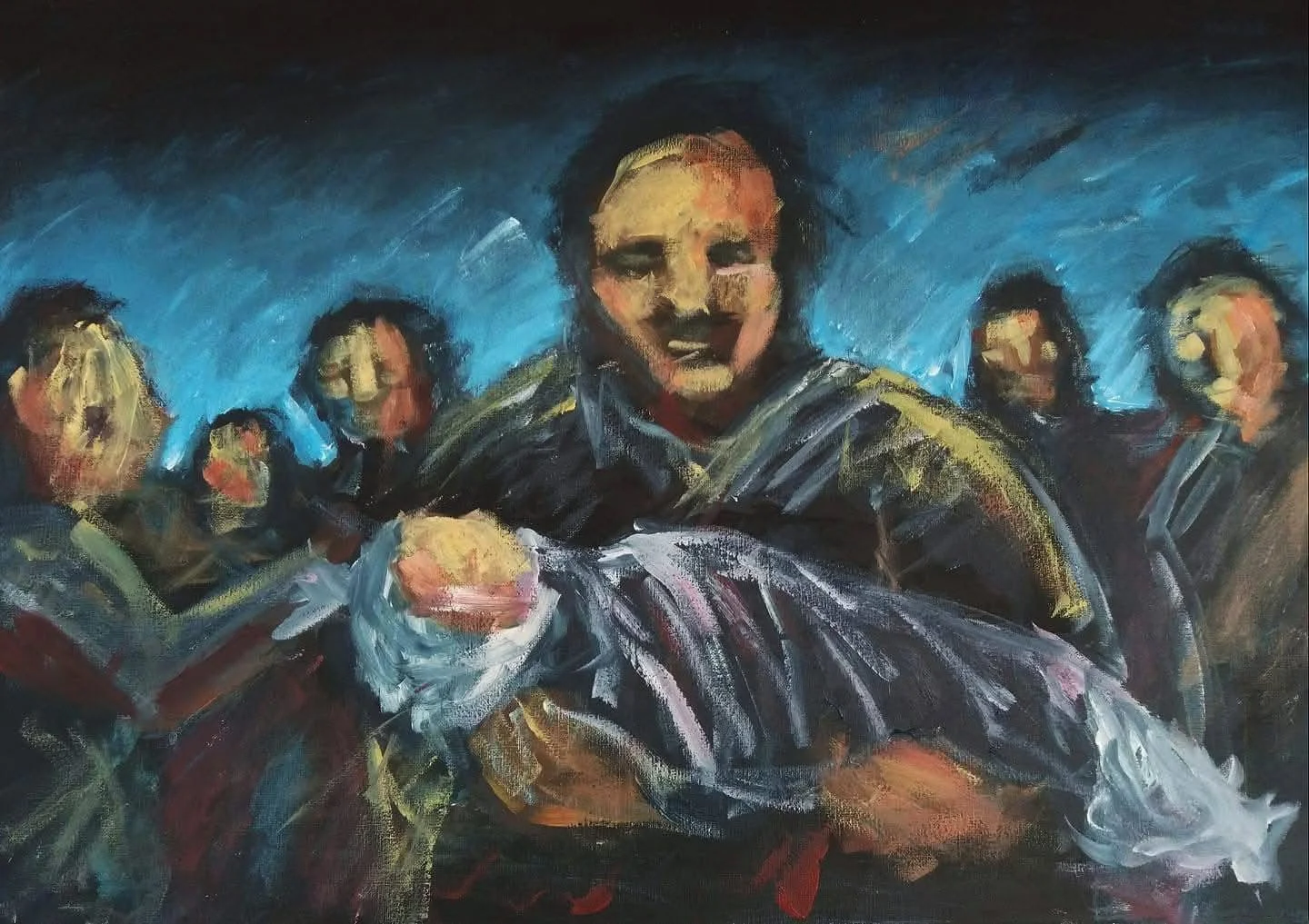
Professionally, Mohammed used his skillset to take on different roles connected to art. This included holding positions such as the director of a fine arts forum in Gaza. He also worked as a drawing teacher in many institutions, associations, and cultural centers – such as the Childhood Happiness Center, the Gaza Municipal Library, the Haifa Association for Culture and Arts, and a number of summer camps. It was reported that Mohammed co-founded a fine arts program with a fellow artist and close friend, Thayer al-Tawil, who was martyred in November 2023.
Another aspect of Mohammed’s work was that he was an active muralist. This included participating in drawing the 100-meter Al-Awda Garden mural in 2019, a mural commemorating the Nakba, one in solidarity with Iraqi people, and more.
Mohammed Abu Layeh had spoken to the Iranian news agency Tasnim in July 2023 about a new mural he had worked on, at the time, with a group of other artists.
The mural, painted in Gaza, commemorated the ninth anniversary of a July 2014 battle between PIJ fighters and the IOF called Revenge for the Free Men. Artists showed stages of the fight as a way to honor the memory of resistance soldiers martyred. Separately, he also designed posters for select martyrs of PIJ and the Popular Front.
“Naturally, a Palestinian artist’s responsibility is to narrate a common message or one of the many messages that reveal the cruelty and repression that the occupier forces commit against every human being, every individual or every Palestinian citizen. An artist has the responsibility to try to portray the oppression and the power of resistance of its nation.”
He also contributed to a mural about the Gilboa prison escape in September 2021, which he spoke to Roya News Agency about.
On September 17, 2025, Mohammed was reportedly martyred, with not many other details still known at this time. This came mere weeks before the “ceasefire” of October 2025. There’s little information about what he endured during the genocide, but like all Gazans it was likely a challenge filled with displacement, starvation, and loss.
Fadi Almeghari
May 2026
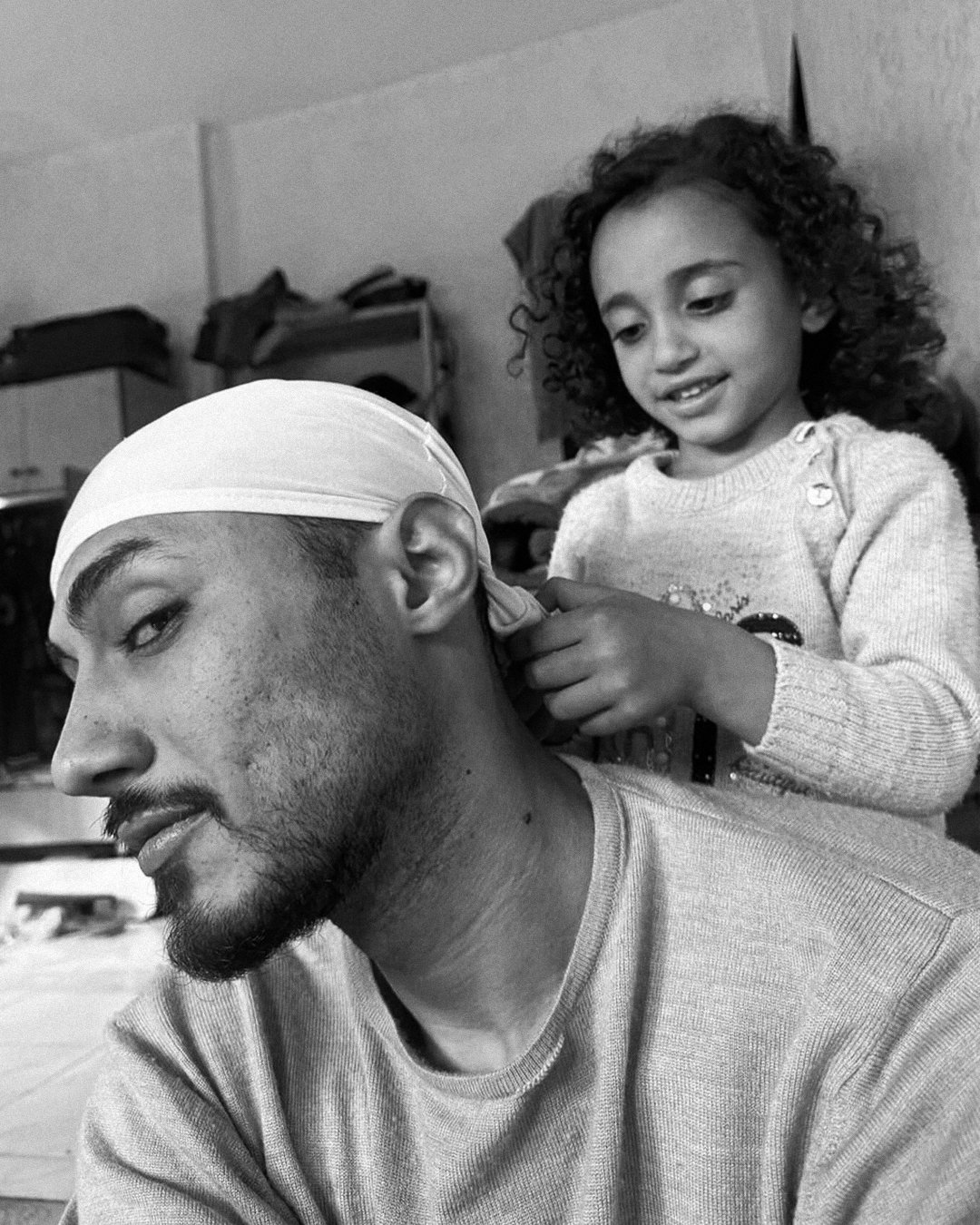
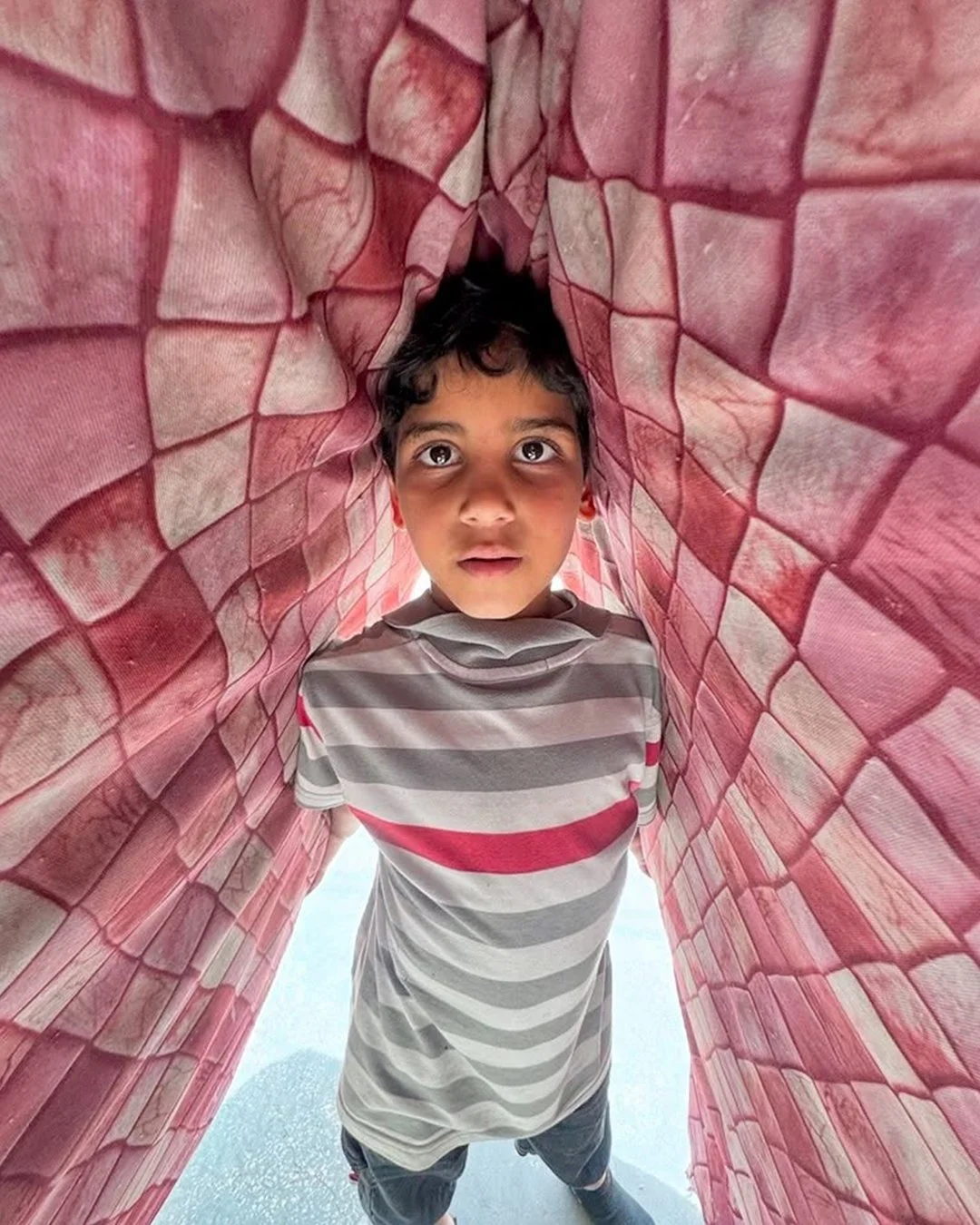
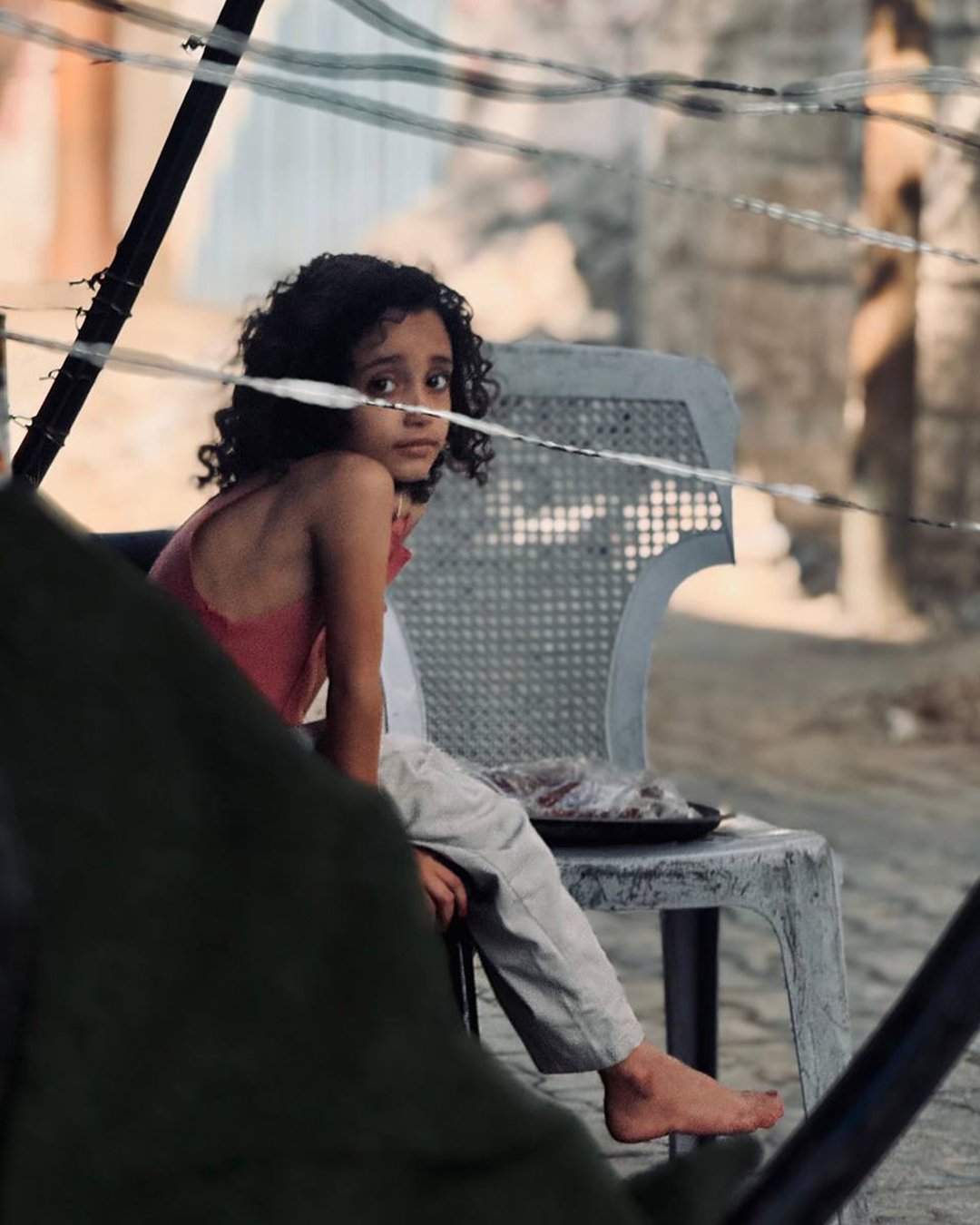
Fadi Almeghari was a 25-year-old photographer who became known during the genocide for his photographs and caring of the children around him. He saw the harsh realities they leaved, and the way they still managed to find joy. He felt they were all symbolically his own kids.
Gaza before the genocide was already a prison to Fadi, as far as the difficult life and limitations it imposed on him. He tried to find refuge in another country, but found himself back in the Strip. Eventually, he came to terms with this difficult reality of occupation. His frustration was channeled into his art and wanting to make an impact through his work.
In addition to being a photographer, he was also a writer. He published many clear-eyed statements during the years of displacement, bombing, and starvation. His words appealed to the world to not leave Gaza alone and to remark on the Palestinian spirit.
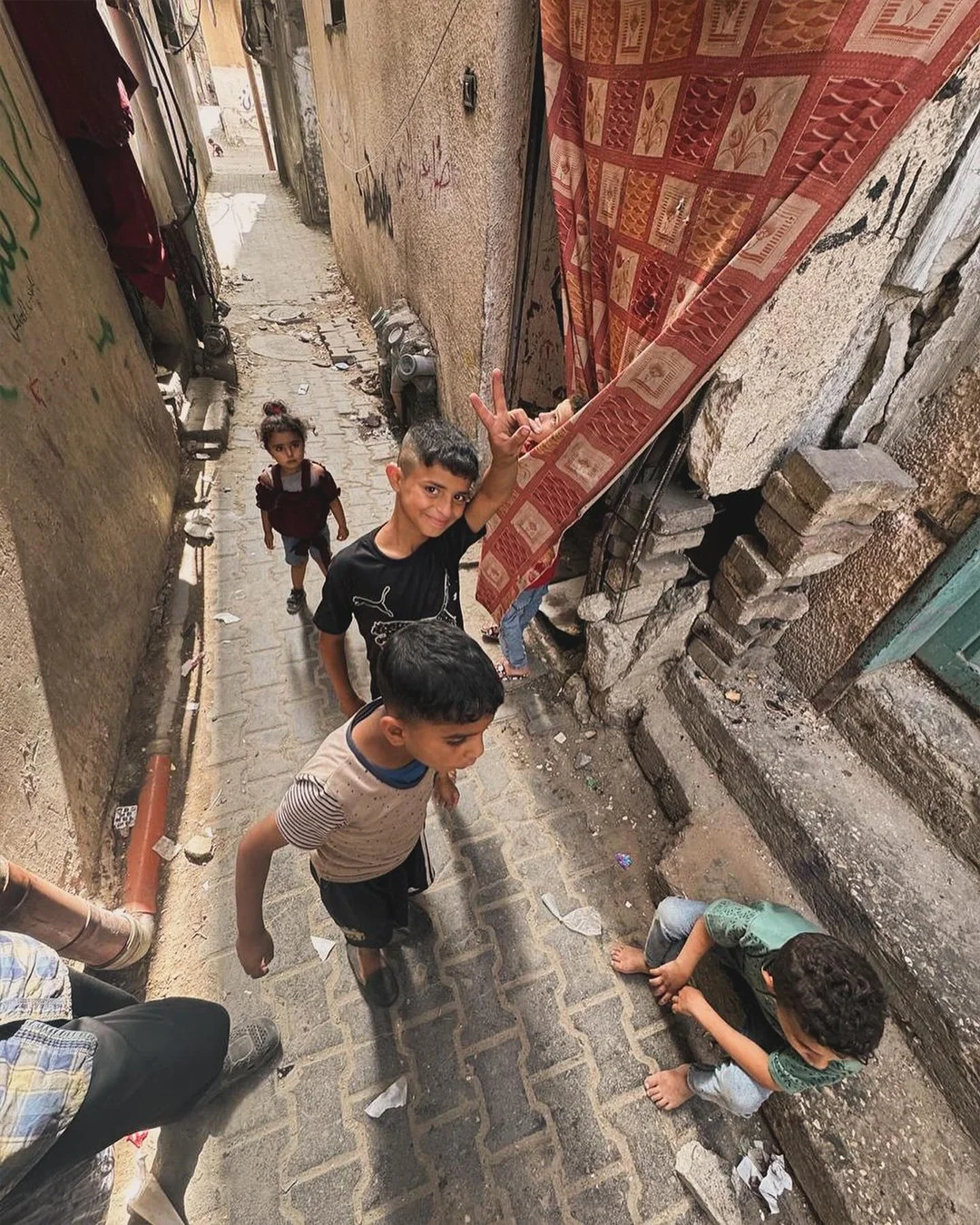
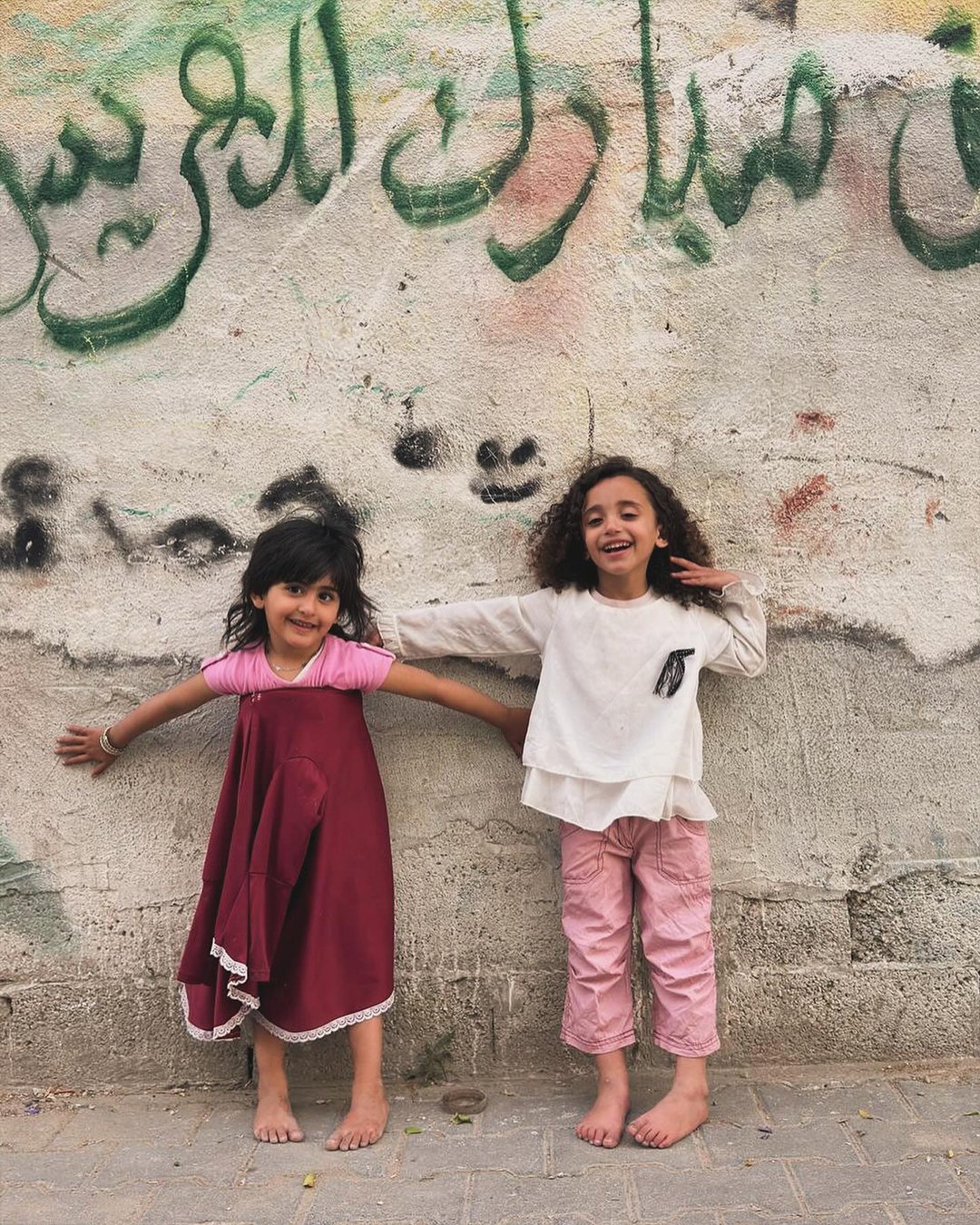
On May 26, 2026, an lOF-backed traitor militia attempted to enter Al-Maghazi refugee camp near the so-called “yellow line” in Central Gaza. They began raiding homes and were confronted by local young men. Fire was being exchanged and the lOF was backing the collaborators from above with drones.
His family was in need of safety and Fadi tried to help them to flee through a narrow passage beside where they were living. It was the only way they could escape. But as he stood at the door to help people leave, the IOF assassinated him by drone strike.
This was during the “ceasefire” period in place since October 2025, but Fadi was one of around 1000 martyrs killed by the IOF – and its backers, the US and Western world – in those eight months.
Fadi leaves behind an Instagram archive with photos and writings to carry on his legacy and not let the dreams of his impact end with his martyrdom.
Additional Artist Martyrs
Others with not as much information or art examples available at this time.
Iyad Ibrahim Al-Sawalhi - A 50 year old visual artist from Khan Yunis who engraved and carved panels, in addition to drawings, in his personal work. He also helped to run several visual arts activities, workshops, and more for students in Gaza. He was martyred on an airstrike on October 21, 2023.
Muhannad Al-Agha - A 30 year old calligrapher from Khan Younis who specialized in Ruq‘ah and Diwani calligraphy. His home was targeted by an airstrike in October 2023.
Marwan Tarzi - A 62 year old photographer who was nicknamed “the guardian of Gaza's visual history" as someone who dedicated his career to preserving thousands of photographs taken of the Strip, many of which he inherited from his brother. Marwan was martyred with his family when the IOF bombed the Greek Orthodox Church of Saint Porphyrius in the Gaza, on October 20, 2023.
Maria Nafeth Al-Maghari - A 20 year old arts student from Al-Bureij Refugee Camp in central Gaza. According to Palestine Studies, “she studied graphic design and founded a project that provided professional, high-quality printing services for people's photos and memories.”
Mohammed Saad Aldeen Al-Zamr - A 40 year old artist whose work used leftover materials from "israeli" bombs to transform them into art – painting on them as a way to symbolize the objects that stand between Palestinians and the life they want to live. He was martyred in an airstrike with his family on an airstrike on their home in January 2024.
Tha'er Al-Taweel - A 43 year old artist and the head of hte Visual Arts Forum. He was martyred in an airstrike.
Haitham Ibrahim Hussein Eid - A visual artist from Al-Bureij Refugee Camp in Gaza. Martyred in family home in July 2024, wiping his family from the civil registry.
Dr. Oraib Al-Rayes - A dentist and artist from Gaza, martyred in an Israeli airstrike that targeted the Al-Rayes family home.
Islam Abu Ghazaleh - A microbiologist and an artist with a talent for drawing, who dreamed of pursuing a PhD in Early Childhood Education.
Amir Abu Aisha - A graphic designer and video editor who also volunteered as a paramedic with Palestinian Red Crescent teams. He initially had been arrested and tortured by the IOF for his work documenting the suffering at Al-Amal Hospital in Khan Yunis, and was later martyred by a sniper in March 2024 while working in the operating room.